
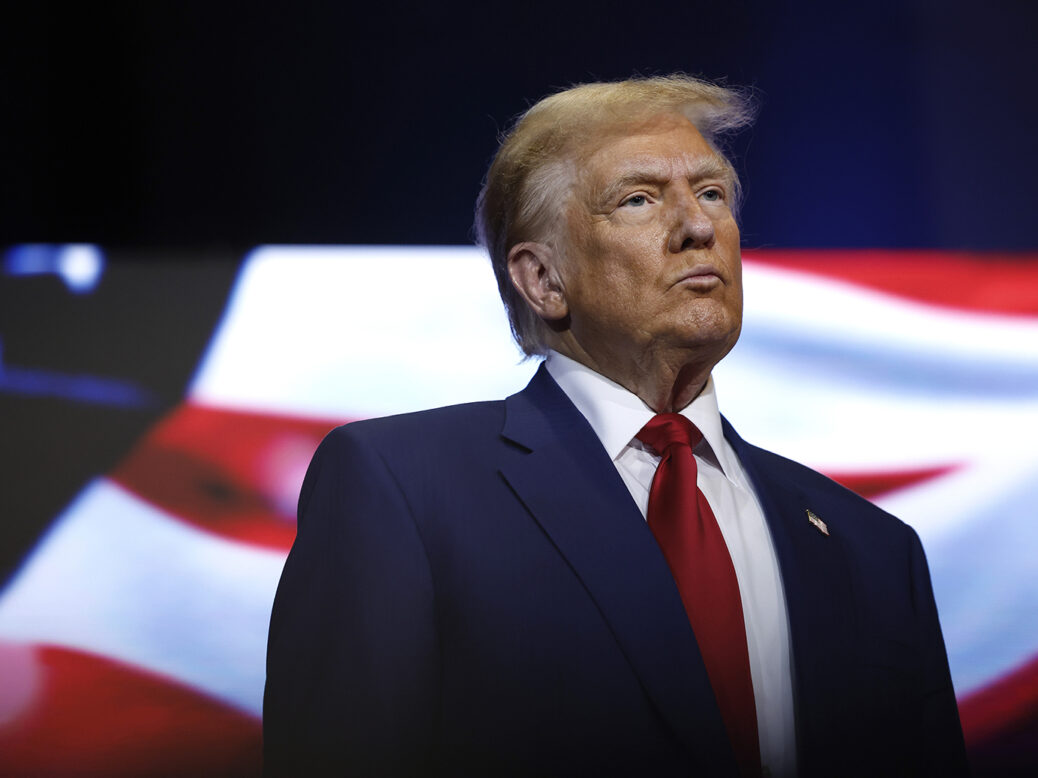
“I think of the future, but I refuse to paint it,” the American poet Donald Trump told Playboy in 1990. “Anything can happen. But I often think of nuclear war.” Trump volunteered this, unprompted. It was obviously on the magnate’s mind. He went on to say it was the “greatest of all stupidities” to think nuclear war would never happen. “What bullshit,” he said. “It’s like thinking the Titanic can’t sink.”
This was not the first time that Trump grappled, in his own way, with what the biologist EO Wilson once described as our “Palaeolithic emotions, medieval institutions, and god-like technology”. Six years earlier, Trump’s fixer Roy Cohn had arranged an interview with the Washington Post because Trump believed himself to be a good candidate for Ronald Reagan’s arms negotiator with the Soviet Union. On whether he had the expertise, Trump said that he would only need “an hour-and-a-half to learn everything there is to learn about missiles”. He told another journalist he wanted to put sanctions on the French and stop supplies of plasters to the Pakistanis in order to get them to give up the bomb. As ever, Trump is more consistent than you might think.
Of course, in the 1980s, he was attracted to the prestige of negotiating a deal on the biggest issue of the time. He once went down to the lobby of Trump Tower to meet Mikhail Gorbachev, only to discover that he had been duped by an impersonator. There was no bigger prize, no better stage on which to prove he was the greatest deal-maker the world had ever seen than negotiating over nuclear bombs with the Kremlin. Trump has apparently overcome his distaste for “forever wars”, though his aversion to nuclear Armageddon is consistent and long held. But his flirtation with non-proliferation in the 1980s was nothing compared to his anger at the thought that America was protecting other countries at US expense. When Playboy asked what Trump would actually do as president, he replied: “Part of the problem is that we’re defending some of the wealthiest countries in the world for nothing.”
It’s this, not some existential concern about humanity, that explains Trump’s approach to nuclear weapons. America First matters much more than non-proliferation. Trump would rather other countries acquired nuclear weapons than offer them free protection underneath the American nuclear “umbrella”, as it’s euphemistically called. After a back and forth with CNN’s Anderson Cooper about nuclear weapons in 2016, Trump got to the crux of what he believes: “Here’s the thing: with Japan, they have to pay us or we have to let them protect themselves.” Cooper asked whether the US should allow Japan, South Korea and Saudi Arabia to develop nuclear weapons. “Can I be honest with you? It’s going to happen, anyway,” Trump replied.

In office, Trump has shown little interest in fulfilling his youthful ambition to become America’s arms negotiator. His stance in the 1980s was more a question of acting than activism. In 2017 he threatened North Korea with “fire and fury like the world has never seen”. The last remaining deal (first signed in 2010) limiting nuclear weapons between Russia and the US expired in February – with no sign of an extension. And then, on 21 July, Trump’s Department of Energy signed a multibillion-dollar deal with Saudi Arabia in which American companies would help build nuclear power stations, reportedly with a path for Riyadh to enrich its own uranium.
The Saudis have been seeking US permission to develop nuclear energy since the Obama administration. But it’s Trump that has given it, at the very time he has launched America’s most destabilising war since 2003. The US’s other Gulf allies will not look kindly on the kingdom taking its first step towards a weapon of such terrible power – and they’ll perhaps be asking whether they should be next. Reporters are already asking the White House why Iran suffers such punishment when Saudi Arabia is helped along with its nuclear progress. The day after the announcement, the president revised the agreement, suggesting there would be no enrichment and that the deal was conditioned on Saudi Arabia recognising Israel, all while promising that it would still happen.
Why the rush? There is another America First angle to the deal – if you interpret “America First” in a very narrow sense. The New York Times has provocatively written an article that lists all the members of Trump’s circle who have an interest in nuclear energy. In November, his two sons became part owners in a company that produces isotopes that can be used as nuclear fuel. Commerce secretary Howard Lutnick’s firm Cantor Fitzgerald has made a fine dime raising money for nuclear energy companies in recent years. One of them is a top US producer of uranium. The tech oligarchs have nuclear energy interests too: few things are more energy hungry than a data centre. Then, of course, there is the $2bn that Saudi Arabia has invested in the firm of Trump’s son-in-law Jared Kushner. The US president looks kindly on those who pay tribute to his clan.
Trump is finally painting that future, and it is one in which nuclear weapons look more likely to spread – at least among those countries militarily dependent on America, whom Trump demands either cough up or look after themselves. This is because America First, mingled with Trump First, has always been the key to understanding Trump’s foreign policy – even at the subatomic level.
[Further reading: The new nuclear terror]
Content from our partners


Related
This article appears in the 29 Jul 2026 issue of the New Statesman, The new terror
Join the debate
Subscribe here to comment