
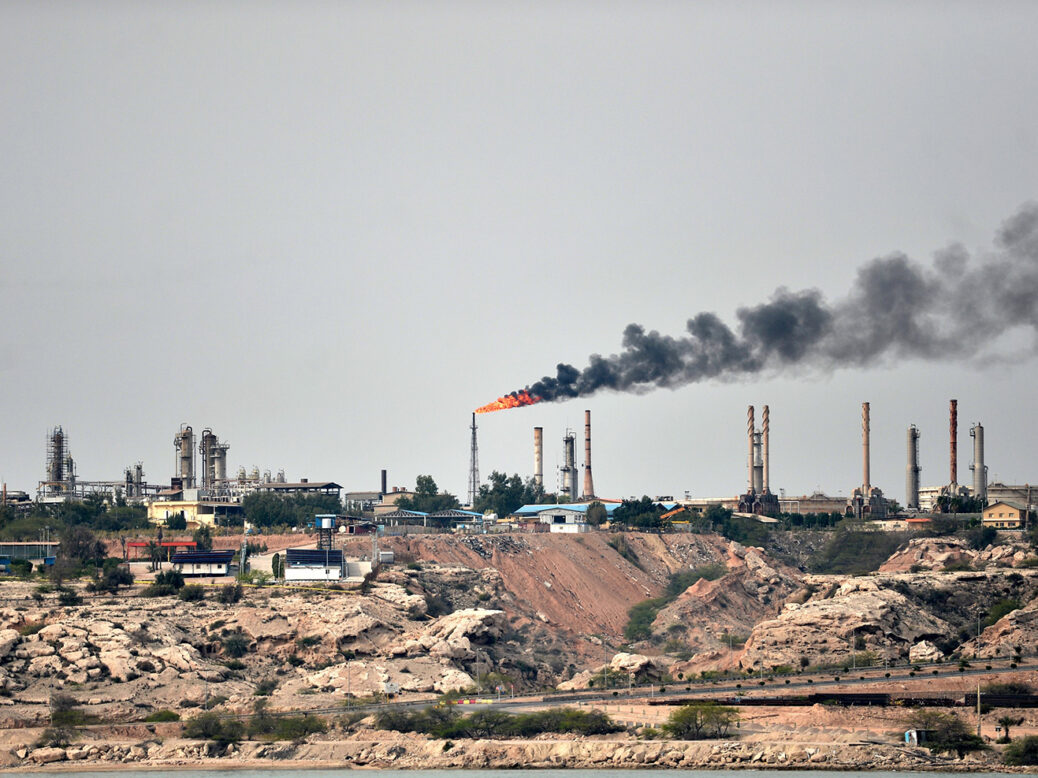
Twenty-four hours into the US-Israeli war with Iran, the Chinese state-owned shipping company Cosco announced it had ordered all vessels in the vicinity to “proceed to safe waters”. Danish shipping giant Maersk said it was suspending crossings through the Strait of Hormuz, one of the world’s most important maritime energy supply routes, due to the “deteriorating security situation”. Ship-tracking websites showed multiple vessels making U-turns to avoid the area.
This triggered an immediate surge in oil prices, which rose as much as 13 per cent on 2 March, before slightly receding as traders grappled with the consequences for energy supplies of a conflict that Donald Trump said could last four to five weeks, or “far longer than that”. Roughly one fifth of the world’s crude oil shipments and a quarter of liquefied natural gas (LNG) supplies go through the Strait of Hormuz, which runs along Iran’s southern coast and is just 21 miles across at its narrowest point. While it has not been officially closed, the Iranian military is reportedly warning ships in the area by radio that “passage through the strait is currently unsafe”. At least three tankers in the vicinity have already been hit.
Eighty-seven per cent of the Iranian oil previously passing through the strait was bound for China, as was more than half (55 per cent) of the oil exported from Venezuela before the US operation to capture Nicolás Maduro in January. Some commentators therefore view this conflict as a significant blow for Beijing, which will be hit by rising oil prices at a time when the Chinese economy is already faltering, or even as an indirect attack on China that aims to dismantle its regional influence.
This is a stretch. China’s leadership will not welcome the prospect of a global oil shock; the economic slowdown is already a significant source of concern and Beijing values domestic stability above all else. Yet China has also been stockpiling crude oil and is thought to have 1.2 billion barrels of oil in storage, enough to last around 104 days, according to researchers at Columbia University. China has also diversified its sources of oil in recent years to avoid becoming overly dependent on any one country, including Iran.

So, while Iran depends on oil sales to China, Iranian oil amounted to just over 13 per cent of China’s seaborne imports before this conflict. The majority of that oil went to smaller “teapot” refineries that operate independently of the major state-owned oil companies and have a reputation for processing sanctioned oil from countries such as Iran, Russia and Venezuela. Iran is just not as important to China as the other way around. Xi Jinping understands China stands to lose from a worsening conflict in the Middle East, from where his country sources around half its oil imports, just not quite as much as the US and its allies. He might well believe China is better positioned to face the coming economic storm than his democratic counterparts in the West, where voters are already aggrieved about the cost of living.
The situation could be further exacerbated by a protracted war drawing in more of the region. On 2 March, the world’s largest LNG company, QatarEnergy, halted production after it was targeted by Iranian drones, causing gas prices in Europe to spike as much as 50 per cent. An oil refinery in Saudi Arabia has also suspended production following Iranian attacks. This is all good news for Vladimir Putin. Despite the risks for Russia, if – and it’s a big “if” – a new regime takes power in Iran and turns away from Moscow, he stands to gain, in the short term, from rising oil and gas prices while the Russian budget is strained by the war against Ukraine. “$100+ oil per barrel soon,” predicted Kirill Dmitriev, who heads the Russian Direct Investment Fund and has emerged as a key interlocutor for the Trump administration in negotiations over the war. “Not only an oil shock but also a natural gas shock,” he wrote on X on 2 March. “The EU’s strategic blunder of avoiding cheap and reliable Russian gas is backfiring.”
The conflict also benefits both Russia and China to some extent by distracting the US and by depleting its stockpiles of key munitions. While Putin is bombarding Ukraine and Xi is carrying out an extraordinary purge of his generals as he steps up pressure against Taiwan, both will be quite content for the US to be tied down in another war in the Middle East. The long-promised but never quite realised US pivot to Asia is presumably now only further away. Both leaders will also attempt to capitalise on the hit to America’s global standing, pointing out, however hypocritically, Washington’s disregard for international law. Xi will attempt to position China, by contrast, as a force for stability.
The other important outcome is likely to be a strengthening of the alignment between Russia and China. During the early months of Trump’s second term, there was heady talk in Washington about the potential to pull off a “reverse Nixon” by drawing Russia away from China. This was never a serious prospect, but the war with Iran will only underline for Beijing why its relationship with Moscow is so valuable, despite the periodic tensions and the headaches that come with it. China will be able to compensate for some loss of supplies from the Middle East by increasing its imports from neighbouring Russia, which are not vulnerable to the chokepoint in the Strait of Hormuz and cannot be interdicted by the US. Xi and Putin will also have noted that any deal negotiated with an American president can be torn up by his successor. Far better to trust their survival to hard power.
[Further reading: Fiona Hill: We are heading into absolute chaos and brutal slaughter]
Content from our partners



Related

This article appears in the 04 Mar 2026 issue of the New Statesman, Trump's global terror
Join the debate
Subscribe here to comment