
John Gray
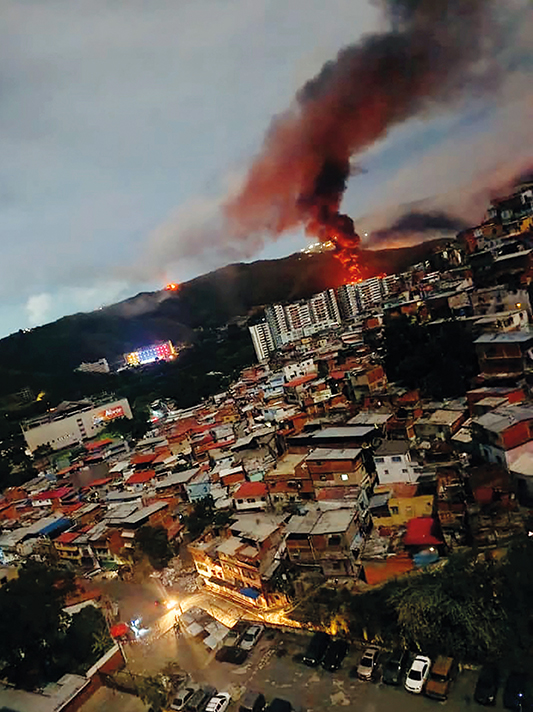
Donald Trump may not have written – or indeed read – the US National Security Strategy (NSS) published in November last year, but it’s remarkable how closely the strike on Venezuela on 3 January aligns with its world-view. Renouncing any role as guarantor of global security, the document laid out a “Trump corollary to the Monroe Doctrine”, proclaimed by President James Monroe in 1823, in which the US asserted its right to protect its interests in the Western Hemisphere, where necessary by military force. Renamed by Trump when he announced the capture of president Nicolás Maduro, the “Donroe doctrine” puts an American stamp of approval on a multipolar world of great powers carving out spheres of influence.
The superbly executed operation – a powerful reminder of America’s formidable military machine – leaves many questions unanswered and possibly unasked. Few will regret the toppling of a brutal and corrupt dictator. Whether Trump’s exercise in gunboat diplomacy can achieve its geopolitical goals – securing control of the country’s natural resources and benefiting from them – is less clear. Venezuela is the site of the world’s largest oil reserves, but the industry’s infrastructure has been ruined by mismanagement and will take many years to repair. How will America “run the country” (as Trump has put it) in the meantime? The Nobel Peace Prize-winning opposition leader María Corina Machado seems not to have been invited. Trump has designated Maduro’s vice-president Delcy Rodríguez as interim leader, while threatening that she must comply with his wishes. This is a curious kind of regime change. Was Maduro’s overthrow an inside job that Trump fears may come unstuck?
Whatever the answer, the significance of Trump’s Venezuelan gambit lies in the message it sends the world. For the high-rolling American president, this may be only the first of several unilateral moves. Next in the line of fire could be Greenland, about which he said “we do need, absolutely” after the Venezuela attack – then Cuba, Colombia, Mexico, even Canada. For Xi Jinping and Vladimir Putin, the Donroe doctrine of American hemispheric suzerainty is a green light to defining and hardening their own spheres of influence. We should not be too surprised if, following this “spectacular assault” in Venezuela, the pace of events begins to accelerate in Ukraine, and in the Taiwan Strait.
John Gray’s latest book is “The New Leviathans: Thoughts After Liberalism” (Allen Lane)

Catherine Royle
Venezuela was the most polarised place I ever lived. When I was the British ambassador in Caracas from 2007 to 2010, it was normal to be asked by Venezuelan contacts why I had visited a Chavista supermarket or an opposition restaurant. Nothing was neutral. Everything diplomats did was viewed as a message, even when you were just getting your groceries.
This state of affairs did not emerge overnight. An opposition supporter once told me it was a pity I hadn’t been in the country in the Nineties because it had been paradise. But that wasn’t true for most people. The country’s wealth benefited about 10 per cent of the population, while the rest lived in the richest country in South America but without access to healthcare, good education or decent jobs. That’s why Hugo Chávez was elected in 1999. He tried to spread the benefit of Venezuela’s oil wealth across society. Living standards did rise for many, but nationalising the oil company PDVSA made it less efficient, and PDVSA was used as a cash cow for all the Chavista social programmes.
An attempted coup in 2002 gave officials in Cuba, Iran and Russia the chance to convince Chávez that a hostile US was trying to remove him from power. From then on, national wealth was used for geopolitical purposes, such as supporting Cuba and baiting President Bush by providing cheap oil to people in the Bronx, rather than improving the lives of ordinary people. Economic mismanagement was evident, with continual shortages in supermarkets just one manifestation of the problem. Corruption was rife, and Chavistas enriched themselves. Elections were preceded by generous handouts to ensure support – but Chávez was also helped by a tone-deaf opposition. When asked how his family coped with the country’s shortage of milk, one opposition politician said they were fine: they had it flown in a Spanish airline.
The Chávez dream died long before he did. The polarisation is still there and worsened as the Maduro regime put down any political opposition with brutality – culminating in a refusal to accept the result of the last election. That political intolerance, coupled with a failed economy causing deep poverty for many, and high levels of violence and crime have led eight million people to leave the country. Most Venezuelans would like their country and its people to have a chance of peace and security in which to build lives that benefit from the natural riches of their country. It seems like a long road from here to there.
Catherine Royle is principal of Somerville College, Oxford, and the former British ambassador to Venezuela, 2007-10
David Miliband
The eight million Venezuelans who have fled the country in recent years, along with the majority of those left behind who voted for the opposition in the 2024 elections, have expressed delight at Maduro’s ousting. But many also question what it means for the US to “run” Venezuela (without even a US embassy), why the democratic opposition appears absent from US plans, and how much revenue from its oil reserves will be requisitioned. While the military operation to seize Maduro was meticulously planned and impressively executed, the future settlement remains vague.
That has regional consequences, but the fears and questions about a new free-for-all are global. In 2025, the US administration railed against rules, institutions and norms it claimed had “failed”. In 2026 and beyond, the danger is that there are no rules at all – especially for big countries, but not only for them. Consider Sudan, where the superpowers are peripherally engaged, which is fragmenting under the sway of powerful neighbours backing rival armed groups. Across the world, states harbour ambitions to meddle or expand their influence and territory, and the handrails are already too weak.
Moscow and Beijing have issued statements of protest. But events in Venezuela will lend rhetorical succour to their arguments about the future of eastern Europe, Asia and beyond. They have long claimed that Western commitments to rules and norms are a sham, and have hoped the Western alliance would fracture – notably between the US and Europe. They will be encouraged by this.
The reason rules were codified after 1945 was that a world without them had proved disastrous, especially in Europe. A rules-based order was necessary because the alternative was calamitous disorder. Today, Europe – including the UK – is especially exposed, given its dependence on the US to help contain Russian aggression in Ukraine. While there has been a serious mustering of force and finance for Ukraine, Europe’s Russia problem is far broader. What is needed is a Russia strategy, not merely a Ukraine policy.
David Miliband is CEO of International Rescue Committee and a former foreign secretary
Emily Thornberry
What happened in Venezuela was contrary to international law, and international law matters. We cannot allow powerful states to bully others, and deciding they can invade another country because they dislike its leader, then abduct them and put them on trial in their own courts. Since the Second World War, we have had norms and rules, and we need to uphold them. The liberal international order has served us reasonably well. We cannot simply allow it to slip through our fingers.
Emily Thornberry is a Labour MP and the chair of the Commons Foreign Affairs Committee. This is an edited extract of her appearance on the New Statesman podcast.
Listen to the New Statesman podcast



Jeremy Bowen
The removal from power of a Latin American leader by the US is hardly a novelty. What is new is the way Maduro’s fate confirms Donald Trump’s view of how American power can be used. Unlike other US presidents, he does not attempt to cloak his actions in the legitimacy – however spurious – of international law or the pursuit of democracy. Trump dismissed the aspirations of the Nobel Peace Prize-winner and Venezuelan opposition leader María Corina Machado in a single sentence. The only legitimacy he requires comes from his belief in the force of his own will, backed by raw American power.
The Maga ideologue and powerful Trump advisor Stephen Miller summed it up on CNN. The US, he told Jake Tapper, was operating in the real world that “is governed by strength, that is governed by force, that is governed by power. These are the iron laws of the world since the beginning of time.”
Recent US interventions have rarely gone well. The country’s record in Iraq and Afghanistan is well documented, and it is no better in what Washington calls its backyard in Latin America and the Caribbean. In 1994, I was in Haiti when the regime crumbled in the face of 25,000 troops sent by Bill Clinton. The invasion is not the only cause of that island’s misery since then, but in 2026 it is a failed state in the grip of bloodthirsty gangs.
Trump, always impatient for quick victories, is enjoying a geopolitical sugar rush. He has made it clear to Colombia, Mexico, Cuba, Greenland – and Denmark – that they should fear where his appetite might lead him next.
Jeremy Bowen is international editor of BBC News
Clare Short
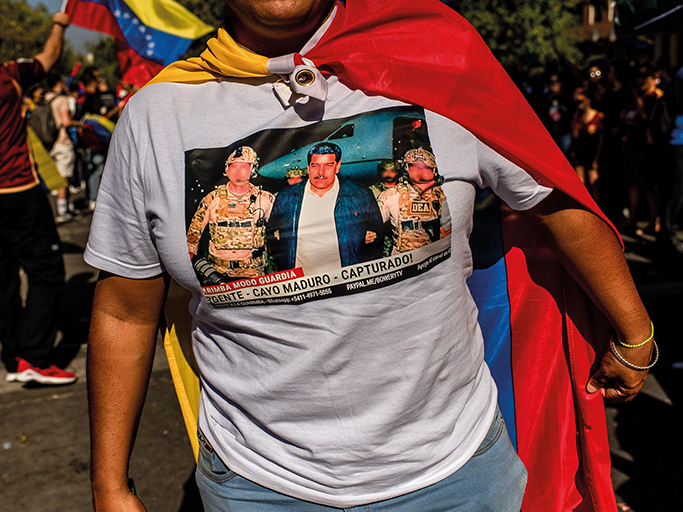
Article 2 of the UN Charter prohibits the use of force against the territorial integrity or political independence of any state. The only excuse is self-defence. This principle has, of course, been breached many times, but this instance is so unashamed that it may mark an endpoint. The question is not whether the Maduro regime is attractive, it is whether the US has the right to take control of the country, and to threaten Greenland, Colombia, Mexico, Cuba and Canada, as well as judges in the international courts. Starmer spelled out the UK position to Laura Kuenssberg: “I constantly remind myself that 24/7 our defence, our security and our intelligence relationship with the US matters probably more than any other relationship… and it would not be in our national interest to weaken that in any way.” The future is increasingly dangerous and the UK irrelevant.
Clare Short is the former secretary of state for international development, 1997-2003
Kim Darroch
With Maduro behind bars in New York, what next? Don’t expect a plan: that’s not the Trump way. The early bluster about the US “running Venezuela” and boots on the ground is already being walked back. The Nobel Peace Prize-winning opposition leader has been sidelined. Instead, the emerging idea is that the US will run the country by remote control, using Maduro’s hapless and out-of-her-depth deputy, Delcy Rodríguez. So what happened to regime change? It was never the priority. This is about oil. Venezuela has the largest oil reserves on the planet, and, as Trump has repeatedly said since the attack, US companies will now take control. With Trump, in the end, it is always about business.
Kim Darroch is the former British ambassador to the US, 2016-19
Jeremy Corbyn
In 2003, a Labour prime minister supported the invasion of a sovereign nation to remove its leader and seize its resources, wilfully ignoring the pleas of those who predicted the catastrophic consequences. Today, another Labour prime minister is overseeing a foreign policy devoid of legality, morality, or independence from the imperial whims of the US. Bombing a sovereign nation and abducting its head of state is illegal. It is absolutely staggering that a prime minister with a background in law cannot bring himself to say something so obvious. It is not that he does not understand – the truth is far worse: he understands perfectly well and is choosing to desecrate the meaning of international law to avoid upsetting Trump. In doing so, he is allowing the US to act with impunity. Venezuela first; who’s next? The story of US-led foreign interventions is one of chaos, instability and misery. How many more of these failures will it take before a British government defends the principles of international law, national sovereignty and peace?
Jeremy Corbyn is a former leader of the Labour Party and the Independent MP for Islington North
Samuel Moyn
Reminiscent of old-school American hemispheric imperialism, Trump’s abduction of Maduro was nonetheless marked by two features that have been neglected amid the torrent of justified condemnation. First, Trump’s act reflects US geopolitical decline, not imperial endurance or renaissance. Never before have Latin American hijinks been a compensation for imperial retrenchment globally, but Trump’s foreign policy now stands for the two together.
Needless to say, this doesn’t mean that his aggression towards weaklings won’t recur. The Venezuelan operation proved that neither allies across the Atlantic, nor constitutional or international law, will stop him. European politicians have embarrassed themselves after years of highlighting Russian illegality by excusing Trump’s. Coalitional politics could, but on the domestic scene.
Second, that coalitional politics is shifting. Trump’s fearsome second term is showing signs of political defection and exhaustion. Through belligerence in Iran and Venezuela, Trump won minor new support from neoconservatives who have opposed him. But his latest outrage is best explained as a distraction from his cratering domestic support by means of foreign spectacle. If there is hope, it is that “regime change” is likely to damage his standing even further.
Samuel Moyn is the Kent professor of law and history at Yale University
Robert D Kaplan
The capture of Maduro by the American army’s Delta Force is the kind of technical wizardry that the US has always excelled at. But it is no guarantee against subsequent chaos in Venezuela. In 1946, the American journalists Theodore H White and Annalee Jacoby published a book, Thunder Out of China, in which they pointed out that the detonation of two atomic bombs on Japan was a mere act of technical wizardry that would not help the US navigate the future convulsions in Asia. The 1949 communist victory in the Chinese Civil War, and subsequent upheavals in Vietnam and Laos, would soon prove their point. Venezuela has a politically divided population of 29 million, greater than Iraq in 2003, and is rife with corruption and criminality. Restoring stability there will be a Herculean task.
The dilemma is that the US has been in an imperial-like situation since the end of the Second World War. And the very definition of an imperial predicament is that you find yourself involved not only in places vital to your national interest but also in those that are not. The US captured Maduro because it could – why pass up the opportunity if you have the means to do so? But that temptation leads you into a situation you are not competent to execute: rebuilding a vast and shattered society. The interventions in Vietnam, Afghanistan and Iraq were built on a misunderstanding of the political forces in those societies. Venezuela could be similar. Although, as the country is located in America’s backyard, the chances of success may be greater than in the Middle East and Asia.
Robert D Kaplan’s latest book is “Waste Land: A World in Permanent Crisis” (C Hurst & Co). He is a senior lecturer at the University of Texas at Austin
Matt Frei
The first year of Trump’s second term has been a succession of shock therapies. At his inauguration, he outlined his radical domestic and foreign agenda, including his attempts to revive the 19th-century Monroe Doctrine for the 21st century, and his emphasis on the exercise of power rather than the pursuit of common values. The dramatic pre-dawn extraction of Maduro is just the latest example of how Trump operates: consult neither allies nor Congress; nor attempt to unify the American nation behind his actions.
You can hear the panic in the voices of European leaders as they respond to the dramatic head-of-state heist. Yes, Maduro was a “bad hombre”, but what about the global rules? And who could be next? If Trump has signalled to Xi and Putin that might is right, where does that leave Ukraine, let alone Gaza? Trump may not end up “running” Venezuela as he has pledged. It is hard to see how that will work. But maybe he doesn’t care. He inflicts geopolitical whiplash. If the results don’t match the opening gambit he moves on to the next stunt. On tariffs, forced deportation, his battle with the Federal Reserve or elite universities, Trump has ended up, as they say in Texas, more hat than cattle. But this is little comfort for a world plunged into the chaos of an attention-seeking showman.
Matt Frei is a presenter for Channel 4 News
Vladislav Zubok
Some view the US invasion of Venezuela as another blow to the post-Cold War world order created by the West. This is historically inaccurate. What Trump has been dismantling since January 2025 is a concept of a Euro-Atlantic community of common interests and values. This concept, as one British diplomat astutely noted, was “virtually invented” by the US government in 1990-91 in the context of the end of the Cold War and the Soviet collapse. The Monroe Doctrine has never been dead, before or since, but it was clouded by new rhetoric. Now, Trump has reasserted it as the “Donroe doctrine”, named after himself.
For Putin, Venezuela proves what he has believed in for the past 20-something years: that the community of common values and interests has always been a sham, a fig leaf for US hegemony. For Europe and Ukraine, this is bad but not big news. It is just another confirmation of what has been known for months. The security guarantees of a sovereign country have finally revealed to be what they always have been: backed by force and the will to resist – or meaningless.
Vladislav Zubok is Stevenson professor of international history at the London School of Economics. His latest book is “Collapse: The Fall of the Soviet Union” (Yale University Press)
Matt Labash
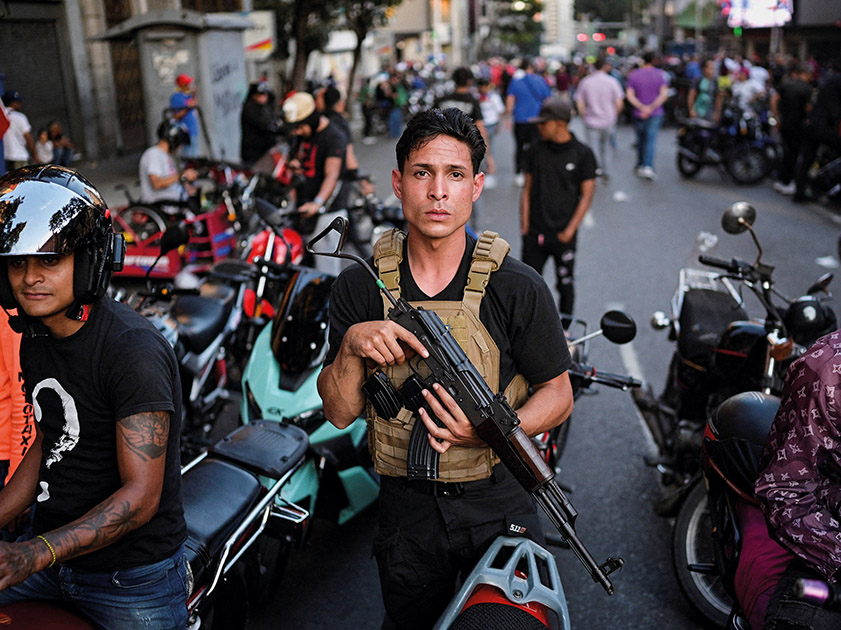
Maduro was a rotten dictator – the type Trump usually has a high tolerance for, being an aspiring one himself. In fact, the US president might have been jealous, since Maduro did something Trump tried but couldn’t manage to pull off: stealing an election. But Trump’s “Make Venezuela great again” policy (where are our isolationists when we need them?) could make tinpot authoritarians in southern climes quake – unless they’re named Nayib Bukele, who gets a Maga pass as the US’s foreign prisons subcontractor in El Salvador. They’re in good company, for this should make plenty of Americans nervous, too. Because Trump has proved completely inept at running our comparatively stable country, as nobody elected him to build big, beautiful ballrooms or rename the Kennedy Center after himself, all while jacking up the price of everything from our groceries to our healthcare. However awful Maduro was, most Americans hoped we’d got out of the nation-building business. We gave that a go for 20 years this century, with disastrous results. Is Captain Chaos going to bring order to this country? I would bet all the oil in Venezuela that won’t happen, if Trump doesn’t swipe it first.
Matt Labash is an author and journalist. He writes the Slack Tide newsletter
Rana Mitter
China won’t draw a direct analogy between the US action in Venezuela and the Taiwan issue, because it regards the latter as a long-standing “internal” matter that dates back to the Cold War. Nor is it likely to seek opportunities for military interventions in nearby states, as it regards economic and technological influence as better ways to cement Chinese influence. But Beijing will be torn between two interpretations of the Venezuela case. The confrontational reading is that if Trump has declared the US can act with impunity in its own sphere of influence, so can Beijing. (Chinese thinkers have been writing about Xin Mengluozhuyi – “New Monroe-ism” – for decades.) Yet cautious Chinese analysts now know that one piece of conventional wisdom has been exploded: the idea that Trump is an isolationist. They will remember that the US secretary of state, Marco Rubio, now ascendant, has recently praised US bonds with its Asian allies – and that America is not just a Caribbean power, but a Pacific one too. This could put Japan, Korea or Taiwan in its wider backyard.
Rana Mitter is ST Lee chair in US-Asia relations at the Harvard Kennedy School. His most recent book is “China’s Good War: How World War II is Shaping a New Nationalism” (Belknap Press)
Wolfgang Streeck
We read about tens of people dead – nothing as yet compared to Iraq with 200,000 civilians at least (Bush and Cheney), or Afghanistan with 170,000 (Bush to Obama). But of course, this is not the end of it; American presidents like it big. One wonders how much military protection the oil companies will demand before they go in and invest as told. Cuba seems to be next in line; its oil was from Venezuela, but no longer. Note that Rubio is from Florida, where the Cuban diaspora is waiting to “Make Cuba great again”. As to Europe, Trump has already appointed his special envoy to Greenland, waiting to rise to viceroy. With just 57,000 people, Greenland should be easy to govern, and in any case, Trump seems to mean it. If that happened, expect an “interim administration” for a few years, during which Greenlanders would be bought out and the “Europeans” would get used to mining rare earths and other goodies, for a charge of course. Chancellor Friedrich Merz, busy assembling German ground troops for Ukraine in need of protection by American intelligence, won’t take long, assisted by Keir Starmer, to discover the “legitimate security interests” of the US in Greenland, given the Russian threat and the Chinese ships on the Northwest Passage. Interesting things are happening; be ready for more.
Wolfgang Streeck is an author and emeritus director of the Max Planck Institute for the Study of Societies in Cologne
Curt Mills
You knew this show jumped the shark when the Trump administration wheeled out the George W Bush-era adviser John Yoo to defend its flimsy legal pretext for the daring raid on Caracas. But there has otherwise been a predictably farcical aftermath and lack of planning for what’s next in South America. Yoo, for the uninitiated, was the author of the Bush “torture memos”. Maga’s appeal, at least for conservative hardliners and Trump 2016 primary voters like myself, was rooted in its evisceration of the Bush years and the war on terror – not to allow that set a brazen comeback.
Anyone hoping for Congressional oversight will be crestfallen, as hawks in the Republican Party, if anything, are usually more enthusiastic for war than the Trump team, not less. Erstwhile independents and self-styled Legal Conservatives such as the senator for Utah, Mike Lee, immediately caved after the Venezuelan attack. A quick call from Secretary of State Rubio apparently did the trick, in which America’s chief “diplomat” cited vague constitutional authority. Lee might as well have said he had concerns after the Night of the Long Knives, but that after Carl Schmitt explained how “Der Führer protects the law” his anxieties were assuaged.
Curt Mills is executive director of the “American Conservative”
Robert Service
Don’t mention the war! The Trump administration is keen to avoid the blunders of 2003, when the Americans, after defeating Saddam Hussein, dismantled the Iraqi army and installed their own provisional civilian administration. Trump has relied on the abduction of one man and his wife, President and Mrs Maduro – and the helicopters of US special forces left immediately afterwards. But is presidential decapitation, even when accompanied by threats of worse to happen should there be any resistance, enough to secure domination of a country of almost 30 million people?
Trump prioritises taking control of Venezuelan oil reserves. He talks of doing this by turning the acting president, Delcy Rodríguez, her cabinet and armed forces into American proxies. No talk of democracy, elections, or any politics at all – only of stabilisation. And nothing but contempt for opposition leader María Corina Machado.
Hands-off governance from a great distance is rarely easy. It worked in Japan and West Germany after 1945 because they had been utterly defeated in war. Venezuela, until the arrival of US military helicopters, was at peace. Its economy was in ruins and, under Maduro, a huge exodus of talented and entrepreneurial citizens had occurred. He was a scoundrel but at least he paid the welfare bills. Immense tensions, however, exist throughout society. Perhaps Trump aims to manage the situation without needing to keep many American boots on the ground. George W Bush thought just that in 2003.
Robert Service is emeritus professor of Russian history at St Antony’s College, Oxford
Nicholas Kumleben
Oil is certainly one motive for the US in wanting a stable, democratic and functional Venezuela, but I doubt it is the primary motivation. Revitalising Venezuela’s oil industry will take years, if not decades, and could require upwards of $100bn of investment. The primary attraction of a stable Venezuela for the US is that it will staunch the flow of migrants fleeing Maduro’s regime – migrants who often end up at the US southern border.
In terms of broader relevance, the clearest impact is on Cuba, rather than Iran or Russia. The capture of Maduro is the clearest evidence yet of the “Donroe doctrine”: that the US has returned to a policy of seeing Latin America as its backyard. Cuba could be the next domino to fall: it has been propped up by Venezuelan largesse for decades, and Marco Rubio would love nothing more than to end communism in his ancestral homeland. Chaos in Venezuela could even be a boon to Russia and Iran, as Russian and Iranian oil competes directly with Venezuelan crude in the shadowy corners of the oil market. Canada has nothing to fear, given the long pathway to recovery in Venezuela and Canada’s superior infrastructure links to the US market.
Nicholas Kumleben is energy director at Greenmantle
Murtaza Hussain
It is often said that hypocrisy is the tribute vice pays to virtue. But the US government’s assertion of a right to kidnap a foreign head of state and bomb a capital city –without even the pretense of legality – marks something more profound: the effective death of the post–World War II aspiration that power might be restrained by laws and norms, and that the strong could be bound in their treatment of the weak.
A cheering section of liberal commentators has attempted to justify Trump’s actions as serving some higher good, even as he openly frames them in terms of seizing Venezuela’s oil resources. Many of these defenses suggest a failure to grasp the world as it now exists, rather than the one they wish still governed it, and which gave them their own identity.
Above all, Europeans should take note. No group invested more deeply in the ideal of liberal internationalism after the catastrophes of the twentieth century. When Trump says he has designs on Greenland, or hints at escalating demands on Europe itself, he should be taken at his word. Appeals to laws and norms whose illusory nature has already been laid bare are unlikely to offer protection, and may even whet the appetite for more aggression.
Murtaza Hussain is a journalist who covers national security and foreign affairs for Drop Site News
[Further reading: Venezuelans don’t trust Trump]
Content from our partners
Related
This article appears in the 07 Jan 2026 issue of the New Statesman, What Trump wants
Join the debate
Subscribe here to commentTrump has taken a big gamble.
If it looks as though it has worked, he’ll be garlanded with praise.
If not, large numbers of ripe tomatoes will be thrown at him.