
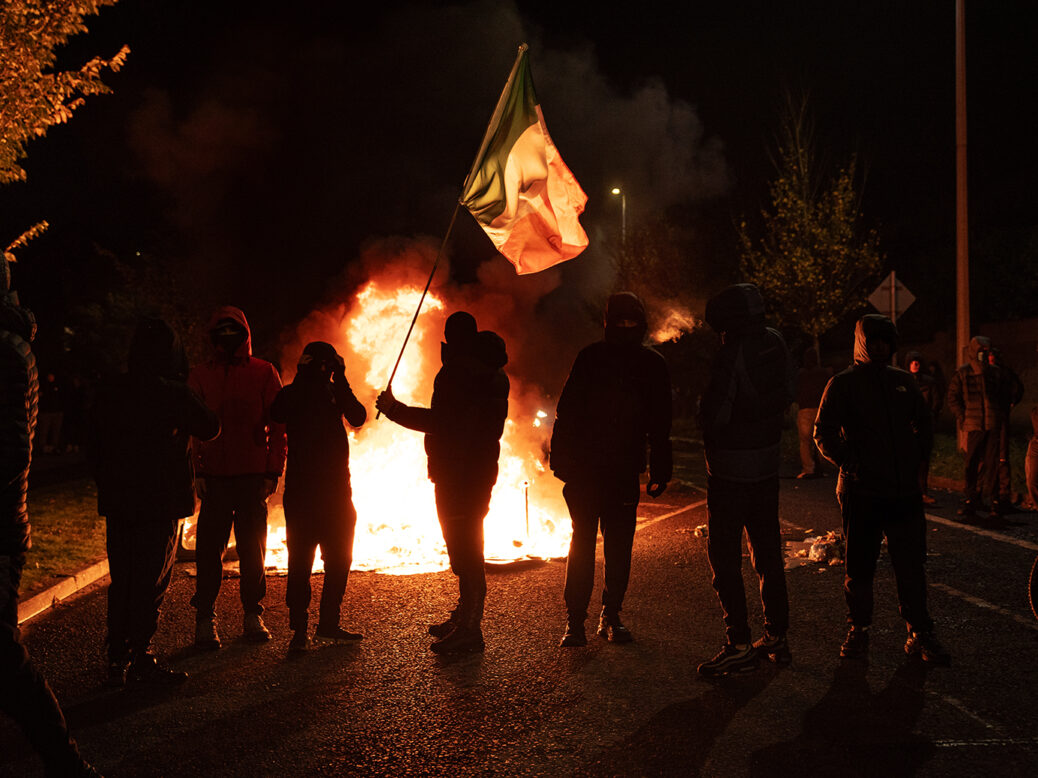
There was something medieval about it, in the end: a horse-drawn cart charging into riot police; a man actually wielding a pitchfork. On Tuesday night, in a leafy exclave of West Dublin, thousands of protesters-turned-rioters clashed with police in an attempted advance on an asylum hotel. Men waved Irish tricolours, many were pepper-sprayed, women watched on and called the police traitors, chants of “get them out” were ambient. We are familiar with the scene by now.
The events leading up to the skirmish make it all seem inevitable. On Tuesday morning, a man in his twenties was charged – via an Arabic translator – in connection with the sexual assault of a ten-year-old girl. Mary Lou McDonald, leader of Sinn Féin, said he had been issued a deportation order earlier in the year, yet he remained in the Republic of Ireland. There had already been local opposition to the government’s decision to make the CityWest hotel for asylum seekers in the small town of Saggart. And so, this familiar convergence of factors tumbled into street violence. Perhaps it was always going to.
Think back to the clashes in Ballymena, Northern Ireland, in June – which were preceded by the court appearance of two 14-year-olds accused of sexual assault on a teenage girl, litigated through a Romanian interpreter. Or to the Bell Hotel protests in Epping, Essex – which were preceded by an asylum seeker charged (now convicted) with sexual assault of a 14-year-old girl, days after arriving to the UK.
Both the England-wide riots of 2024 and the Dublin riot in 2023 came in the wake of a violent (and in the case of Southport, fatal) attack on schoolchildren. The assailant in both cases was falsely identified as an “illegal immigrant”. But this distinction is collapsing on a street level – it is dismissed as a little detail that can be discarded at the altar of a bigger political project.

On both sides of the Irish Sea, there is a small, angry, nativist cohort galvanised by attacks on children and with a common rhetorical cause. In Dublin, protesters shout “Ireland is full”, in England banners read “We want our country back”.
But this only skates on the surface of Irish anti-immigration rage. Since the 2000s, Ireland has been gripped by the shibboleths of political correctness – making direct conversation about immigration more taboo than it ever was in England. This was an overcorrection to Ireland’s years as a turbo-conservative country under the authority of the Vatican. But it introduced a politeness code that permeated every level of the country’s establishment – even Sinn Féin, once of the working class, embraced the porous border liberalism of its political rivals.
Combine this with precipitous demographic change – caused in part by the intake of 100,000 Ukrainian refugees, and a record number of asylum applications in 2024 – and the country was destined for a powder-keg moment. Anti-immigration protests, agitation and skirmishes have been happening since 2019 on the island.
Away from policymakers, there is a divide on the ground too. Last year, while on the 2024 Irish election campaign trail, I found two very different Dublins. In a wealthy South Dublin suburb – a heartland of Fine Gael, one of the governing parties – I heard almost nothing of immigration. This was not the case in the deprived inner city, the constituency of McDonald and location of the 2023 riot. The area is rundown and voters are apathetic. They are fed up with the born-to-rule posture of Fine Gael and its fellow ruling party, Fianna Fáil; they are disenchanted with McDonald’s progressive turn. They are unhappy with visible demographic change.
And so, you have a governing centre that drags all fringe politics to the middle ground (the logic of the system demands this). But you also have people who, despite their geographic proximity, are observing different social universes. Dublin is one of the richest cities in Europe. One has to wonder if the young men charging horses into riot police have seen much of that wealth.
On Friday, the country will head to the polls to elect a new president. This is nominally a ceremonial position, but thanks to the recent tenure of Michael D Higgins, the office is slowly being recast in a vox populi way. The woman most likely to win is an open-borders left-winger. The woman most likely to lose is another Fine Gael archetype. Unavailable to the pitchfork wielders in West Dublin last night is anyone who would ventriloquise their rage. It is a minority position, but one that will keep searching for political expression it cannot find in the mainstream.
[Further reading: I thought Labour would fix everything. I was wrong]
Content from our partners


Related
Join the debate
Subscribe here to comment