
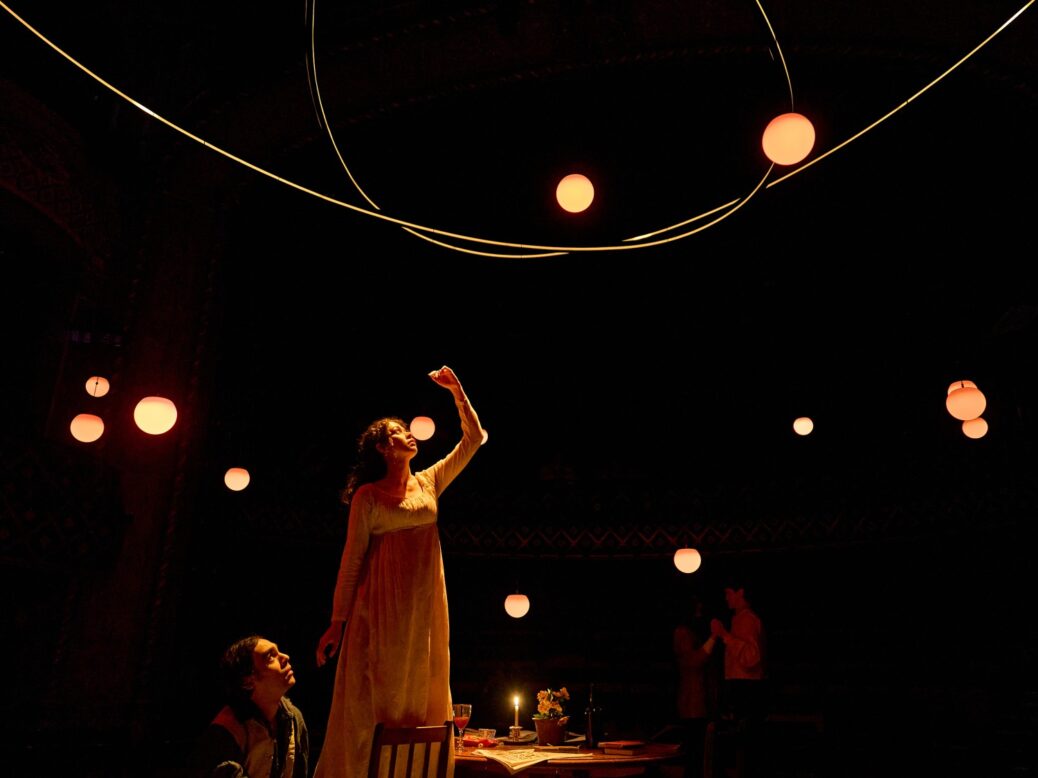
Tom Stoppard’s Arcadia is a famously difficult play. A programme for Carrie Cracknell’s revival contains a glossary to help the audience follow along. Luckily, beyond that, the director refuses to dumb it down.
Set in the fictional estate of Sidley Park, the play tells two stories. In one, in the early-19th century, the tutor Septimus Hodge (Seamus Dillane) guides his brilliant pupil Thomasina Coverly (Isis Hainsworth) through the latest discoveries in mathematics and physics. In the wings, the heat rises: a husband has been wronged, a deadly duel may or may not be fought, Lord Byron visits. In the other story, it is the late-20th century and the academic Bernard Nightingale (Prasanna Puwanarajah) visits the same house, convinced that uncovering the events surrounding Byron’s visit will make him famous.
In this production, staged in the round at the Old Vic in central London, Alex Eales’s double-revolve set rotates clockwise and anti-clockwise at the same time, allowing characters to step in and out as space and time collapse. Lights hang like electrons over the nucleus of the stage, and the action is atomic. Characters, in turn, discuss landscape gardening, chaos theory and Newtonian physics, but sex – “the attraction Newton left out” – is never far away.
Any staging of Arcadia lives or dies on how it marries the time periods of each story. Dillane and Hainsworth are electric – Hainsworth’s portrayal of Thomasina is equal parts innocent and intellectual. The play only falters when it returns to the modern day. Puwanarajah is unconvincing as the rakish Nightingale, and the scenes become expositional. Nevertheless, the action flows beautifully. It is Stoppard at his finest. Metaphor builds upon metaphor, yet the playwright’s death last November hangs over the performance. Does his oeuvre match his reputation? Does any of it still matter? The answer from the show is simple: yes.

[Further reading: How Wuthering Heights seduced its readers]
Content from our partners


Related
This article appears in the 11 Feb 2026 issue of the New Statesman, Labour in free fall
Join the debate
Subscribe here to comment