
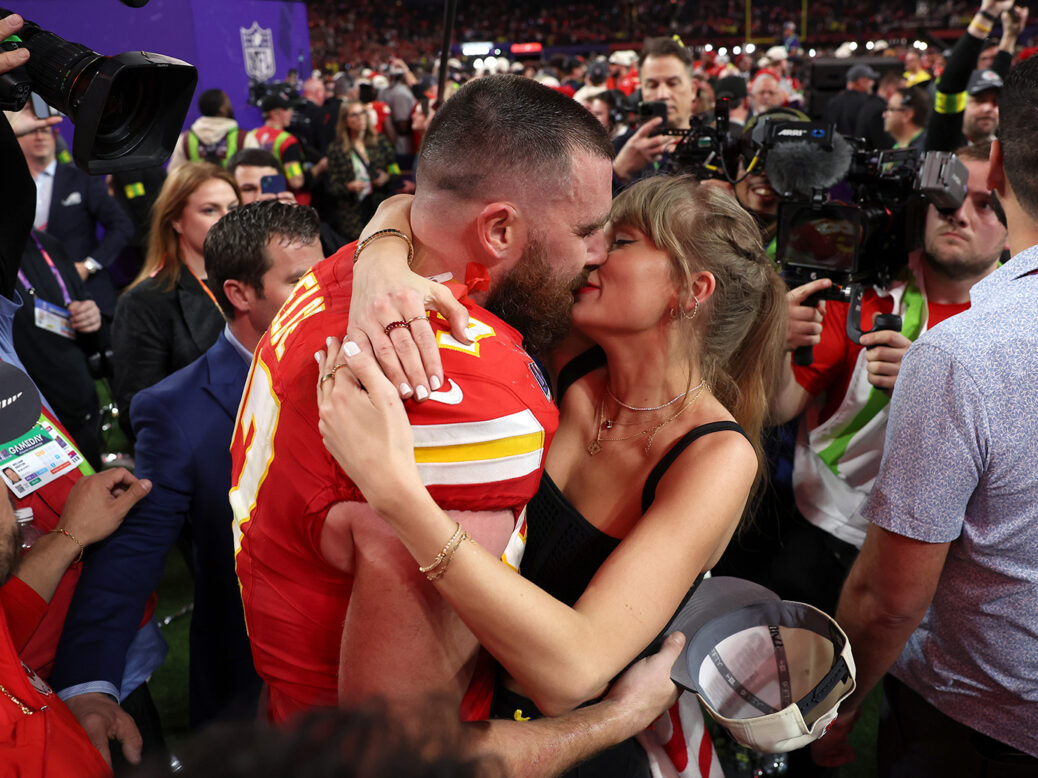
The same woman who sang “take me to the Lakes where all the poets went to die”, can – from the bottom of her artificial heart – sing of sex with her fiancé, “Redwood tree, it ain’t hard to see / His love was the key that opened my thighs”. And yet, these are the vast gradations contained within Taylor Swift. A fractured, splintered woman who once anxiously asked her muse, “would it be enough if I could never give you peace?” and is now marrying another one in Madison Square Garden, about the most conspicuous place in all of Manhattan.
Such is the Swiftian Gestalt. So deeply eager to please (“I’m still trying everything to keep you looking at me”) and so full of spite (“I breathe flames each time I talk”). Swift heard one day that old cliché about people containing multitudes and said, “you wanna bet?” I have spent more than half my lifetime in Swift’s musical universe and everyday I return and I find someone new. So how to assess someone with no stable sense of self, no sonic, emotional or aesthetic coherence, who is “happy, free, confused and lonely at the same time” (and that ain’t even the half of it)?
The listener has to assume Taylor Swift has studied Democracy in America. You know, the de Tocqueville treatise about America’s republican destiny – that the United States, as we now know it, was fated to become the egalitarian, democratic place that Reagan spoke of with such confidence, 140 years later. The compound forces of history were just too strong for any other other outcome. And how else to understand Swift’s theory of the self? The arc of the universe is long and swooping – but it was always going to lead here.
A 4 July wedding in the huge baseball arena, Madison Square Garden? Hell, why not. “In your life you’ll do greater things than marrying the boy on the football team” (2008) she says, with forceful inevitability. And fine, she is the most commercially successful recording artist of all time and perhaps the most famous woman in the world. Her Eras Tour (2023-2024) broke every record conceivable and she has won Album of the Year at the Grammys four times – which does matter to some people. But what about all of this, and marrying the boy on the football team?

She always knew – she knew everything when she was young. “I’m gonna find someone someday who actually treats me well” she comforts Taylor, 16 years-old, on the same album and with that same sense of historical determinism. And, well – here it is. The real American love story: a blonde popstar beleaguered by love burned and broken and lost, meeting the champion footballer. There have been false starts and broken promises in between (“you know I love a London Boy” she declared, for him to leave her alone in the house they shared on the heath). But there goes that arc of the universe again.
In fact, when she sings on “The Fate of Ophelia” (2025) that divine intervention saved her from suicide, Ophelia-style (“And if you’d never come for me / I might’ve drowned in the melancholy”) those “providential facts” of de Tocqueville’s imagination must rattle around. No, this was destiny manifest. The Gods willed it. And only now, she can “see it all” – the end of history – with someone, someday, ring on finger. Expressed in the indicative.
And that preternatural sense of self-assurance (soooo American!) appears with tremendous force in her 2010 ballad “Long Live” (she would have been 20). Predicting, or willing, the future, Swift sings to her fans: “When they point to the pictures, please tell them my name”. And then she astral projects ten years into the future, when she’s no longer the ingénue, when there will be young starlets snapping at her heels (Sabrina Carpenter, Olivia Rodrigo?). “Bring on all the pretenders” she cockwalks, a decade too early. “Ah, try and come for my job” she says somewhat more defensively in 2023. Superstardom was never an ambition for Taylor. Nothing so meek and carnal. No, it was written in the stars. The compound forces of history, and all that.
Plenty of jejune things have been written about the singer’s rapacious capitalism, her chart manipulation, her expensive tickets and reams of merchandise flogged to willing fans, and how this unmoors her from her greatest appeal: the lyrical intimacy, the forced closeness, the I’m-just-like-you of it all. And maybe that is true but it is not really interesting. Swift may fly everywhere in a private plane but I also resent the older men who I have dated, and we both really do love the heath. The intimacy, forced or not, real or fake, still convinces the listener.
No. Swift being rich doesn’t mean anything to the grander cosmic project (sorry!). However, far more needs to be said about her consistent argument for that imperial expansion. When American settlers planned to expand westward in the 19th century, they forced the belief that it was a necessary and inevitable fact of history. Swift invokes a manifest destiny of her own: colonising the music industry was both bound to happen (through her superior talent – “Taylor Swift is the music industry” Barbara Walters then enthused of the 24 year-old) and morally ordained (who else speaks so sweetly to the experience of female adolescence? “Maybe that’s what Eras really is,” Taffy Brodesser-Akner wrote in the New York Times, “the acknowledgment of girls as people to memorialize”).
Settlers headed West, Swift took over the world. From plucky banjos to synth pop via indie folk and misadventures in R&B, over 12 studio albums, record breaking tours and the total colonising of the adolescent female mind. And then married the boy on the football team. This is America at 250: no more Kings! But a royal wedding is permissible.
When Swift finishes the opening track of the Eras Tour she gazes out to the audience, a face of gorgeous and forced astonishment at the sheer size and volume of the crowd. “Hi, I’m Taylor” she waves (of course they know who you are Taylor, they paid $150 to be here!). The “who, me?” underdog act doesn’t work. It never did – not for someone who always knew selling out ten nights at Wembley was an inevitability not a product of a lucky break.
“When you are young they say you know nothing” she demurs on “Cardigan” (2020), but “I knew everything when I was young.” And there it is – the source code and key stone of Taylor Swift. She may be angry and confused and sweet and unmoored, powerful and vulnerable, America’s sweet-heart-cum-manipulator in chief. But she knew she would be all of those things, standing on a pile of money and waving to a rapturous crowd. Who all know her by name and much more than that.
[Further reading: The Degradation of Independence]
Content from our partners



Related

Join the debate
Subscribe here to comment