
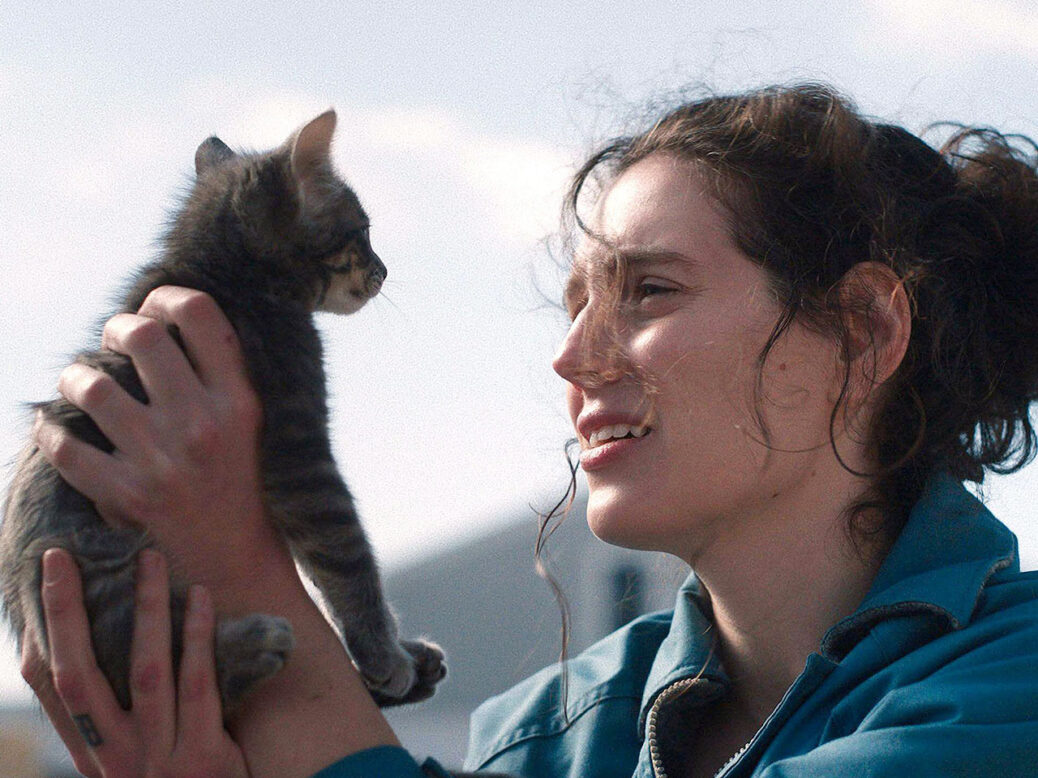
In a fair world, how we behave would determine how we are treated. But life often feels the other way round. Sorry, Baby, starring debut director Eva Victor, concerns the pain of being alive and knowing it. We are trapped in the way others treat us and, as Victor’s character Agnes Ward explains, people can treat us in different ways. They can be “respectful, like you’re a person who lives and breathes and thinks for themself”. But then there are also “some ways people treat you are not that way, and they’re bad”.
Agnes, a professor at a liberal arts college, has been treated the bad way; she is the victim of a sexual assault, but she finds it hard to talk or even think about. She knows it is bad only because people “look really scared for me” when she tells them. The one person who listened without fear was her university friend Lydie (Naomi Ackie). But after graduation, Agnes stayed in their college town, while Lydie moved to New York and fell in love. The film starts with her coming back to tell Agnes she is pregnant. The two are instantly at ease with each other, under blankets on the sofa and joking about sex. But, as they brush their teeth, Lydie delivers her news with a quiet note of apology – “sorry” – by which we understand how much Agnes needs the care that will now go to the baby. Agnes begs uncertainly, “Don’t leave.” Lydie can only plead falteringly, “Don’t die.” Then she must leave Agnes to herself.
The scene is sparse, wintry, New England, in a small rural town: clapboard houses, big coats, thick socks, bare trees, snowfall. The second chapter is titled “The Year with the Bad Thing”, and recalls the period when Agnes and Lydie are writing their theses. Their teacher, Preston Decker, invites Agnes to discuss hers at his house. When Lydie had previously asked Agnes if she’d have sex with him, the answer was “No,” Lydie said, “Well if you don’t want to fuck him, definitely don’t fuck him.” But when he opens the door, Preston mentions that his child is away with his ex-wife, and asks Agnes to take off her boots.
The incident is portrayed in three excruciating, mesmeric long shots. For a minute and a half, we watch the house from outside. It is daytime, then evening, then night. The door opens and Agnes leaves. She puts her boots on out on the cold steps rather than inside. For another 90 seconds, we watch Agnes driving away. The camera is fixed outside the windscreen, looking into the car; Agnes cannot move within the frame, even as the world around her does. When a car approaches from behind, its headlights blind the camera. Lastly, for a full four minutes, we are fixed on Agnes in the bath, with wet hair and bare shoulders, faltering as she tries to explain what happened to her to the unseen presence who turns out to be Lydie. “That’s what I kept thinking. One more time and he won’t move [his hand] back, because it’s so obvious I’m moving it away. But he kept moving it back.”

The film refuses to fold into a trauma plot. In fact, for the rest of the runtime, the world seems to be doing the best it can to will Agnes on to recovery. Decker leaves the next day and is not seen again. Agnes goes on to meet a series of kind, gentle people – all acted with amazing care. A gruff workman (John Carroll Lynch) helps her breathe after she pulls over with a panic attack. A dorky neighbour (Lucas Hedges) becomes a patient, forgiving love interest. Sweet laughs come throughout. Agnes adopts a kitten.
When she speaks about how vulnerable we all are to other people, Agnes mentioned the bad and also the good. Eva Victor is so impressive because, as Agnes, she is always someone who has been treated both hatefully and lovingly. She is at some times trapped in horror, at others free in her gawky humour, and never one without the possibility of the other. Sorry, Baby is so powerful because it really seems invested in the question it poses, which is whether all the bad things that are bound to happen to us can be redeemed by a friend who promises “you can just tell me. I’ll never be scared by that.”
[See also: Remembering Terence Stamp]
Content from our partners


Related



Join the debate
Subscribe here to comment