
For a small town in Germany, Weimar has a remarkable history. Goethe wrote his masterpieces there, as did Schiller. They ran the Weimar theatre together. Bach lived in Weimar for a time, and so did Liszt, as well as Nietzsche. Germany’s first parliamentary democracy was founded in Weimar, whence came the ill-fated republic’s name. The same year, Walter Gropius established the modernist Bauhaus school there. Weimar is where Marlene Dietrich met Alma Mahler, Gropius’s ex-wife. While holding out her hand for the young Marlene’s kiss, Mahler exclaimed: “What eyes this child has! What eyes!”
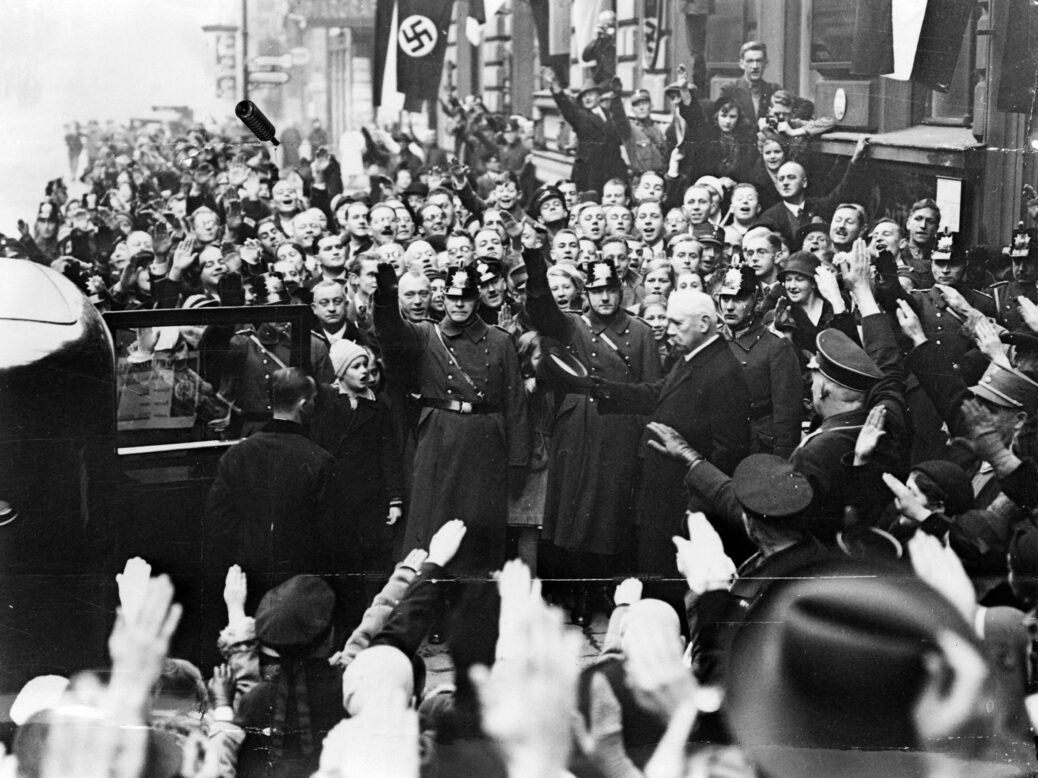
After the town’s rightward turn forced Gropius to move his hated (by conservatives) Bauhaus elsewhere in 1925, Hitler considered moving his Nazi headquarters to Weimar. In 1924, Thuringia, whose capital Weimar then was, became the first German state to lift the ban on the Nazi party. He ended up choosing Munich as the “capital of the movement”. But Weimar was designated by the Nazis as the “capital of culture”.
The lovely slopes of the Ettersberg, just outside Weimar, is where Goethe and his friend, the poet Johann Peter Eckermann, would converse under an oak tree about history, religion and art. One of the largest and most brutal Nazi concentration camps was constructed on that same site in 1937. The plan to call it Ettersberg was objected to by local worthies who didn’t want Goethe’s picnic place to be associated with a camp. It was named Buchenwald instead. Even before it was built, another camp, the first in Nazi Germany – more like an improvised torture chamber in an old schoolhouse – had been established on the outskirts of Weimar in 1933.
The story of how the Nazis came to power and what they did with it has been told many times. But Weimar, as the hub of Enlightenment culture, democracy and modernism, as well as a town of savage reaction and violence, is the perfect place to consider this black period once more.

Katja Hoyer offers a lucid, lively description of the culture and politics of Germany between the two world wars, but the strength of her book lies in her personal approach. She follows the lives of a number of Weimar’s denizens: some who became ardent Nazis, some who opposed them, and some who kept their heads down and tried to stay out of trouble. The notion of “humanising” Nazis is sometimes criticised as a form of apologetics, of softening their crimes. Demonising them makes it easier for us to distance ourselves from their crimes. But humanising Germans who lived during the Third Reich, whether as perpetrators, victims or bystanders, is surely the right thing to do. For they were all too human. Entirely to her credit, Hoyer describes the vices, vanities and fears, the cowardice and the heroism, the naivety and the cynicism, the opportunism as well as the very human instinct to protect oneself and one’s loved ones from danger, without indulging in self-righteous moralising. Even some of the most dubious characters, such as the deeply misguided Hitler Youth leader Baldur von Schirach, are vividly rendered.
Von Schirach, a dreamy aristocrat, was one of life’s born worshippers. Unfortunately, instead of mooning over actresses or Jesus Christ, he picked Hitler as the object of his devotion. He was a teenager when he first met the Nazi leader in Weimar; overcome with emotion, he rushed home to write a poem about the future Führer and placed on his desk a silver-framed photograph of him. There was no way but up from there. Von Schirach was put in charge of the Hitler Youth, and became governor of Vienna. Things grew frosty between him and his leader after Von Schirach’s wife asked Hitler why Jews had to be treated quite so harshly. But Von Schirach was himself culpable, deporting Viennese Jews to the camps and receiving for this a 20-year prison sentence at Nuremberg.
Another character who appears several times is the bookbinder and printer Carl Weirich, a music-loving man of faith. Weirich was born under the Kaiser; served in the First World War; had high hopes for the German republic; was demoralised by the economic slump; cheered on Hitler; briefly patronised the SS; and then continued his stationery business in communist East Germany after the war. He lost his first wife and two sons, one of them as a soldier in Soviet captivity. Weirich was among the Weimar citizens forced by the American victors in 1945 to tour Buchenwald and see for themselves the gallows, the torture instruments, the crematorium and the skeletal corpses of prisoners.
Weirich didn’t hurt anyone. He was disgusted by what he saw in the camp and felt ashamed by “our German downfall”. But this ordinary family man, in Hoyer’s words, “viewed history as something that happens to people, big waves of events and developments that individuals can’t control or break.” Weirich’s tour through Buchenwald was meant to teach him, and other Germans, that they hadn’t been responsible citizens, “implying that Carl, too, could and should have done something to prevent Nazi atrocities”. Probably so. But the path of resistance in dictatorships is extremely dangerous. Hoyer’s view seems judicious to me: “It is always easier to condemn than it is to explain, but in the latter lies the key to understanding history and ultimately to drawing meaningful conclusions.”
Understanding why so many people commit, or condone, or ignore, monstrous deeds at certain times and places is not easy. The idea that the German “national character” was to blame, as though an entire people was cursed with some ghastly moral defect, is now hopelessly outdated. Instead, Hoyer takes us through the various catastrophes that led up to Hitler’s rule: the disastrous defeat in the First World War, the terrifying inflation, huge unemployment, and so on.
Then, too, the fledgling Weimar Republic was crippled by sometimes violent conflicts between utterly different concepts of the ideal state. There was no consensus on what Germany should be. Liberals saw Germany as a republic of free citizens. Conservatives yearned for the old monarchy. The communists hoped for a workers’ revolution. And the Nazis wished for a community of racially pure Aryans tied to their Führer in blind obedience. The Weimar Republic fell, in the end, because too few people were prepared to defend it.
Hoyer is wise not to draw parallels with our own age. There are too many differences. But one can detect disturbing echoes: the systematic undermining of judicial independence, the deliberate spreading of lies and conspiracy theories, the purging of the civil service to make it subservient to the ruling party, and the worship of a charismatic leader.
Hoyer shows how such things were happening in Germany before Hitler grabbed total power in 1934. In 1920, members of the security police and the army took part in a failed coup against the republic. Much of the judiciary was on the side of the plotters. Even though Germans were probably no more anti-Semitic than most other Europeans, Jews were widely blamed for Germany’s ills. In Weimar, the racist ideologue Artur Dinter led a faction demanding the removal of Jews from the civil service. In 1930, Thuringia had suspended parliamentary control over its executive.
It was then, before the Third Reich was established, that a robust defence of democratic institutions could have made a difference. Too many Germans, who were decent people, chose, like Weirich, to let history take its course. By Hitler’s time, it was too late for them to prevent atrocities, unless they were brave enough to risk being tortured to death.
Weimar: Life on the Edge of Catastrophe
Katja Hoyer
Allen Lane, 496pp, £30.00
[Further reading: When Britain fought for revolution]
Content from our partners



Related

Join the debate
Subscribe here to comment