
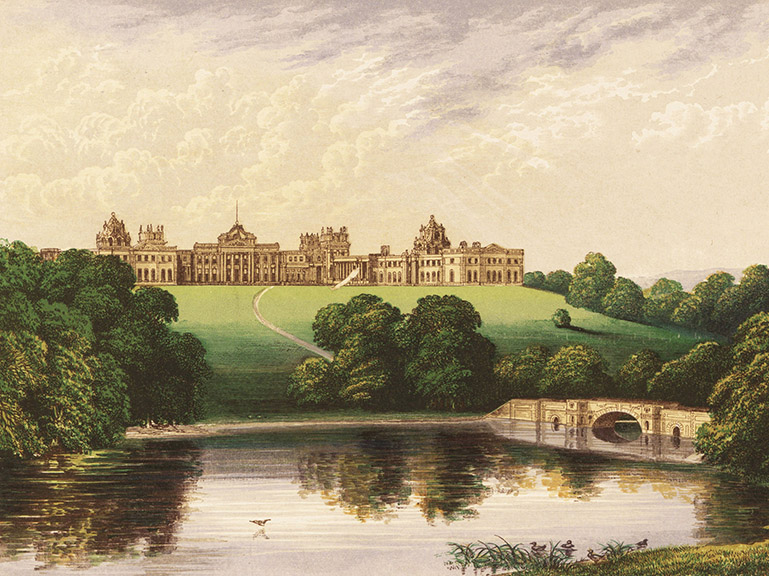
Autobiography is integral to many of the arts – what, after all, would painting, music and literature be without it? – but it is not usually thought of as a defining trait of architecture. Buildings, however celebrated their designer, are more often seen as the product of the needs and self-image of patrons, of available technology, or of the exigencies of the historical moment, rather than as expressions of the personality and experiences of the architect. The great exception is John Vanbrugh (1664-1726), who died 300 years ago and whose tricentenary, under the rubric Vanbrugh300, is being celebrated with numerous events throughout the year.
Vanbrugh was the youngest member of the triumvirate that revolutionised British architecture in the late 17th and early 18th centuries, alongside Christopher Wren (1632-1723) and Nicholas Hawksmoor (1661-1736). These men lived and worked at a time before the specialisation of professions. Wren was, among other things, an inventor, anatomist, military engineer and natural scientist, as well as an architect. Hawksmoor, too, was a mathematician, geographer and geometrician. Vanbrugh, meanwhile, had parallel careers as a successful playwright, theatrical entrepreneur and, possibly, spy.
Nevertheless, singly, in pairs or as a trio, they were responsible for a staggering number – and variety – of buildings across the country. Tasked by the Rebuilding of London Act 1666 with replacing the places of worship lost in the Great Fire of London, they designed 51 new churches as well as St Paul’s Cathedral, and another tranche following the 50 New Churches Act of 1711. Their non-ecclesiastical buildings included the Royal Naval Hospital, Greenwich and Chelsea Hospital; a cluster of the stateliest of stately homes, such as Castle Howard and Blenheim Palace; numerous additions to Oxbridge colleges; and everything from bridges to follies.
Before their advent, an architect of the older generation, Roger Pratt, noted that England was a backwater: “Architecture here has not as yet received those advantages which it has in other parts, it continuing here almost as rude as it was at the very first.” But as Wren, Hawksmoor and Vanbrugh’s structures poured from their imaginations, they gave form to an anglicised version of the baroque, pared of some of the autocratic and Catholic associations that, to the English mind, tainted it on the continent.

If Wren was the grandest and most accomplished of the three, and Hawksmoor the most thoroughgoing as an architect, it was Vanbrugh who had the most vibrant backstory. He was born in Chester to a family of genteel origins and some wealth, derived from the sugar trade with the West Indies – wealth that was needed, as Vanbrugh was one of 12 surviving children. He had a brief spell as a wine trader, then went to India to work for the East India Company in Gujarat, later returning to take up an officer’s commission in a foot regiment of the army. At that point he seems to have become involved in undercover political manoeuvring on behalf of the faction opposing the Catholic James II and supporting William of Orange’s claim to the English throne. Four careers in, Vanbrugh was still only 22.
In 1688 he went to the Hague on secret business and, on his return via France, was arrested for travelling without a passport. What he had been doing remains mysterious, but he was most likely delivering messages to William of Orange ahead of his arrival in England in November with a Dutch army, when he took the crown in what became known as the Glorious Revolution. The French may have assumed Vanbrugh to be a high-value hostage to be swapped for a captured French spy, but they misjudged his status: no one seemed unduly keen to have him back. Vanbrugh spent the next four years in French jails – Calais, the Château de Vincennes, and finally the Bastille. His efforts to gain his freedom even included petitioning the man he had helped depose, James II, by then in exile in Saint-Germain. It was during his imprisonment that Vanbrugh first drafted a play.
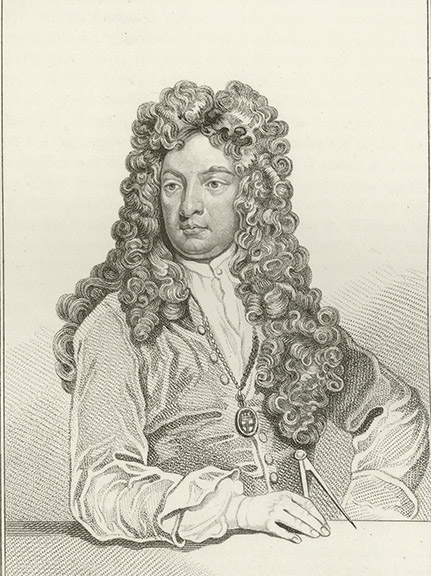
from Godfrey Kneller’s 1733 portrait.
Image via Look And Learn / Elgar Collection / Bridgeman Images
On his release Vanbrugh risked it all again, joining an Anglo-Dutch fleet that in 1694 attempted to take the French naval stronghold at Brest. The result was a disaster: the allied fleet was routed; Lord Carmarthen fired on his own fleeing sailors; and the ships headed for home, slowing only to bombard Dieppe, Le Havre, Dunkirk and, no doubt to Vanbrugh’s satisfaction, Calais on the way.
The derring-do that had characterised his endeavours so far was in evidence again when he turned to playwriting. In 1696 he went to see Love’s Last Shift by Colley Cibber at the Drury Lane Theatre and decided that he could do better. He wrote his response, The Relapse, in just six weeks. The play was performed the same year and then, on the back of its success, he retrieved The Provoked Wife, the work he may have written while in a French jail.
Vanbrugh’s plays were essentially tragicomedies characterised by sexual frankness and a critique of loveless marriage. Peopled by fops, rakes and put-upon women, his dialogue is rich with wit and the vernacular; this was the stage equivalent of Hogarth’s paintings. The mixture proved too much for one high-minded critic, Jeremy Collier, who censured Vanbrugh in A Short View of the Immorality and Profaneness of the English Stage (1698). The playwright responded with A Short Vindication, in which he accused the po-faced Collier – a cleric and unrepentant supporter of James II – of adopting the lofty position of “gown” versus the “town”, with all its moral irregularities, that was represented in the plays. He only bothered to respond, he said, because of “some people whose temporal interest engages ’em in the squabble, and the natural propensity of others to be fond of any thing that’s abusive”.
As if to show how unconcerned he was, he wrote four more plays. Nevertheless, the fuss – and the encouragement of his Whig friends in the Kit-Cat Club, importantly the Earl of Carlisle and the Duke of Marlborough among them – may have prompted him to turn to architecture. As Jonathan Swift wrote: “Van’s genius, without thought or lecture,/Is hugely turn’d to architecture.”
There is no record that Vanbrugh had any formal architectural training, so his first commission – from Carlisle to build a huge Yorkshire country house, Castle Howard – was an extraordinary leap of faith for both patron and designer. Vanbrugh came up with an imposing central block capped with a dome and flanked by two symmetrical wings, enfolding a courtyard on one side and offering a flat perspective on the other. To translate his ideas into stone he enlisted the help of Hawksmoor, an accomplished technician and draftsman who brought with him the lessons he had learned while working with Wren. Construction began in 1699.
The building that emerged mixes classical detail – columns, pilasters and pediments – with baroque flourishes, from the dome to a skyline punctuated with vases and statues (a profile Vanbrugh may have encountered in France at Versailles). The result is a façade some 600ft long without a dull inch.
A greater test came with the commission to build Blenheim Palace, a gift from a grateful nation to the Duke of Marlborough, the man who had defeated the French in a series of gory battles during the War of the Spanish Succession. The project was enormous and plagued by financial problems, with the Crown withdrawing support when the Queen and the Duchess of Marlborough fell out. The Duchess had initially wanted Wren as architect and never took to Vanbrugh; design and construction inched ahead against a background of caustic enmity.
At heart there was a difference in their understandings of what the building should be: home or monument. Vanbrugh was convinced it should be the latter and designed a structure accordingly: “This building, tho’ ordered to be a dwelling house for the Duke of Marlborough and his posterity, is at the same time by all the world esteemed or looked on as a publick edifice,” he reminded the seething Duchess, “raised for a monument of the Queen’s glory through his great services.”
Hence he eschewed the rhythmic character of Castle Howard and made Blenheim overwhelming: the portico overlooking a deeply recessed courtyard; a massing of unrusticated stone; Brobdingnagian columns; and minimal curves. Flanking blocks act like theatre curtains pulled back to reveal the main house; the external forms jut and recede, creating crisp shadows on the stone, while what Vanbrugh termed a “castle air” was imparted by square corner turrets. The overall impression was intended to convey strength and power. To make the point, a 30-tonne marble bust of Marlborough’s defeated enemy, Louis XIV, was raised above the garden portico to look down for eternity on his conqueror’s spoils. The interiors, too, were meant to awe – the eye drawn through the cathedral-height entrance hall to an oversized proscenium arch leading to the private rooms.
It was not what the Duchess wanted and, in 1718, when she sued him, Vanbrugh complained that she intended to “throw me into an English Bastille, to finish my days as I began them, in a French one”. The falling-out was unbridgeable: when Vanbrugh and his wife attempted to visit the palace in 1725, the vengeful Duchess refused them entrance even to the park. It was the sheer visual weight of Blenheim that led to the posthumous satirical epitaph dreamed up by the epigrammatist and Oxford wit Dr Abel Evans: “Lie heavy on him, Earth, for he/Laid many a heavy load on thee.” Vanbrugh’s willingness to ignore the propriety of classical architecture was condemned elsewhere. When Voltaire visited Blenheim in 1727 he wrote that he thought it “a great mass of stone with neither charm nor taste”.
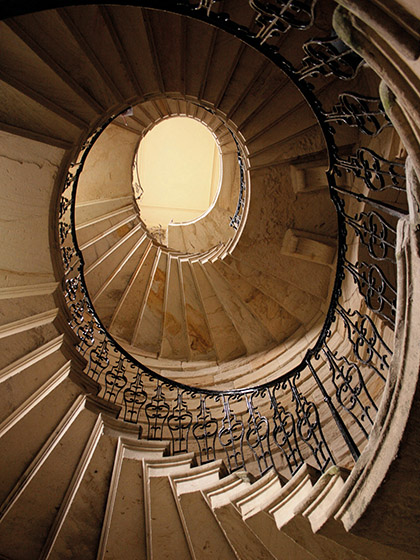
Image via Bridgeman Images
Where Blenheim revealed something of Vanbrugh’s autobiography was in its theatricality and its visual memories of his incarceration in the Château de Vincennes and the Bastille: indeed, he called the Scottish-style castle house he built for himself in Greenwich “The Bastille”. The prison associations were even more striking in Seaton Delaval Hall, the house north of Newcastle upon Tyne that he designed for another Whig politician, Admiral George Delaval, in 1718 (although Vanbrugh’s Whig friends might have been less than enamoured of his plan to fund paving, drainage and a sewer system for Westminster by taxing gentlemen’s coaches). It is a building straight out of a Piranesi print – squat and uncompromising, with an almost childlike massing of projecting parts and a Gothic evocativeness. That it was one of his few buildings made without Hawksmoor’s input perhaps helps account for its eccentricity. Seaton Delaval, a stronghold as much as a home, also offers proof of Francis Bacon’s observation that “there is no excellent beauty that hath not some strangeness in the proportion”, even though its beauty is an acquired taste.
Vanbrugh’s “mixed style” – a touch of Palladian classicism, baroque drama, Elizabethan innovation (John Smythson’s Hardwick Hall of 1590, the “prodigy house” he built for Bess of Hardwick, is a spiritual ancestor), lively skylines and distinctive silhouettes, and personal motifs – did not find favour with everyone. When he built another house for himself (now destroyed) in Whitehall in 1701, using stones from the royal palace that had burned down in 1698, Jonathan Swift dismissed it as a “thing resembling a goose py”: a dish made not just of goose but also chicken, tongue and sometimes forcemeat balls – in other words, a bit of everything.
To appreciate how outlandish, and even inelegant, Vanbrugh’s designs appeared to some of his contemporaries, one need only look at the work of peers such as Colen Campbell (1676-1729), the author of Vitruvius Britannicus, the bible of nascent Palladianism, and James Gibbs (1682-1754), whose St Martin-in-the-Fields overlooking Trafalgar Square represents the more restrained and classically “correct” strand of 18th-century architecture.
What remains less than clear is Hawksmoor’s role in bringing the inventions of the brilliant dilettante Vanbrugh to fruition. He was, after all, the man who made the first drawings for Castle Howard and who finished Blenheim. He had the technical know-how Vanbrugh lacked and was clearly much more than simply a high-end draughtsman. Theirs was a mutually supportive and complementary arrangement: Hawksmoor’s interest, despite never leaving England, lay in classical Roman architecture rather than Vanbrugh’s stylistic hodgepodge. But it was Vanbrugh who had the better contact book: as an independent architect, Hawksmoor had no new commissions between 1704 and 1711, so collaboration was a necessity. Nevertheless, Hawksmoor approved of his senior colleague’s sprightly imagination. Discussing Vanbrugh’s designs for a garden building at Castle Howard, he commended the proposals as being “well and founded upon ye rules of ye ancients. I mean by that upon strong reason and good fancy, joyn’d with experience and tryalls.” Vanbrugh, meanwhile, thought Hawksmoor a man of “fine, ingenious parts”.
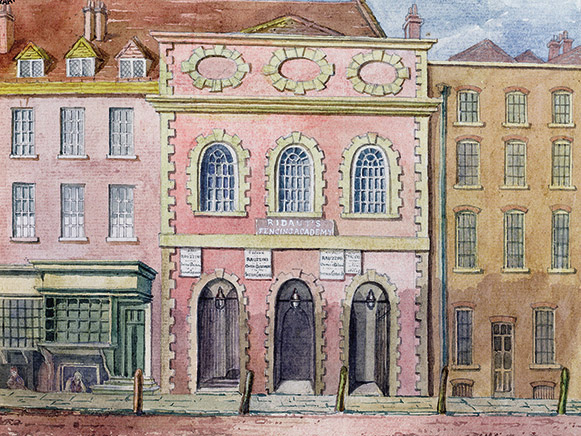
Image via Alamy
The honours, however, fell Vanbrugh’s way. In 1702, Whig influence was again at work (Swift’s description of the party was similar to his dismissal of Vanbrugh’s architecture: an entity “patch’d up of heterogeneous inconsistent parts”) when his friend the Earl of Carlisle finessed his appointment as comptroller of the King’s works, and the following year as Carlisle Herald at the College of Arms. At this point, Vanbrugh was still writing plays and running, albeit not too profitably (although, contrary to the customs of the time, he was always scrupulous in paying his actors and his builders promptly), his own playhouse, the Queen’s Theatre on Haymarket. These achievements were furthered in 1714, when Queen Anne died and was succeeded by George I; Vanbrugh was the first person the king knighted. The honour recognised the role he played in English life – both as one of the men who had secured the Protestant succession and, despite his plays and buildings dividing public opinion, as an inarguably dominant cultural figure.
After Vanbrugh’s death, later architects came to appreciate his innovations more fully. John Soane described him as “the Shakespeare of Architects”, with “all the fire and power of Michael Angelo and Bernini”. Robert Adam lauded his sense of “movement”. The art grandee Joshua Reynolds believed that Vanbrugh was “an Architect who composed like a Painter” – composed being the key word – and that in his buildings “there is a greater display of imagination than we shall find perhaps in any other”. Ironically perhaps, given his unhappy if educative time in the country, it was two French Enlightenment architects, Étienne-Louis Boullée and Claude-Nicolas Ledoux, who drew the greatest inspiration from Vanbrugh’s grouping of weighty geometrical forms and designed a series of visionary buildings – few of which, in Boullée’s case, were actually built – that took his sense of theatricality to radical new extremes.
In his play The Relapse (1696), Vanbrugh, who died at 62, wrote: “Thinking is to me the greatest fatigue in the world.” Even though he sometimes came across as a gentleman amateur, he had earned his fatigue: he was a man whose thinking went wider and deeper than that of most of his contemporaries and, moreover, who left something imperishable to show for it.
Vanbrugh events can be found at vanbrugh300.co.uk
[Further reading: In the moment, at night, with Keith Jarrett]
Content from our partners



Related



This article appears in the 25 Mar 2026 issue of the New Statesman, Easter Special
Join the debate
Subscribe here to comment