
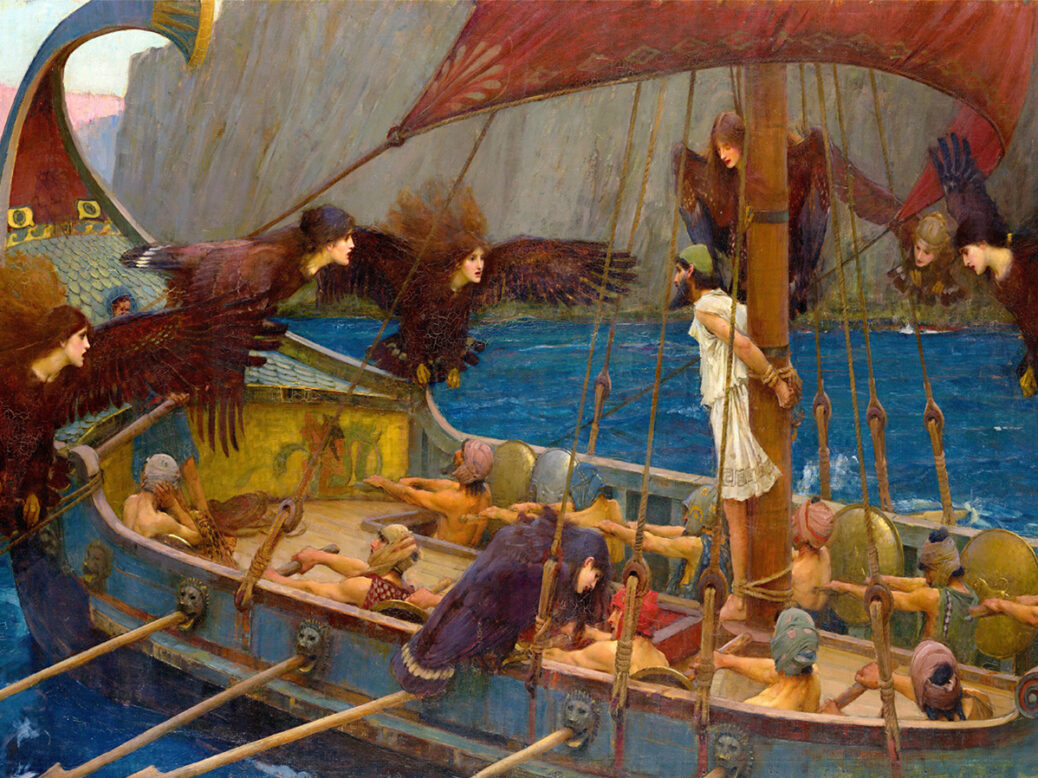
Daniel Mendelsohn is a literary polymath; he writes memoirs, monographs, literary and film criticism, edits the New York Review of Books (at large) and translates poetry both modern – three volumes of Cavafy – and now ancient, since his rendering of the Odyssey was recently published in the UK for Penguin Classics. It will probably be the authoritative translation for years to come.
An American who teaches at Bard College in New York, he is the opposite of the stuffy ivory tower classical scholars this country has traditionally produced, regularly trending on X with his surprising threads on how to translate Homeric epithets. He is probably the only translator of the Odyssey you might want to send to review a Spider-Man musical (as the NYRB has done). But he’s also the sober author of one of the most moving books about the Holocaust yet written, The Lost: A Search for Six of Six Million (2006), which won a panoply of awards. His writing combines levity and moral seriousness as well as a deep erudition of the classical tradition in which he was trained and the modern tradition in which he is steeped.
As we prepare for Christopher Nolan’s blockbuster, I spoke to Daniel for the New Society Podcast about everything anyone needs to know about Homer’s Odyssey. Who really wrote it, when, and why does it represent the foundation of Western literature as well as its most potent and generative inspiration in the modern world? This is an extract from our conversation, edited for clarity.
Tanjil Rashid: I suppose we should start at the beginning, and I don’t mean the beginning of the Odyssey, but supposedly literature itself – some would say Western literature. Why is it, alongside the Iliad, the foundational classic of Western literature?

Daniel Mendelsohn: We start, as it were, with a bang, two of the most dense, complex, and perfect literary works. That’s unusual, though we don’t of course have the rough draft so to speak. They stand at the beginning of the tradition and have a kind of authority as the progenitors of Western literature, or at least the Greco-Roman half of that DNA, because between them, they cover everything.
The Iliad is about a confrontation with mortality. It is ultimately about what it means to be a human person who has to die at some point. That’s the great struggle Achilles has to deal with. And the Odyssey is about homecoming. It’s about identity. It’s about marriages. And it has a more or less happy ending. So the Iliad seems to be the progenitor of all tragedy, in a sense, and the Odyssey is a kind of blueprint for all comedy.
So the Iliad is about death, and the Odyssey is about life, and apart from life and death, what else is there? They’ve got it covered.
Yeah.
In what sense are they really the first in the classical tradition? Borges was of the view that there were other texts just as great that that didn’t make it. Or perhaps the fact that they were great had something to do with why they were preserved and transmitted. What do you think?
The Odyssey and the Iliad were part of an entire cycle of epics that treated everything that had to do with the Trojan War, basically. But I’m not so sure that they were just lucky. We do have evidence that some of these other epics were not so great. Aristotle talks about some of them in his Poetics and has a very dim opinion of them. I’m always the first person to be reminding people that when we talk about “classical literature”, we’re actually talking about a fragment of what there was. But what is so interesting in the case of our literature is that these two incredibly major works, very sophisticated in structure and detail, emerge fully grown from the head of Western culture at the very beginning.
And who wrote the Odyssey? You know, the “Homeric question”. What’s your view on this?
The texts were produced by oral transmission, in other words oral storytelling in verse form, and with each successive generation, different poet-performers would add and elaborate, and the texts got bigger and bigger. At some point, somebody wrote them down. The Odyssey is 12,110 lines. There’s no way you can just recite all of that.
There’s a great controversy about when they were written down. Some people think it was about 500 BCE. Some people think it was much later. We can’t agree. But most scholars don’t believe that there was a person called Homer who sat down at his laptop one day and said, “Oh, I’m gonna write this 15,000-word poem about Troy.” “Homer” is a sort of shorthand for the entire process that produced these works.
Now, it’s very possible whoever was the person who collated the existing versions and wrapped them into a nice package with a nice bow on top, who gave it its very elaborate and highly structured shape, maybe that’s “Homer”.
One of the ways in which it evolved was through this bardic tradition, composed, as Milman Parry famously discovered, through improvised performances.
There are features of the Homeric poems, which suggest that they were composed in performance. Anyone who picks up virtually any translation of the Odyssey will see that there are verbatim repetitions quite frequently throughout the text. Lines are repeated, epithets are repeated, whole scenes are repeated. Every time you sit down to dinner in the Odyssey, it’s the same five lines.
An American scholar in the 1920s and 30s called Milman Parry was studying bards who were still living in Yugoslavia. There’s a tradition there of heroic epics; people would recite them, and Parry could see that they were improvising during the performance. And this gave him the idea that maybe these funny features of the Iliad and the Odyssey are traces of a tradition in which you were you were creating new poetry as you were reciting. So these formulaic passages were sort of placeholders while you’re working out the story in your head while you’re in the bar performing for the audience.
You’re buying time, basically.
Basically. It’s a way of having something to revert to. That has become the dominant theory. It does account for a lot of elements of the Iliad and the Odyssey that don’t make sense if they were written down from the start. There is no reason to repeat things verbatim so often.
It’s amazing to go to somewhere like Macedonia or Albania, where the Odyssey was recited millennia ago, and then find the living inheritors of Homer, basically doing the same thing. It seems almost too fanciful in a way?
I would say, think of it an oral version of Wikipedia. You start out with this kernel, and then people start adding on and enhancing and correcting and revising and then putting new things in. Also, remember that we’re talking about an era in which memory was very different from now. You are in a preliterate culture; memory functions in a much more important way than it does for us today.
If, say, you’re a singer-performer, a Homer-like person, and you have an apprentice, and you’re telling him, how to do this, you’re giving him big chunks of memorized material. Then maybe when that apprentice grows up, he takes that, but he decides that, you know, the Cyclops episode needs a little more drama. So he puts in 15 new lines, and that’s how it happened. One could imagine in a rough way how this happened.
When was all this happening?
The culture that is depicted in the Iliad and the Odyssey is not the culture that produced them. The culture that is depicted in these poems is Bronze Age Greek culture, what we call the “palace cultures” that spread throughout the Mediterranean. We’re talking about a culture, a civilization that came, it looks like, to a pretty abrupt end around the year 1180 BCE. And people theorize about why. There could have been natural disasters. It seems to have ended quite suddenly. But they were sophisticated cultures with extraordinary artistic achievements. They were military cultures. They had thriving economies, and they left incredible material remains.
They liked to bathe a lot, didn’t they?
They did like to bathe a lot! And so what followed for about, say, 400 years was a period we used to call the Dark Ages of Greece, where there was a significant economic collapse, diminished cultural life, very little building. And out of the ashes of that culture – so now we’re talking about 800 BC – what we call Archaic Greece, arose. That culture is looking back on this fabulous Mycenaean palace culture. There are traces of it, and they are idealising what these fantastic people must have been like with their incredible armour and their beautiful palaces.
What were they fantasising about and why?
Any homecoming story is irresistible because we all have homes and we all want to get there. Every adventure story is irresistible because even though we like to have a comfortable home, we also like to have a little adventure in our lives. It’s why we go on exotic vacations. The DNA of the story is irresistible to a good storyteller. It combines two of the things that are most important to us as human beings: the meaning of home and the allure of adventure. And then you start inventing what these adventures could have looked like. It gets a little fantastical. It gets a little science fiction, there are witches, ogres. Then they become more literary. There’s more complexity.
The Odyssey falls into two giant chunks. It consists of 24 books or chapters. The first 12 are about the adventures. At the beginning of the 13th, which is exactly dead in the middle, he finally does get home, and then he has another series of adventures because he has to reclaim the wife, the child, the family, and the land that he left.
But why do you think at that point the Greeks decided to devote such imaginative energy to the idea of home?
It is a period in the historical evolution of Greece where two things are happening. There is a lot of what we call colonisation. So Greece is not a rich country in terms of farming. It’s very rocky, it’s very mountainous. So towns would become overcrowded, and they would send out what we call colonists. A leader would gather a few families, and they would go in search of a new island to help with the population problem back at home. So Greeks are moving outwards. They’re starting to explore.
That’s one background. The other is the Phoenicians, who are great traders. They’re sailing at around the same period. They’re sailing all over the Mediterranean. There’s a lot of economic exchange. The Greeks get involved with that. There’s a fascination with new lands, new places. In the Odyssey, many oadventures involve the hero encountering strange new civilizations.
We do have literature that’s older than the Odyssey. Among them the epic of Gilgamesh from Sumeria and the tale of Sinuhe from Egypt. Both centre on a protagonist who leaves his homeland and undergoes a transformative journey, encountering and living among foreign peoples and lands. They experience a sort of existential anxiety, and the nostalgia to return home. What’s going on in the ancient world that the oldest literature seems to have the same form and content?
I would say the answer to that is that all human experience is the same. Gilgamesh is clearly a blueprint for the Iliad, more so than the Odyssey. It’s about a hero learning about his heroic gifts, but also confronting mortality, initially through the death of a beloved friend, right?
The Odyssey is also such a profound and formative text for the modern mind. Why?
I’m both glad and terrified that you asked that because I’ve puzzled my whole life over the fact that the Odyssey has been very generative. It has produced whole genres. I already mentioned science fiction, fantasy, one could also say the rom-com in a way, the hero and heroine separated by all these obstacles, having to find a way to get back together. But the Iliad hasn’t!
I think it’s partly because the figure of a lone wanderer at loose in an unfamiliar landscape, in a post-war world where none of the old rules apply, trying to find his way, is a proto-modernist figure. I don’t think there’s any question. And that loner trying to make sense of things for himself is an essential modernist character from Joyce to Kafka. That is one of the reasons the Odyssey always feels current in a way that the Iliad doesn’t.
Listen to this conversation in full on The New Society podcast.
[Further reading: The Odyssey is more Hollywood than Homeric]
Content from our partners



Related


Join the debate
Subscribe here to commentBritish and Canadian fans of the Odyssey might enjoy Fortunate Son: A 20th Century Romance. It is a tale of idealized love and remarkable events.
Orphaned in infancy, Frederick Hunter Wilkinson was raised by the Barnardo’s charity in England and sent to Canada at age nine in 1899. He apprenticed as a blacksmith and enlisted with the Canadian Field Artillery in World War I. After the war, Fred married his soulmate Vera and settled in Uxbridge, Ontario, to raise seven children during the Roaring Twenties, the Great Depression, and the tumultuous decade of the 1940s.