
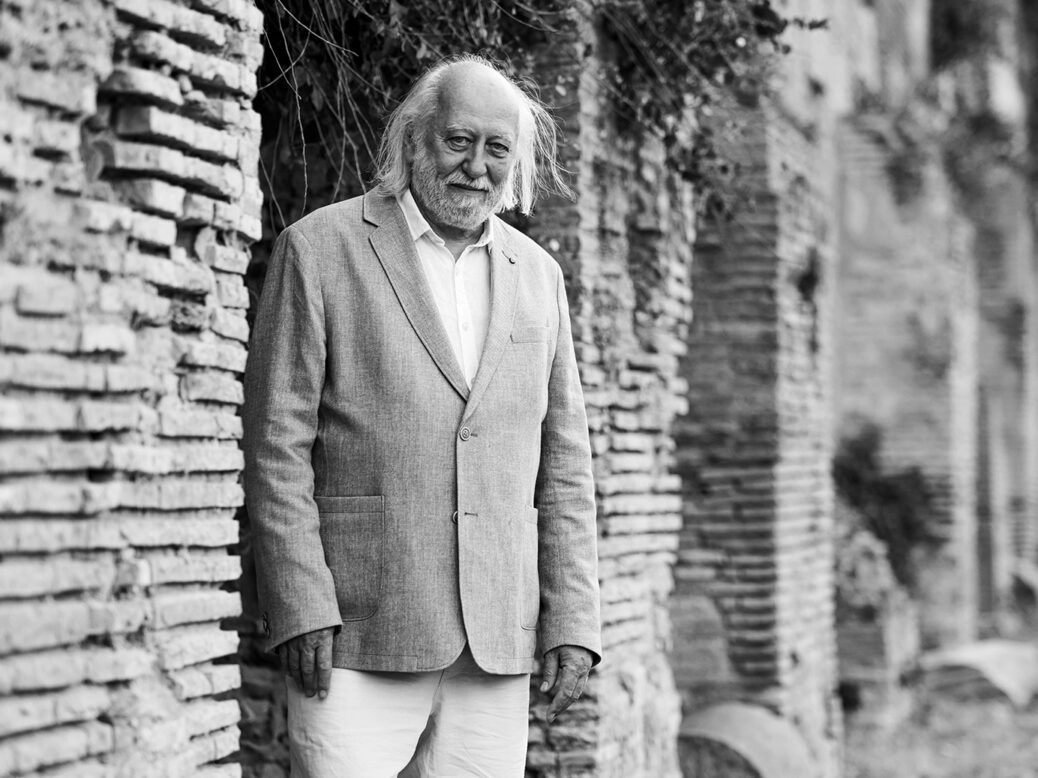
The Hungarian novelist László Krasznahorkai, who has been awarded the Nobel Prize in Literature, came to attention via an unusual route – as a screenwriter. There have been previous Nobel winners with notable film credits, for example Harold Pinter, like Krasznahorkai an heir to Samuel Beckett, who was responsible for some of the most prominent British films of the 1960s and 1970s, all of them directed by Joseph Losey. What differentiates Krasznahorkai is that his sideline didn’t simply attract publicity for his literary output. It was inextricably linked. Pinter adapted novels by Hardy, LP Hartley and Nicholas Mosley, as well as writing unproduced versions of work by a pair of notable non-recipients of the Nobel Prize, Joseph Conrad and Marcel Proust. But the most substantial films that Krasznahorkai wrote for his compatriot, the director Béla Tarr, were adaptations of his own first two novels, still perhaps his most accomplished and admired: Sátántangó, published in 1985, filmed in 1994, and The Melancholy of Resistance (1989), which became Werckmeister Harmonies (2000).
Krasznahorkai, who is 71, emerged at a time of notable vitality for Hungarian prose, in the work of writers like Péter Nádas, the London-based Victor Határ, Péter Esterházy, Adam Bodor, Péter Lengyel, and the older Imre Kertész, the country’s only previous Nobel laureate. But Tarr’s is the name with which Krasznahorkai is most strongly associated. During the 1990s, a time when American cultural hegemony prompted a fervent internationalism among cinephiles, the unyielding, darkly funny, deeply stirring and disquieting films that Krasznahorkai and Tarr did together became a cultural touchstone, along with directors such as the Russian Aleksandr Sokurov, the Iranian Abbas Kiarostami, and the Taiwanese Edward Yang, Tsai Ming-liang and Hou Hsiao-hsien.
Sátántangó, which concerns a demonic visitor to a run-down village, remains a favourite, despite its daunting length. A recent retrospective of Tarr’s films at the British Film Institute in London included a late-night – therefore all-night – screening at the IMAX. It was an unlikely moment of arrival or vindication, the masterpiece of the film movement known as Slow Cinema being projected on a vast screen that usually displays footage of swelling fireballs and underwater fauna. But for some, this was the only way to appreciate a seven-hour film, with a structure based on the steps of the tango, and uninterrupted takes of enigmatic dialogue, trudging across fields, and frenzied dancing. Either way, it was reflective of the impact and appeal of Krasznahorkai’s imaginative world, its extreme inverted charm.
But while Krasznahorkai is not an example of an unknown Nobel winner, his work did not appear in English until 1998, when the poet George Szirtes translated The Melancholy of Resistance, which portrays the visit of a circus to a strange town, among other things. It received praise from WG Sebald and Susan Sontag, who called him a “master of apocalypse”. That concept comes up again and again in responses to Krasznahorkai’s fiction. The Nobel committee, obliged each year to summarise the winner’s body of work in a way that explains or at least asserts its Nobel-worthiness, stated that it was recognising Krasznahorkai’s affirmation of the power of art “in the midst of apocalyptic terror”. Other Krasznahorkai keywords (hardly unrelated) are “visionary” and “obsessive”. Also, in reference to Krasznahorkai’s dour subject matter and long – sometimes book-length – sentences: difficult, challenging, prickly, modernist. Szirtes, one of two English translators, along with Ottilie Mulzet, has evoked “a vast black river of type”. The opening of Sátántangó exhibits many of his central characteristics (strange phenomena, negatives, parentheses, dismal weather, aversion to the comma):

“One morning near the end of October not long before the first drops of the mercilessly long autumn rains began to fall on the cracked and saline soil on the western side of the estate (later the stinking yellow sea of mud would render footpaths impassable and put the town too beyond reach) Futaki woke to hear bells. The closest possible source was a lonely chapel about four kilometres southwest on the old Hochmeiss estate but not only did that have no bell but the tower had collapsed during the war…”
By chance, the growth of Krasznahorkai’s reputation as a novelist outside Hungary and other parts of Europe coincided with the end of his partnership with Béla Tarr, who retired in 2011. Their last film together was The Turin Horse, which takes as a starting-point the horse-whipping incident that sent the philosopher Nietzsche into a frenzy from which he never recovered, and then shows us what happened to the animal. A short book which Krasznahorkai did with another collaborator, the painter Max Neumann, Animalinside, appeared in English a few months after The Turin Horse premiered at the Berlin Film Festival, and prompted an appreciative essay by James Wood, who emphasised the power of another novel available in translation, War and War (1999). Sátántangó finally appeared in English in 2012, and instantly elevated him from the status of insider’s favourite (a class of writer often associated with a Sontag cover puff). In 2015, he was awarded the Man Booker International Prize, a kind of mini-Nobel, given to a body of work by a fiction writer in any language. In the period since, his novels Seiobo There Below and Baron Wenckheim’s Homecoming have won prizes for translated literature, and his stories have appeared in English-language magazines.
There has been no Krasznahorkai backlash, as sometimes happens with translated writers who appear as if from nowhere and are treated as obligatory reading (for example, Sebald, admittedly a more pervasive presence). The only stirrings of discontent were heard earlier this year with a review by Federico Perelmuter in the Los Angeles Review of Books of Krasznahorkai’s latest novel Herscht 07769 appeared under the headline “Against high brodernism”. It was an argument about taste or critical instinct, an elitist version of herd thinking. (I did know an disproportionate number of people at a screening of Sátántangó I attended at the Institute of Contemporary Arts.) But Krasznahorkai wasn’t simply caught in the crossfire. Herscht 07769, in which a troubled orphan writes endlessly to Angela Merkel – the title is his return address – was described in passing as a novel that “does not have much to offer”.
But then this Nobel, like many before it, has been awarded on the strengths of the writer’s early, not his recent, work – and for the uniformity of vision and approach. Variations in quality are by the by. Krasznahorkai never seemed at risk of being a merely temporary vogue, and now his renown has been given an extra few layers of insulation.
[Further reading: English literature’s last stand]
Content from our partners



Related


Join the debate
Subscribe here to comment