
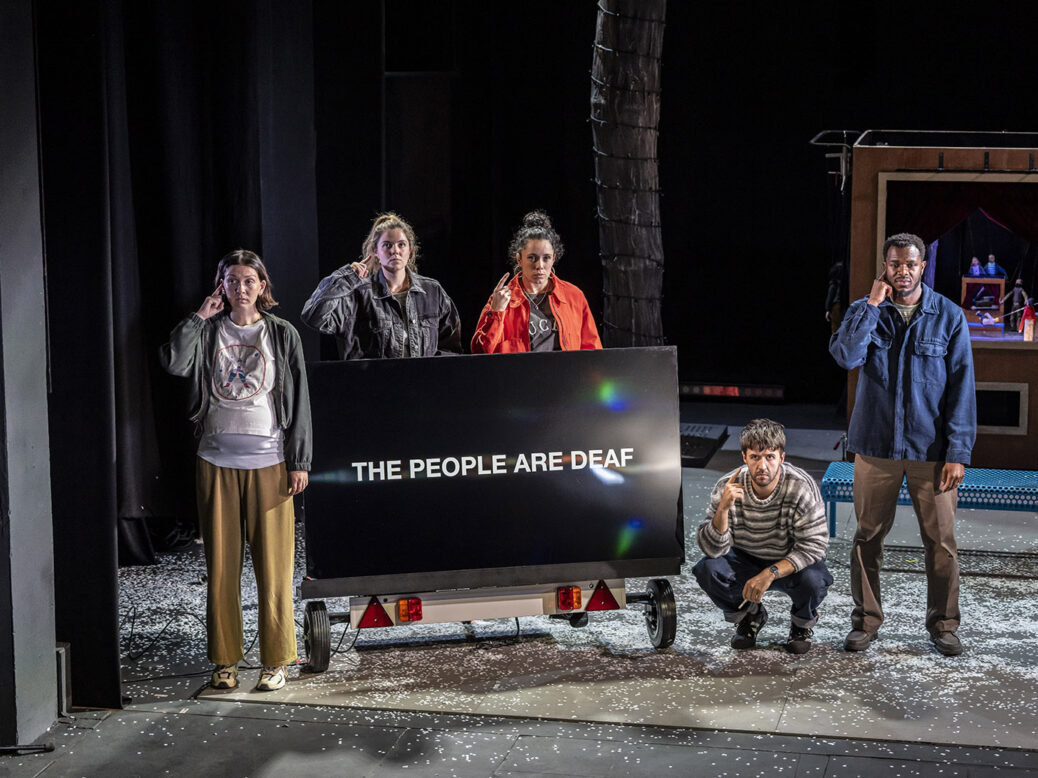
Behind the heavy wooden doors of a former 19th-century whiskey distillery in the Liberties in Dublin, rehearsals for a theatre adaption of the Ukrainian poet Ilya Kaminsky’s 2019 award-winning collection, Deaf Republic, have begun. The actors congregate in the brightly-lit warehouse-turned-performing space after their break, all wearing comfortable clothing, some opting to go shoeless. Bush Moukarzel, the co-writer and director, signals the start of the run-through of a distinctive production combining spoken English, British Sign Language (BSL), and visual vernacular that will open at the Royal Court Theatre, London, today (29 August).
In an enemy-occupied fictional town of Vasenka, a deaf boy named Petya loses his life at the hands of a soldier for disobeying orders he couldn’t hear. The next morning the country wakes up and, “in the name of Petya”, refuses to hear the occupying troops. Whether the citizens have gone deaf or have simply chosen not to hear is left to interpretation. But now that they cannot hear, the people also cannot speak, so they fashion a new means of communication – through signs.
Dead Centre, an award-winning theatre company based between Dublin and London, is no stranger to adapting works “that don’t lend themselves to an adaptation so readily”, as Moukarzel told me in one of the office spaces upstairs off the distillery’s winding, white-painted corridors. Both Moukarzel and his co-writer Ben Kidd have previously adapted Sigmund Freud’s Interpretation of Dreams and the Nobel laureate Olga Tokarczuk’s Flights. But Kaminsky’s book of poems is different: it uses theatrical language has a list of dramatis personae on the opening page of the book and uses puppet theatre as a form of protest.
The first practical workshops for the performance began in February 2022, mere weeks before Russia invaded Ukraine. Moukarzel recalls the “strange experience of starting to plan this production before the full-scale invasion” and how they “had an added responsibility of catching up with the world”. As Kidd explains, that meant becoming more sensitive to what was happening in Ukraine and becoming “more aware of Ilya and his presence… the Ukrainian community, Ukrainian artists, Ukrainians in general”. Although Kaminsky’s poems and in turn the theatre adaptation are set in a fictional town to make the experience of the townspeople more universal, I could not help but notice Cyrillic lining the walls of the rehearsal space – “Васенька” for Vasenka, “Мама Галя” for Momma Galya – and even the “Курение убивает” (smoking kills) sticker on the packet of cigarettes carried by the actor playing Alfonso Barabinski. Although those are Russian words, not Ukrainian, the reference is easy to pick up.

Kidd and Mourkazel were joined by Zoë McWhinney, a deaf actor and BSL consultant, in 2024. She works with the actors to make the silent parts of the conversations accessible not only to deaf viewers, but also those who do not know sign language. She told me that the fingerspelling between actors on stage is borrowed from Ukrainian Sign Language, not Russian – a nod to a means of resistance. When the performance returns to Ireland for the Dublin Theatre Festival from 2 October, the main signing will switch to Irish Sign Language, but the fingerspelling will remain Ukrainian-inspired. Even so, McWhinney tells me, there are “so many equivalents when it comes to [Deaf Republic]”, referencing Gaza, Congo and Sudan.
On the surface Kaminsky’s poems are about resistance and taking a stance. Even during a half-spoken, half-signed conversation between two characters about how to communicate through signing there’s a level of implied resistance as one of them explains: “You can’t just be a passive observer. You have to take a position” (the BSL-visual vernacular mix is explained by captions projected on a screen behind them). But Moukarzel brings my attention to “the other side of the poem, which is celebration and the amplification of tenderness”. Kidd points out that there is “another power trying to destroy the people of Vasenka, to dehumanise them, to stop them from loving each other”. To him Deaf Republic is about solidarity, how to create a community, and the honouring of life.
“Are you really going to run around and play being an Eastern European and a person from the USSR, or what?” Kaminsky asked himself while writing his first book of poems, Dancing in Odessa. Kaminsky was born there in 1977 while it was still part of the Soviet Union. In 1993, he and his family was granted asylum to live in the United States due to the growing anti-Semitism in Ukraine in the post-Soviet period. Like Petya, he found himself functionally deaf: “I grew up hard of hearing in the USSR meaning I did not have hearing aids,” he tells me over video call from his home in New Jersey a week after the play’s rehearsal in Dublin. Growing up he was forced to lip read.
Kaminsky began writing poetry as a teenager. The critically acclaimed Dancing in Odessa, published in 2004, “was very much an Eastern European book, looking to the writers of that tradition,” he says. There are 15 years between the publication of Dancing in Odessa and Deaf Republic but Kaminsky began working on his second book of poems in 2006, right after he moved to San Diego and witnessed violence that wasn’t as well documented then as it is now. The poems’ geographical and ideological split between America, “in the street of money in the city of money in the country of money” where “we (forgive us)/ lived happily during the war” and the Eastern European-inspired Vasenka is perceptible.
When I ask about any autobiographical elements, he confirms that “there are some real stories that very much impacted the book”, though not in a documentary kind of way, “but more in a way of images”. His grandfather was executed as the “enemy of the people” under Stalin and his grandmother was sent to Siberia for ten years simply for being his wife. Their son, Kaminsky’s father, “was a stolen baby”: somebody took him in because he was too young to survive in the orphanage.
The puppet show that is central to the poems and the theatre adaptation was inspired by his grandmother’s experience in the labour camps in Siberia. She lived in barracks with only women, usually the mothers, sisters or wives of those who were designated “enemies of the state”. On public holidays they would get extra rations of bread and some new clothes in sacks. They would then put two bunks together to form a stage and make a head for the puppet from the sack and use the bread to make eyes and a nose. “They had puppet shows in their rooms and when the soldiers came by, they put those puppets in their pockets,” Kaminsky explains, “When somebody died, they put a puppet on that person’s bed, as a way to mourn, you know.”
Kaminsky didn’t write the poems with the intention of having them developed into a theatre production. Not only was he inspired by his grandmother’s story but also by Karel Čapek, the Czech writer who was banned from writing by the Nazis and in turn used finger puppets to tell stories to those around him. Similarly, during the demonstrations in Seattle against the Iraq War, protesters used puppets in a public theatre of protest. Time and again, art has been a tool of resistance.
When I ask Kaminsky about his thoughts on the importance of art and poetry during the war in Ukraine he replies that “in a number of times [that I have been in a bomb shelter in Ukraine] I have seen people sing together or recite poems to each other. It’s that music of language in your body.” He also shares a story of his friend, a literary translator in Kyiv, who ended up translating poetry with children in a bomb shelter to distract them. “That to me was a pure example of why culture matters. If a bunch of children got peace in a city that has been bombed for however long, yeah, art matters.”
Kaminsky has translated Ukrainian poems for an anthology, In the Hour of War, which was published in 2023. He is also a contributor towards Poems Not Bombs, an organisation based in Odesa to help support children’s curiosity and creativity where they learn to write and read poetry as they hide in bomb shelters.
The meaning of his poems did not shift for Kaminsky with the outbreak of the war in Ukraine: as for many other Ukrainians, the war has been going on since 2014 (they call the current struggle “the Big War”). “I was so ready not to be in that world of Deaf Republic anymore,” he says with a sad laugh, “I was really happy to write other poems. When it started in 2022, I was like, ‘Oh shit, I have to stay in this world for longer.’” Now, he is considering writing a sequel.
As Moukarzel pointed out to me a week earlier, Kaminsky’s Deaf Republic serves as a protest against occupation as well as a celebration of community and life. “I go to Ukraine now about twice a year and it’s not unusual to hear from somebody, and not even in an angry way, but more in a resigned way, such a quote: ‘We are reality TV for the West,’” he says.
“In the West, as we see news about places of conflict, we usually see horror, horror and horror. You get a street of bombed buildings or a crying mother,” Kaminsky continues. “But it is a kind of one-sided truth.” He describes how in Ukraine he sees young people lining outside the town hall – due to wartime restrictions on how many people can be in a building at one time – with flowers, waiting to get married. “The Western news viewer gets numb in five minutes. In five minutes, all the deaths seem the same and there is no difference between two deaths or 102 deaths. We really need to be a little bit more open about not just how people are being violated, but how they survive.”
As with his poems, Kaminsky draws a distinct line between Western and Eastern Europe. “They’re different parts of Europe and it requires a little more attention and a little more studying of history to really understand what was happening in Eastern Europe”. When I ask about what some call the “decolonisation” of Ukraine, referencing the cultural derussification movement that began after the dissolution of the Soviet Union, Kaminsky appears hesitant, preferring to call it an “anti-imperial movement”. “Sure, you can say colonisation is the same everywhere, but then there are so many people’s stories that you would just sweep under the rug. Because they are so different. How do you deal with people living in Lviv at the same time as Ukraine was colonised by Russia, and yet Ukraine gathered Polish cities? Try to explain that sort of colonisation to your typical western professor.”
Kaminsky highlights how multilingual and multinational Ukraine is with a turbulent history of “different kinds of colonisations”, be they Austro-Hungarian or Russian. “There are many cities in Ukraine that were built by the Russian Empire and in that regard, it would be strange to call them colonised if they were actually built,” he explains, “I respect the slogan [of decolonisation], but I would try to spend a little more time on it because all slogans do is pretend that we can understand everything very quickly. That’s not a reality in Eastern Europe.”
Speaking directly about Russia’s war on Ukraine, Kaminsky emphasises the irony of Putin’s propaganda justifying the invasion as: “in defence of the Russian language in Ukraine. But most cities that got truly horrifically bombed were all majorly Russian speaking cities. Cities like Mykolaiv, like Mariupol, all of the Donbas area.” The idea of nonsensical propaganda can be seen in both the book of poems and the theatre adaptation of Deaf Republic.
Moukarzel believes that “the existence of Ukrainian art threatens Russian ideology” and when I ask Kaminsky if he agrees he states that “culture is the only means of a nation’s survival… culture is not just a weapon against Russia, but also against death”.
After another night of bombardment in Kyiv, life goes on. Kaminsky’s uncle wakes up and goes to work, like so many other Ukrainians; people sit in the park and eat ice cream; some play a piano that has been left outside. Deaf Republic, both the poems and the theatre adaptation, teaches us about deafness not as a disability but a means of empowerment, of building community and resistance. But it also honours life and its perseverance: people in Vasenka play the piano, get married and welcome children to the world. As Kaminsky writes in his poem “Eulogy”: “You must speak not only of great devastation.” Even amidst war there is celebration and there is ongoing life.
Deaf Republic will be at the Royal Court Theatre from 29 August to 13 September and at the Samuel Beckett Theatre from 2-5 October
[See also: The millennial parent trap]
Content from our partners

Related


Join the debate
Subscribe here to comment