
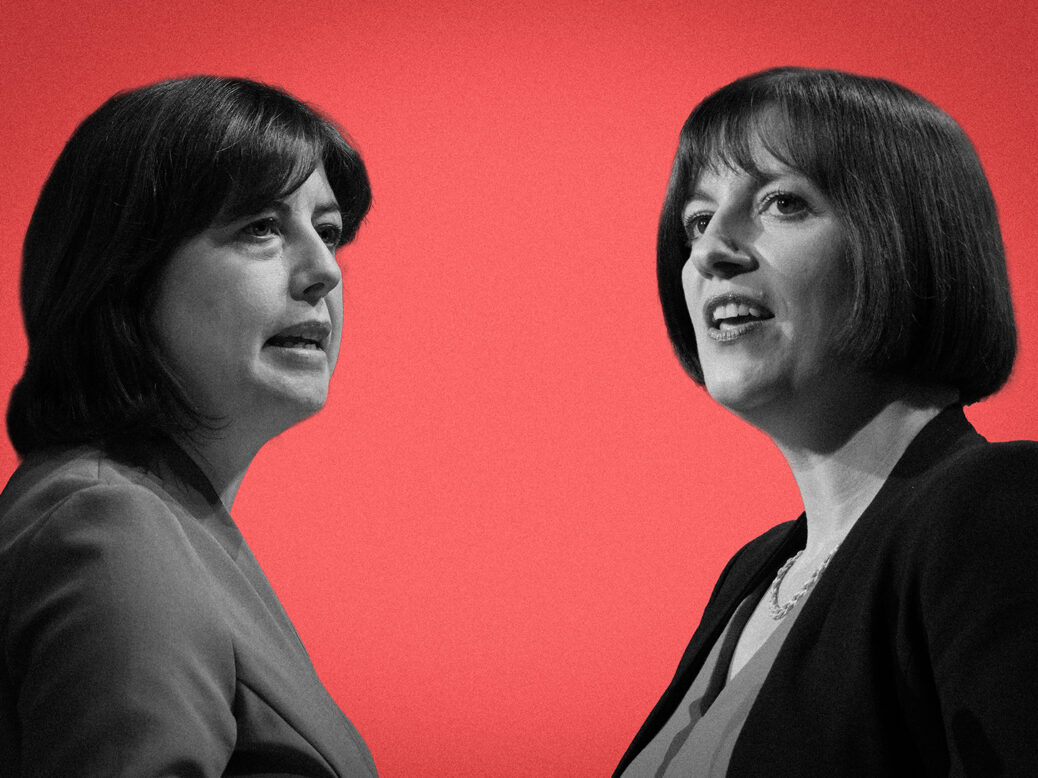
Labour’s deputy leadership election is easy to dismiss. A high nominations threshold of 80 MPs meant that just two candidates – Bridget Phillipson and Lucy Powell – made the ballot. One MP likens the contest to “choosing between beige and magnolia”. As briefing wars break out, others paraphrase Sayre’s law on university politics: “It’s so bitter because the stakes are so low.”
But the election tells us more about Labour’s past and future than these jibes suggest. Start with 2010: the year in which Powell managed the leadership campaign of Ed Miliband, the soft left’s great hope, while Phillipson, then a 26-year-old backbencher, nominated David, New Labour’s torchbearer.
Some 15 years on, with remarkable symmetry, the divides that defined that election endure. Powell is the soft left’s chosen candidate, backed by the Tribune Group, Neil Kinnock and Miliband; Phillipson has been embraced by New Labour grandees such as David Blunkett and Alan Johnson.
Back in 2010, Powell was admired for her organisational nous but viewed with suspicion by some in Miliband’s circle for her more centrist leanings. “Lucy works in this senior role in Ed Miliband’s office but she doesn’t even remotely share Ed Miliband’s politics,” one aide said then.

Powell is not the kind of politician who talks grandly of remaking capitalism. When I recently interviewed her she spoke in broad terms of her commitment to “addressing inequality” and “getting justice for people when the state fails them”. Her declaration that the government needs a “course correction” – and her suggestion that she is already moving policy leftwards – has resonated with Keir Starmer’s critics. But even Powell’s cabinet opponents concede that she has run a canny campaign, avoiding the kind of attacks recently deployed by Andy Burnham.
Phillipson hails from the Blairite tradition – if not the one that is always remembered. She is socially liberal, rejecting the conservatism of Blue Labour on the grounds that “for people like me it would have been a social, cultural and economic prison”. She is redistributionist, consistently arguing for more resources to be devoted to child poverty. And she is pro-European: one figure from the People’s Vote campaign praises her “courageous” decision to campaign for a second Brexit referendum despite her Sunderland constituency voting heavily to leave.
Earlier this year Phillipson was assailed by a number of New Labourites over her school reforms, which will force academies to teach the national curriculum and employ qualified teachers. But her allies cast this as a return to the principles of early Blairism, which emphasised “standards, not structures” (in Blunkett’s words).
Both candidates, then, represent familiar Labour traditions – and with them, familiar feuds have resurfaced. “Members might want to consider why a group that caused so much damage to the Labour Party over many years is backing my opponent,” Phillipson declared of Momentum’s endorsement of Powell, reviving the charge that the soft left is all too soft on its hard variant. To this, a Powell ally ripostes that the Education Secretary has made a “massive mistake” in using arguments that will “go down badly with the membership”.
Where both sides agree is that the contest could be closer than some assume. Membership polling has so far favoured Powell, who won 269 Constituency Labour Party nominations to Phillipson’s 165, but two factors give the latter’s supporters hope. The first is trade union support: Phillipson is backed by Unison and the GMB, giving her an advantage among hundreds of thousands of affiliated members. The second is London – home to several of Labour’s largest CLPs – where Phillipson won 29 nominations to Powell’s 19.
Both candidates have radically different visions for the job of deputy leader. Phillipson casts herself in the tradition of John Prescott, Harriet Harman and Angela Rayner – a members’ voice around the cabinet table. Powell, by contrast, insists that she will decline a post in government, vowing not to be “confined by collective agreement”.
Here is why Phillipson told me that “there is a genuine risk of the party being destabilised”, with some casting Powell as a ready-made rebel leader. That’s a suggestion that she dismisses not only as wrong but as “offensive”. Her aim, supporters say, will be to prevent flashpoints such as the welfare splits through a “quiet word in Keir’s ear”.
But victory for Powell would be an unashamed rebuke to a leadership that sacked her only last month. The former leader of the House of Commons has been struck by the number of party members who professed that they were close to resigning, but remained in order to vote for her.
Victory for Phillipson would now, ironically, be viewed as a reprieve for a Downing Street that she has accused of “sexist briefings” against her. But more than this, it would represent a triumph for a Blairite wing that has lost repeated internal elections since 2010.
This contest is far from a repeat of Tony Benn vs Denis Healey, the defining struggle between Labour’s radical left and its old right. But to suggest that there is no difference between Powell and Phillipson is to erase a history that stretches back to 2010. That election, sometimes in unexpected ways, shaped Labour’s future. This one will too.
[Further reading: Labour’s deputy leadership election gets nasty]
Content from our partners



Related


This article appears in the 16 Oct 2025 issue of the New Statesman, The Emperor
Join the debate
Subscribe here to comment