
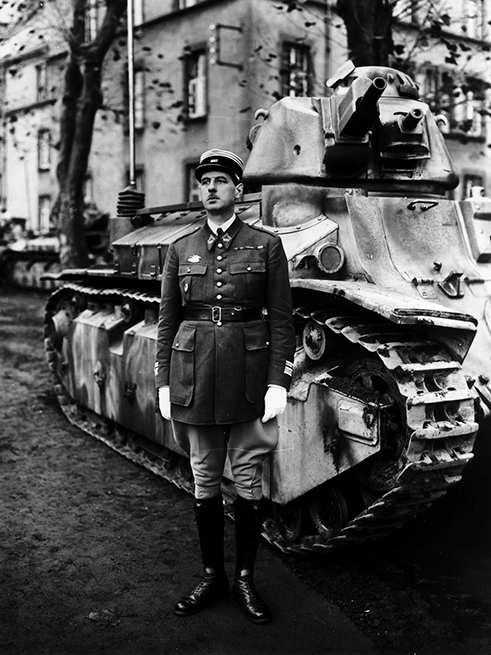
In 1955, after Charles de Gaulle published the first volume of his war memoirs, the celebrated English historian AJP Taylor reviewed the book and considered the great French leader for the New Statesman.
One of Frank Horrabin’s illustrations for Wells’s Outline of History is called “Tribal Symbols of the Nineteenth Century.” There they stand in a row, John Bull in masculine isolation and four females classically draped: Britannia, la France, Germania, Kathleen na Houlihan. Every statesman invokes them; some take them seriously. But after the ringing phrases and the emotional dedication, statesmen have to turn to practical affairs. Bismarck has to manufacture his majority in the Reichstag; Churchill has to consider the figures of aircraft production; Clemenceau reckons how long it will take for the American transports to cross the Atlantic. Logistics determined the hard battering of two world wars. The Tribal Deities were pushed into the wings. Yet they, too, represented a reality. Without them the conflicts would have been senseless, indeed could never have been kept going. The Tribal Deities will reward a worshipper if he is single-minded enough, and General de Gaulle is the proof of it. That mythical symbol, France, made him a world figure; and in return he brought abstract France to life, if only for a brief period.
His book, of which the first volume has just been translated, is called War Memoirs; but the second world war of ordinary sense has a small place in it. The pressing question for de Gaulle was how to restore France to greatness, not how to defeat the Germans. One can understand the impatience of the British, and the contempt of the American Government. Pressed for men, harassed by shipping losses, they had no time to conduct the war according to the protocol of imaginary French sovereignty. Roosevelt would have borrowed Stalin’s phrase about the Pope and have asked it of de Gaulle with more devastating effect: “how many divisions has he?”
The men of Vichy had the same standards. Weygand has recently put the case for them in a plaintive little book†. They were trying to maintain French administration and to rebuild the fragments of an army. De Gaulle’s heroics, they thought, would only bring disasters on France. Weygand, Churchill and Roosevelt sent up a common chorus: let de Gaulle help against the Germans with his few followers and neglect political claims. This strain did not shake de Gaulle. The defeat of Germany would be meaningless for him unless France was present on the day of victory in all her greatness. And he achieved the miracle. France was restored as a Great Power in 1945 thanks to de Gaulle alone, though whether to her advantage or anyone else’s is an open question.

The note is struck firmly in the first paragraph: “France cannot be France without greatness.” This sets the tone of the book as effectively as Proust’s announcement that he used to go to bed early. Most memoirs serve one of two purposes. Either they give a picture of the man, or they record the events in which he took part. Not so the memoirs of General de Gaulle. The human being behind the stern, unbending front never emerges for a moment either in the text or in the photographs. In one of these, indeed, the general is smiling. But it is a political smile: he is shaking hands with a member of the Home Guard. The human being in de Gaulle was of no account, least of all to himself. Napoleon and Trotsky wrote of themselves in the third person in order to assert their individualities more dramatically. The “I” of de Gaulle is an equally effective disguise, but in the opposite sense. Apart from France he did not exist, and would not wish to exist. He said so himself in argument with Churchill: “If I do not represent France, why speak to me?” This was the secret of his success, as of his later failure. He could be reduced to nothing; therefore he was relentless in demanding all. Other political leaders could be cajoled or threatened; they might see practical advantages or recognise practical dangers. De Gaulle knew only one rule of conduct: “limited and alone though I was, and precisely because I was so, I had to climb to the heights and never then to come down.”
He withdrew not only from humanity but from events. His book does little to illuminate the course of the war; and even when the lights are turned on, they produce unusual effects. Not that de Gaulle’s memoirs are untrue or misleading. But they are not about the second world war, as it was experienced by millions of men, high and low, in every belligerent country. They are not even about de Gaulle, as others experienced him. Consider the first two chapters which cover the period until the appointment of Pétain as Prime Minister on June 16, 1940. They show de Gaulle seeking to inspire resolution in Reynaud, proposing offensive manœuvres to Weygand, weighing up Huntziger as a possible commander-in-chief, and finally leaving Bordeaux in calm resolution. “There was nothing romantic or difficult about the departure.” Others failed to notice the hero in the making. There are innumerable French memoirs on the period before the armistice; de Gaulle’s are the only ones to suggest that he played a serious part. Weygand has remarked, probably truly, that he himself was too preoccupied to listen to strategical rhapsodies from a junior general. Sir Edward Spears has drawn a very different picture of the departure: de Gaulle sheltering in the dark behind a pillar, making bogus appointments to conceal his plans for departure, and finally being pulled into the aeroplane as it left the ground. No doubt things happened much like that, though later estrangement may have sharpened a line or two. Yet the historical truth is here a matter of feeling, not of events. Once de Gaulle had become France, he had to hold his head high from the beginning. He became France as he crossed the Channel; and he has never cast himself since for any other part.
Like most legends, the legend of de Gaulle presents itself as all of a piece. The leader arrives in London; he assembles a few devoted followers; and this force continues to grow until, as the climax of this volume, the Fighting French cover themselves with glory at the battle of Bir Hakeim. The real story seems to have been more varied, though also heroic. When de Gaulle first came to London, he did not realise that he would be alone. He supposed that the colonial governors would join him and that his own task was to be the representative of France in London only in the sense of being her ambassador. The governors obeyed the orders of Vichy with one outstanding exception. Even then de Gaulle thought that his isolation would be temporary. He anticipated that all Africa would join the Free French in the autumn of 1940. Instead the expedition to Dakar ended in failure. This was the real turning-point of de Gaulle’s career. Not only was he alone. His warmest adherents, Churchill and Spears, doubted his effectiveness. Spears showed reports from London that “de Gaulle, in despair, abandoned by his partisans, dropped by the British into the bargain, would renounce all activity.” De Gaulle adds:
I, in my narrow cabin, in a harbour crushed by the heat, was completing my education in what the reactions of fear could be, both among adversaries taking revenge for having felt it and among allies suddenly alarmed by a set-back.
He did not weaken. From this moment he set out to embody “the image of a France indomitable in the midst of her trials.” This was “to dictate my bearing and to impose upon my personality an attitude I could never again change.”
Until Dakar, de Gaulle and the British Government both assumed that his movement would soon bring large concrete advantage to the allied cause. After Dakar, de Gaulle had few assets, and these were more or less stable. Equatorial Africa sent colonial troops which performed miracles of valour at Bir Hakeim; France itself provided some centres of intelligence, though hardly a resistance. De Gaulle was left willy-nilly to fight a different war, the war against the allies; and there is nothing to suggest that he fought it with any reluctance. Roughly half the present volume deals with this absorbing struggle. No doubt something real and important was at stake, if only for de Gaulle. Yet in retrospect it provides material for comedy. There was the struggle first for followers. The British intelligence services were eager to kidnap every fresh arrival from France, and would assert cheerfully that de Gaulle and the British were the same thing. In the dark winter blitz of 1940-41 British and French agents dodged and manœuvred for “bodies” as mercantilist powers used to dispute over skilled craftsmen. Then, on a higher level of farce, comes the war over Admiral Muselier. He was accused of treachery on the basis of forgeries so crude that only M.I.5 could have been taken in by them; released after a crisis of international magnitude, then turned into a rebel against de Gaulle; and was finally confined by the British on de Gaulle’s request. It must have been puzzling for Churchill to decide whether de Gaulle had called to have a Free Frenchman released or imprisoned.
This was small beer compared to the conflict over Syria. There must be something in the Near East which deprives men of their common sense. How otherwise explain the long-standing British craze for the Arabs, even at their Egyptian stage of decay? Why should England and France have quarrelled over Syria even as allies, ever since the Crusades? Everyone behaved badly in the Syrian affair. Dentz, the Vichy general, outdid his government in collaborating with the Germans; the British authorities first neglected Syria and then blamed de Gaulle for the consequences of their own mistakes; and de Gaulle claimed to liberate Syria, though it turned out to be impossible for him to do so. The story has all the futility which make men dismiss diplomatic history as trivial. It had important personal consequences. De Gaulle and Spears were permanently estranged; as were many British and French officials in the Middle East. But, of course, it amounted to little in the long run. Both Great Britain and France have been pushed out of the Arab countries; and the events in Syria merely determined the order of their going.
There was a similar dispute when the British acted in Madagascar without de Gaulle’s approval; and a tremendous row with Washington when he ordered Muselier to liberate the islands of St. Pierre and Miquelon solely because the American Government had forbidden the operation. De Gaulle was indeed relentless in asserting himself. Did the British commander in the Middle East plead that he had no transport with which to move French troops from Syria to the North African battlefield? Within twenty-four hours de Gaulle had approached the Soviet Ambassador in London and offered to send a French army to Russia. The same superb assurance served de Gaulle well with the Communists. He makes out now that he welcomed them in order that France should be for once united. Did he not also welcome their assistance against the British and American Governments? The Communists no doubt thought that they had captured him. They were wrong: he had captured them and will go down in history as the only man who has ever outwitted Communists on their own ground.
The whole makes a strange story, a triumph of the human will over material circumstances. Was there any sense, any use in it? So far as winning the war goes, not much; nor can it be said that present-day France has profited from the Gaullist epic. De Gaulle was the servant of an idea, not a statesman, still less a politician. He appealed to others of the same kind—to novelists, anthropologists, perhaps most of all to foreigners who loved France from afar. The France he worshipped meant little to the Frenchmen who lived there. Still, an individual defying the world and succeeding in his defiance, however briefly, will always inspire admiration until the rule of the masses submerges us. The story of de Gaulle has, maybe, little to do with the Second World War, but it is magnificent all the same.
[Further reading: Inside the mind of Tony Benn]
Content from our partners



Related
This article appears in the 06 May 2026 issue of the New Statesman, Tis but a scratch
Join the debate
Subscribe here to comment