
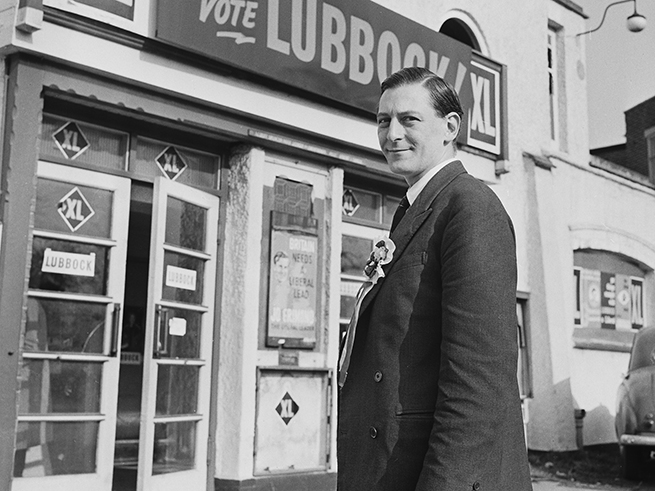
The 1962 by-election in Orpington, south-east London, produced a shock result when the Liberal Party candidate, Eric Lubbock, shot to victory in a previously comfortable Tory seat, outflanking Hugh Gaitskell’s Labour on the left. It was heralded as the end of the two-party system.
After Torrington almost exactly four years ago a friendly bottle of warm sherry was suddenly produced in the Liberal party’s London headquarters – though the effect was rather spoiled as they couldn’t find the cork screw. This time, however, one hopes that they were real devils and brought out the champagne – and not only because it must have had the additional advantage of solving the difficulty about the cork. For no one (least of all those of us who doubted whether the miracle would duly come to pass) should minimise the enormity of what has taken place. And though later on more sober counsels may prevail, for the moment (which happens to be an hour past midnight) one can only record the astonishing nature of the Liberal achievement.
It is worth beginning by looking at the score-card. Not only has Mr Eric Lubbock gathered in at Orpington (which in historical memory has never had a Liberal member) an easy over-all majority over both his opponents; he has also enjoyed the additional sweetness of costing the Labour party its deposit and of subjecting the greatest and whitest hope of modern Toryism to a humiliation unprecedented in modern post-war British politics. Mr Lubbock’s 19th century ancestor, Sir John Lubbock, may have written learned works about The Perturbation of The Planets – and indeed addressed himself to such problems as changes in the earth’s axis of rotation – but the old pioneer can scarcely have realised how dramatically his theories would be given an unorthodox practical relevance by his lineal descendant.
That a perturbation of the party planets has now occurred – and that the British political axis has suffered a nasty jolt – can scarcely be denied. If four months ago when the former Conservative MP for Orpington resigned (even as the constituency chairman he is said already to have had a life-long ambition to be a County Court judge – a modest but, as it turned out, tragic aspiration), someone had seriously suggested that the contest would result in a Liberal victory the horse-laughs would very properly have rung through the Conservative Central Office. For Orpington, of course, carried with it none of the commonly-shared traditional Liberal background of Torrington, Rochdale, Hereford or Paisley – the party’s former proudest battle-honours. Indeed until 1959 there was barely a Liberal party here at all; in 1955 the party saved its deposit by a hair’s breadth and in 1950, in good Sir Waldron’s golden days, it actually lost it.

It is possible, of course, to take the view that the local Liberal party may have been actually helped by having no musty portraits of long-forgotten heroes to hang above its fire-places. But the fact remains that this is the first constituency without the trace of a successful Liberal tradition in which the party has achieved a substantial break-through – giving it incidentally both a tactically-sited base for further aggrandisement in the Home Counties and a larger strength in the Commons than at any time since 1951.
Amid the surrounding melodrama that may seem a modest claim to stake and certainly alongside the picture of the wretched Mr Goldman presumably about to let his lease lapse in Farnborough (Bromley side of the boundary) and the vision of Mr George Brown getting in person a bloodier nose than was ever received even by Lord Hailsham, it must look like small beer. But at the end when the tumult and the shouting is over (and it seems quite possible that they will still be singing For He’s A Jolly Good Fellow in the National Liberal Club on Friday three-week) it is, one suspects, to this point that we shall all return.
For the Liberal Party’s greatest weakness to date has always been that there is no identifiable group which it is in business to represent. Produce a prosperous small businessman and you have displayed a Tory; bring out a replica of Andy Capp and we in all probability see a Socialist; but wheel out a card-carrying Liberal and no one will ever guess what he is or indeed know why on earth he should be. The long-term importance of Orpington seems certain to be that it will at last enable the Liberals to make a fair claim (probably not lastingly valid but at least temporarily plausible) that they are now in politics to represent the New Estate – that struggling, emerging, ‘hi-fi’, younger middle class with its neat front-gardens, carefully disguising the burden of the mortgage rate, the anxiety of the price of the season ticket, and the moral crisis over the school fees.
For years this by no means clearly labelled group has been the undistributed prize of British politics. In 1959 it was undoubtedly won by the Conservatives; since then the Labour party has wooed it with ardour, if not with discretion; and from time to time before now the Liberals themselves have made the odd rather clumsy pass. But at Orpington matrimony was clearly achieved – and though the marriage may not last for ever, at least it has got off to what looks like a pretty propitious start.
For this the Liberals can certainly not claim all the credit, though for once in this by-election they did manage to look (while trying desperately hard not to) like a bunch of hardened professionals rather than a group of gifted amateurs. Far more, in fact, was on their side than their own endeavours.
There was, for one thing, the extraordinary lack of touch displayed by the Conservative Central Office. The deliberate decision to hold the Blackpool by-election (staggering enough in its own right as far as the result was concerned) on the day before Orpington trooped to the polls deserves to be ranked as one of the political howlers of our time.
Indeed the indictment can be taken a stage farther than that. In retrospect at least the choice of Mr Peter Goldman to be the Conservatives’ candidate at Orpington must seem to have been a good deal less than happy. The Liberals, after all, have consistently made it clear that their greatest target is the influence of the party machine; and here they suddenly had a hostage from it delivered straight into their hands.
Those who are still thinking of Liberals as basically ‘nice chaps’ might profitably take a look at some of the campaign literature they put out at Orpington. For sheer virulence and scurrility there can have been nothing like it since the days of Lloyd George; and if Mr Jinkinson, the Labour candidate, was never referred to as anything but Mr Jinxinson, Mr Goldman in his turn could never be mentioned without the reminder, ‘professional political machine-minder.’ Both shots in the event were astonishingly accurately sighted.
Naturally it is this type of thing which, as after Torrington, the two major parties will find hardest to forgive – there may also, one suspects, be some accounts to settle with the Daily Mail’s National Opinion Poll, whose activities were bitterly resented both in Transport House and the Conservative Central Office.
But both Mr Iain Macleod and Mr George Brown will have to look for something other than the easy explanations: for both their local machines – the Conservatives predictably and the Labour party’s astonishingly – hummed throughout the campaign with efficiency, and in neither camp is there a readily available sacrificial victim – unless the candidates are made the scapegoats.
The likelihood, though, is that they will simply take refuge in dismissing this week’s happenings as one of those curious freaks – a quixotic and irresponsible gesture on the part of the electorate from which it will have plenty of time to recover before the next election.
There is admittedly a good deal of readily available support for that diagnosis. Torrington, after all, far from being a glorious name in the Liberal annals is now a humiliating one; and in the middle of the sound and fury it is easy to forget the small but firm voice with which Middlesbrough spoke this week and Lincoln last.
But if the Tories – as there are grounds for suspecting – mean to dismiss both Orpington and Blackpool as little local difficulties (inspired largely by the desire of the electors in both constituencies to get their bread in the Chancellor’s gravy next month) they may well find that they are playing with fire. Provided the Liberals can get out of their present dilemma of seeming to face both ways – of being the alternative to Labour in Middlesbrough and to Conservatism in Orpington – they may at long last really have started something.
[Further reading: From the archive: Profumania]
Content from our partners


Related

This article appears in the 25 Feb 2026 issue of the New Statesman, The Crumbling Crown
Join the debate
Subscribe here to comment