
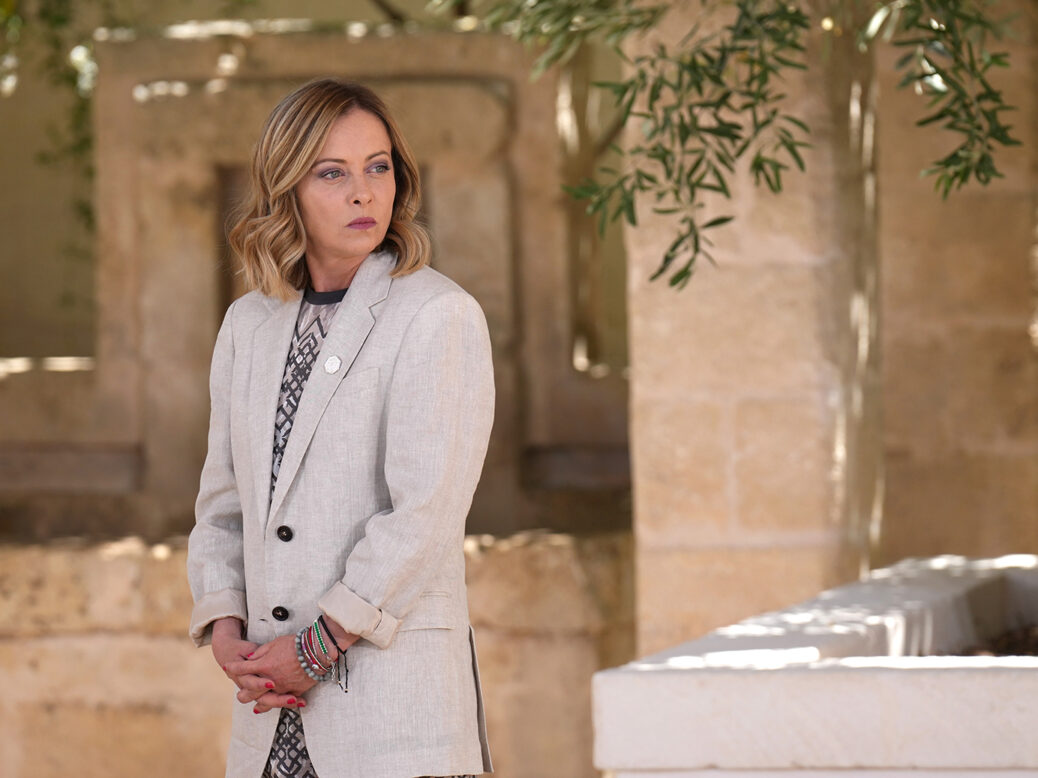
Giorgia Meloni has worked hard to establish herself as a bridge between Europe and Donald Trump’s United States. She was the only European leader invited to Trump’s inauguration in January 2025, along with Argentina’s Javier Milei and China’s Xi Jinping. She has also been a key figurehead for the Mega (Make Europe Great Again) doctrine, an on-the-nose nod to Trump’s Maga ideology. Mega could count on Meloni in western Europe and Viktor Orbán in eastern Europe as its cornerstones – the latter even adopting the acronym for Hungary’s EU Council presidency in 2024. Orbán’s electoral defeat on 12 April, however, dealt a significant blow to the European and global far right. Leaders from Milei to Benjamin Netanyahu had backed his re-election campaign; with his loss, Meloni now stands as the last Mega leader in Europe.
Despite Trump’s trade war and its impact on the Italian economy, Meloni did not abandon her bridging ambitions. In a continent full of leaders who had disappointed the US president she remained steadfast. That was until the US-Israeli attack on Tehran. European Nato members chose not to intervene in the conflict or engage with Iran’s blockade of the Strait of Hormuz – a stance that infuriated Trump and prompted him to threaten withdrawing the US from the alliance. He singled out Meloni personally, and labelled her criticism of his Truth Social attack on Pope Leo XIV “unacceptable”.
Pope Leo XIV has been outspoken on multiple fronts: the US-Israeli intervention in Iran, Israel’s campaign in Lebanon and Trump’s more incendiary rhetoric. The tone of the administration’s response has produced an unprecedented level of tension between Washington and the Vatican. For Meloni – who has defined herself publicly as “a woman, a mother, a Christian” – criticising Trump’s assault on the Pope was never really optional. Although Catholicism has not been Italy’s state religion since the 1984 revision of the Concordat, its cultural weight remains enormous: according to 2024 data from the research institute Censis, 71.1 per cent of Italians identify as Catholic. Among voters for Meloni’s Brothers of Italy, that figure rises to 84 per cent, according to analysis by the data institute YouTrend based on the 2024 European elections.
How long Trump will hold a personal grudge against Meloni remains to be seen – he has proven both volatile and vindictive. What seems clear is that she will have to rethink her strategy. A sign of this intention can be seen in the PM’s participation in a summit on the Strait of Hormuz in Paris on Friday 17 April, indicating a realignment with Emmanuel Macron, Keir Starmer and Friedrich Merz. Meloni also announced that the Italian navy will join a mission to ensure the safe navigation of the Strait, on the conditions that the mission will be only defensive and will start once the hostilities between US-Israel and Iran end.

Meloni has added the condition of parliamentary approval for the mission, showing how much the pressure from the opposition is rising. There are strong domestic incentives to change stances: a YouTrend poll finds 79 per cent of Italian voters are against Trump’s war in Iran and are worried about rising energy prices. Yet another element in Meloni’s Atlanticist leanings (a heritage of Brothers of Italy’s fascist predecessor, the Italian Social Movement) has been adamant support for Israel, a sort of betrayal of Italian foreign policy, given its historical pro-Arab foreign policy. That position has become increasingly difficult to sustain.
Meloni remained resolute through expansion of settlements in the West Bank, military operations in Gaza described as genocide by Human Rights Watch, Amnesty International and the Israeli organisation B’Tselem. She supports the two-state solution in principle, but has declined to recognise Palestinian statehood. A recent announcement – the suspension of the automatic renewal of Rome’s defence cooperation agreement with Tel Aviv – looked significant, given that Italy is Israel’s third-largest arms supplier. But Brothers of Italy MP Giovanni Donzelli clarified to the outlet WILL that the decision was triggered specifically by Israeli warning shots fired at Italian Unifil soldiers in Lebanon, not by a broader policy shift. Opposition politician Angelo Bonelli, co-leader of the Green Left Alliance, made the same point in an interview with Al Jazeera, adding that the agreement has been suspended, not revoked.
Until recently, Meloni navigated domestic politics with relative ease. Scandals – including the use of a government aircraft to return Libyan torturer Osama Elmasry, wanted by the International Criminal Court, from Italy to Tripoli – produced few political repercussions. Her signature migration policy, deporting asylum seekers to detention centres in Albania, has been repeatedly blocked by Italian courts, though it did inspire the European parliament to pass a return regulation permitting offshore processing hubs. Beyond that, the government’s legislative record is thin. Plans for a stronger executive presidency were shelved, as was a proposal to devolve differentiated powers to the wealthier northern regions at the expense of the south. The one reform the government did manage to pass – a judicial overhaul – was rejected by voters in a March referendum. That defeat ended what had been a comfortable honeymoon between Meloni and the electorate, a rupture deepened by the war in Iran and its tangible effect on consumer prices. The opposition, led by the Democratic Party and the Five Stars Movement leaders Elly Schlein and Giuseppe Conte, is capitalising on the government’s weakness, projecting their alliance as the alternative to the government for the Italian voters next year. A turbulent time awaits Giorgia Meloni and her government, at home and abroad, on the long road to the 2027 elections.
[Further reading: The Iran war is over]
Content from our partners


Related
Join the debate
Subscribe here to comment