
In the absence of a clear endgame for the US in Iran, valiant efforts have been made in recent days to retrofit a grand strategy to the war. Some see Donald Trump as the architect of a cunning plan to roll back China’s influence in the region. Some see a neoconservative president determined to bring down the ruling regime and put an end to Tehran’s nuclear ambitions. Still others insist that this is really about oil and control of the Strait of Hormuz.
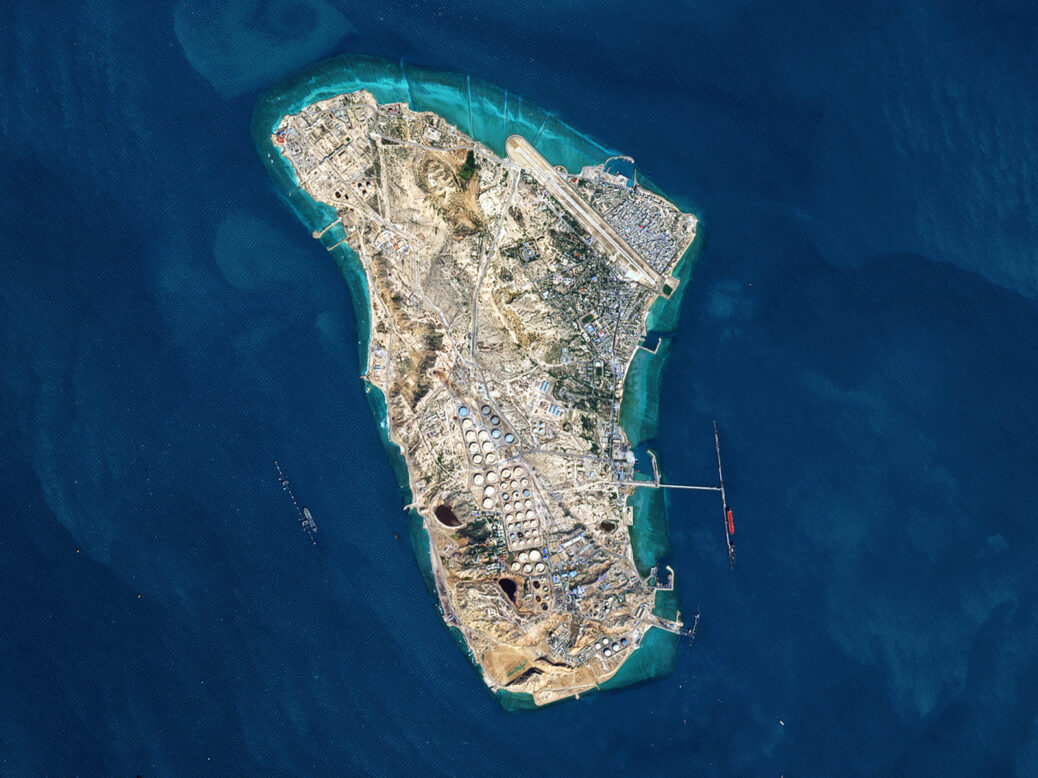
The latest theory to emerge is centred on Kharg Island, a slender strip of land that sits around 20 miles off the south-western coast of Iran. First developed by an American oil company during the oil boom of the 1960s, Kharg is arguably the most important single node in the Iranian oil industry. Unlike most of the country’s coastal waters, which are too shallow to allow large tankers to dock, Kharg features long, deep-water jetty systems that allow multiple vessels to load simultaneously. Approximately 90 per cent of Iran’s oil exports leave the country through this terminal. During the Iran-Iraq War of the 1980s, the island was deemed to be of such strategic importance that Saddam Hussein attempted to destroy it with a multi-year bombing campaign.
Yet neither the US nor Israel, at the time of writing, has fired a single missile at Kharg. Hence the intrigue as to whether the Trump administration might have other plans for the island.
In the weeks leading up to the conflict, Iranian oil exporters accelerated their shipments from Kharg, which shot up from around 1.5 million barrels a day to four million, according to research by the industry monitoring firm Kpler. “That means the Iranians read Trump differently than the Western media does,” argued Guy Laron, a historian at the Hebrew University of Jerusalem, on 7 March. “They don’t think he’s after regime change or democracy. They think he’s after oil.”

Laron sees an American plan to “Venezuelise” Iran, which would involve working with a new, or modified, Iranian regime on oil production, as Trump apparently plans to do with the acting president in Venezuela, Delcy Rodríguez. This would give the US direct control over Iran’s most important stream of income, or so the theory goes, and, if the US Navy also establishes a dominant presence in the Strait of Hormuz, a grip on the “jugular of global energy trade”. The US’s systematic targeting of the Iranian navy, including a torpedo strike that sunk a frigate in the Indian Ocean on 4 March, is evidence, in his view, that the US is “clearing the operational space for a naval seizure of Kharg”.
On one level, it is possible to imagine how an operation to capture Kharg might unfold. The island is sparsely populated and vulnerable to amphibious assault, with Iran’s air defences already “severely degraded”, according to US Central Command. Trump has refused to rule out sending US ground forces into Iran, assuring reporters on 2 March that, unlike his predecessors, he doesn’t “have the yips with respect to boots on the ground”. Four days later, NBC News reported that the US president was privately discussing the idea of deploying ground troops for specific strategic purposes – a definition that could conceivably include the oil facilities on Kharg.
If the US succeeded in securing control of Iran’s main oil export terminal, and with it a major source of revenue for the Revolutionary Guard, Trump might reasonably believe he would be in a position to dictate terms to the leadership in Tehran. But such a strategy would depend on the new Iranian leadership – which so far looks a lot like the previous Iranian leadership – concluding that pragmatic capitulation to the Americans is the most preferable option. If the regime opted instead to target a US-controlled Kharg, adopting an “if we burn, you burn with us” strategy, the immediate impact would be an even greater surge in global oil prices and widespread economic pain. The surviving leadership might wager they can endure the consequences for longer than the US and its allies.
For his part, Trump does not sound like a president with a devious plan to seize control of Iran’s oil. “Certainly, people have talked about it,” he said in an interview on 9 March. “People have thought about it, but it’s too soon to talk about that.” The most likely explanation as to why the US has not yet attacked Kharg Island is also the most obvious: Trump is keeping his options open, wary of completely destroying the economy of a country whose future leadership he wants to help select, as well as the global market panic that would presumably ensue. The US unquestionably has the power to decimate Iran’s oil industry, but doing so risks destroying any prospect of a more palatable Iran – at least from Washington’s perspective – emerging from this war, and unleashing a form of mutually assured economic destruction that would wreak havoc around the world.
Trump has also been talking up the idea that the war would soon come to an end. “We took a little excursion because we felt we had to do that to get rid of some evil,” he told Republican lawmakers and donors at his Doral golf club in Florida on 9 March. “And I think it’s going to be a short-term excursion.” He assured CBS News the same day that the war was “very complete, pretty much”. Then again, he insisted that the US would not allow Iran to “hold the world hostage” over oil and mused of the Strait of Hormuz that he was “thinking about taking it over”. And so the war, and the vexing search for the strategy behind it, goes on.
[Further reading: Will Nato split the Green Party?]
Content from our partners



Related

This article appears in the 11 Mar 2026 issue of the New Statesman, The Great British Crisis
Join the debate
Subscribe here to commentAnd now Trump has attacked the military installations on the island, so what happens now?