
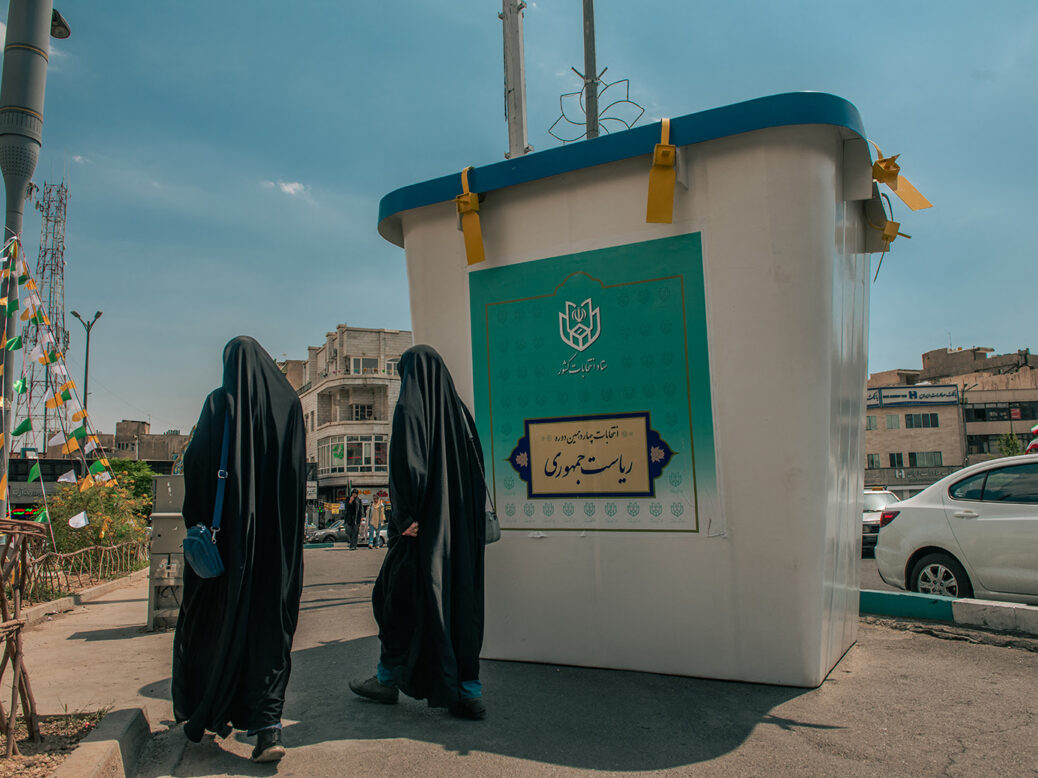
Tehran, 1989. Ten million grief-stricken Iranians are processing through the city’s streets: a sixth of the country’s population. It is said to be the largest funeral in history – and an interment so nationally traumatic it takes two attempts. The first time, the crowd seizes the corpse from its casket, tearing at the shroud for relics. And when, finally, Ayatollah Ruhollah Khomeini is entombed, the Islamic revolution he led is not buried with him; it is renewed.
Iranians, without real elections or polls, vote with their feet. Lately that has meant protests, since the regime is deservedly unpopular, and we have seen less of the morbid collective passions and processions that have historically energised the Shia Muslims of Persia. “Come friendly bombs,” some Iranians even appear to be cheering. But it cannot be forgotten that this is a land where jubilation is no match for lament.
Entranced by Shia mourning rituals, the Holocaust-surviving Jewish writer Elias Canetti showed – in Crowds and Power (1960), the book that won him his Nobel Prize – that ritual lamentation is a means by which the mass asserts itself politically, writing of Iran’s Shia religion, “No faith has ever laid greater emphasis on lament.” We will soon be reminded of this.
For it is now the turn of Khomeini’s successor, Ayatollah Ali Khamenei – assassinated on 28 February – to have Iran’s fuming multitudes mourn him. How large will the crowd be? How great its power? If the procession ever finds an opening in the American-Israeli bombing schedule, it will surely be in the millions – the same millions who turned out for Qasem Soleimani, the senior commander Donald Trump bumped off in his first term. The world pretends, unwisely, these people don’t exist.

Here is the Western alliance’s hope: Islamic government is being “sent to the trash heap of history”, as Reza Pahlavi, the son of the tyrant whom Khomeini deposed in the 1979 revolution, has proclaimed. But successive waves of protest, from the Green Movement to “Woman, Life, Freedom” – each as courageous as the last – have failed to topple the Islamic Republic. Decapitation and bombardment will do little to overhaul a society that, alongside growing popular disaffection, also maintains a stiff pro-regime patchwork of pious masses, powerful clergy, vicious militiamen. This is a constituency far greater than Khamenei alone; they can’t all be killed off.
What made the Islamic revolution at heart so effective was its weaving together of the elites and the masses. Khomeini’s doctrine of Velayat-e Faqih – “guardianship of the cleric”, fusing Plato’s philosopher-king with Lenin’s theory of the vanguard – empowered the seminary-trained scholarly class. But the revolution also committed this elite to the cause of the mostazafin, the “oppressed” masses. This originally Koranic term was given shades of revolutionary socialism by Ali Shariati, the Shia ideologue who, studying in Paris, won the admiration of Sartre, not to mention many an ayatollah (including his friend Khamenei). The civic membrane connecting these strata may be thinning out, but it is rigid: mosques, madrasas, shrines and, most of all, the Revolutionary Guards, a paramilitary cadre of almost 200,000 fanatics, reminiscent of the Red Guards who disseminated Mao’s Cultural Revolution in China.
Iran’s Islamic revolution has long been portrayed as primitive and backward. Travelling through Iran shortly after the shah’s overthrow, VS Naipaul described the post-1979 Muslim world as having “an intellectual thermostat, set low”. Stupidity, then, was behind it all. But this now-common reading misses the point, and the power, of Islamism, its philosophical ferment – its contemporary genius, even.
With Khamenei gone, Iran’s de facto governor for now is Ali Larijani, a scholar with a PhD on Immanuel Kant – the very architect of modern thought. Larijani was mentored in the study of Western philosophy by his father-in-law, Ayatollah Morteza Mutahhari, who was, alongside Shariati, an ideological lodestar of the revolution. This Larijani also masterminded the crackdown on protesters which saw tens of thousands killed. Here is a brutality of which only intellectuals are capable; this revolution has had its share of Robespierres too. Indeed, the French connection runs deep; modern thought reached Iran via Paris, making the country the only Muslim society where the Western intellectual tradition seriously took root.
What, then, does this mean? It’s not a coincidence that it was here, of all places, that the Islamic revolution emerged. During the pivotal 1970s, the luminary among ayatollahs was Allama Tabatabai, a disciple of the French Heideggerian thinker Henry Corbin. And who were the late Supreme Ruler Khamenei’s favourite writers? Balzac, Stendhal and, avant tout, Victor Hugo. Iran’s Islamist ideology aims not, then, as Naipaul misunderstood, “to purify, to go back to the faith”; it is in fact a product of Western modernity, a reckoning with the advancing world that left Muslims behind. Israel’s hi-tech humiliation of Muslims is only reiterating this, and Islamism is becoming more, not less, attractive with development. In the Muslim world’s most recent election, Bangladeshi Islamists made huge gains. The most sophisticated Muslim democracies – Malaysia and Turkey – have prime ministers ideologically rooted in Islamism.
All this to say: if the Islamic Republic falls, its ideology will not fall with it – as Marxism did with the Berlin Wall – into history’s trash heap, but rather into its cauldron, to continue melding old passions with a new world. It will keep bubbling away.
[Further reading: Trump, Iran and America’s years of iron]
Content from our partners

Related

This article appears in the 04 Mar 2026 issue of the New Statesman, Trump's global terror
Join the debate
Subscribe here to comment