
The celebrity historian is the genre of public intellectual Britain has traded in most – as profitably as France has done in philosophers, Germany in social scientists, and Russia in ideologically deranged novelists. After Lord Macaulay and Thomas Carlyle, the Victorian progenitors of popular English history writing, came AJP Taylor – the first in our era of mass communication to achieve fame by broadcasting interpretations of the past to a public that was as much ravaged by history as riveted by it. The interest in history today seems similarly proportioned between curiosity and anxiety, and if Taylor has an heir as the nation’s favourite chronicler of recently elapsed turmoil, there can be no doubt about who it might be.
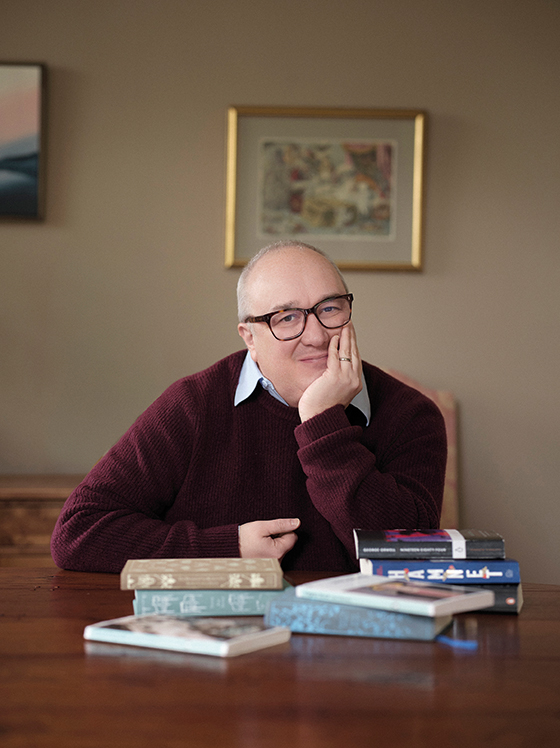
When Dominic Sandbrook walks into the New Statesman’s office, though, he cuts quite a different figure from Taylor, who looked like he’d bought all his clothes during the abdication crisis and then resolved to see them through to the end of the Cold War. That was the time-honoured manner of celebrity history dons, perfuming themselves with the past – which usually meant the smell of wafting pipe smoke. But Sandbrook is a historian content not to be historical, living in the same everyday as the rest of us. He’s wearing trainers, and the collar of his shirt, beneath a maroon jumper, is slightly furrowed; the style is pleasingly normcore. Middle-aged, balding, bespectacled, he is a picture of ordinariness, the kind championed in his writing.
An acclaimed author, newspaper columnist, presenter of BBC documentaries and impresario of a podcast that reportedly takes his earnings to over £1m a year, Sandbrook is, by now, a bigwig; but he doesn’t act it. He’s immensely likeable, and generous with his laughter. Living in voluntary exile from academia – he used to be a lecturer, at Sheffield – he exudes none of the cultural arrogance of all those scholarly chinwaggers on the airwaves of yesteryear, with their lectures on civilisation or the ascent of man. He’s not one for tweed-jacketed gesticulations, or clever-clever witticisms.
His podcast, The Rest Is History, is the biggest humanities podcast in the world, but he seems chuffed to be interviewed on our more modest show, The New Society – even a little bashful. “You don’t know if I’m going to be good or not,” he says of being a guest for a change. His humility, while genuine, feels misplaced. He cringes after suggesting his work on postwar British history might be something he’s famous for. “Unbelievably vain!” he chides himself. “The books that I’m least unfamous for” is how he prefers to describe his quintet of British social history from the Suez Crisis to the Falklands War, each one a bestseller.

Launched in 2020 when Sandbrook and his co-host Tom Holland were still known as writers rather than talkers, The Rest Is History was the original prize stallion of Gary Lineker’s podcast production stable, Goalhanger. It now averages 15 million downloads a month – putting it in the same league as the estimated audience for Churchill’s wartime radio broadcasts.
The podcast’s ubiquity, and the proliferation of shows like it, is such that tuning in to them has become the go-to way for history enthusiasts to engage with the subject. Once they might have read Taylor on the origin of the world wars or, in a more distant era, Edward Gibbon on Rome’s decline and fall. Now they download, they stream, the AirPods go in, while books, seemingly, are out.
As much a writer as podcaster, Sandbrook is aware of the exodus from one medium to the other. At university – Oxford for undergrad, then Cambridge for a PhD – he recalls how when he was interested in a subject all he could do was buy a book. “Now, the first thing I do, like anybody else, is google it and read the Wikipedia entry,” he says, “or listen to a podcast.” For many of us, that means The Rest Is History.
“Lots of people in publishing talk to me and say, ‘your podcast is destroying non-fiction’,” Sandbrook tells me, a little sceptically. “You know, that people were once reading history books on the Tube – I’m not convinced that that many people were reading history books on the Tube – but now they listen to your podcast.” New figures from Nielsen have shown that annual non-fiction sales slumped by 6 per cent; last year saw the sale of 17 million fewer such titles than recorded six years ago. But Sandbrook thinks it’s a simplification just to condemn podcasts. This has been happening for a while, ever since the “internet revolution” and what he calls “the development of digital culture”, in which reading – of websites such as Wikipedia – has actually played a role, too, alongside rapidly accumulating podcasts.
For Sandbrook, “workman-like” writers are to blame, too, for not rising to newfound challenges. Regularly peeved by the historians whose books he reviews, Sandbrook says “they’ve been left behind… they have to deliver something above and beyond what you’re getting on Wikipedia”. That means “a book needs to have personality… a narrative voice.” The best historians utilise plot, a cast of characters, suspense: “‘What happened next?’ is the most powerful question,” he declares. “That’s why you fall in love with history as a child – you love the story.” In other words, history books need to be more like something else preoccupying Sandbrook of late: novels.
After more than 800 episodes exploring historical topics, more recondite by the week (the latest a multi-episode deep dive into the Second Punic War), Sandbrook is starting The Book Club, a literature podcast co-presented with his 28-year-old producer Tabitha Syrett. Listeners of The Rest Is History are mostly under 35; Syrett was one of them, before she began working for Goalhanger following a fan letter to Sandbrook. The new fiction-focused show has grown out of their behind-the-scenes literary chats; it’s also essentially in keeping with the passion for narrative in the podcasts they’ve already been producing. “He’s a remarkably gifted storyteller,” says Syrett, explaining Sandbrook’s popularity with literary types like herself, “he’s able to really spin a yarn.”
Both studied literature at university – classical in her case, French in his. And in fact, though he resists this designation, Sandbrook is really a critic in his own right. His book The Great British Dream Factory (2015) is a vindication of British popular culture, including richly contextualised appreciations of the novelists HG Wells and William Golding, although the book’s anti-elitist stance is slightly overegged. (He at one point derides “the scorn of highbrow critics such as Richard Hoggart” – a strange judgement on the founder of the field of cultural studies, who did more than anyone to enable the serious study of popular culture so typical of Sandbrook’s own work.) There has also been a foray into art criticism, to write about (what else?) pop art.
The Book Club will develop in that spirit, flattening distinctions of highbrow and lowbrow into “complete omnivorousness”. He namechecks, as intended topics, PG Wodehouse and Robert Harris. But he also wants to get into 18th-century novels. Discovering Laurence Sterne and Henry Fielding a few years ago, he thought, “God, why aren’t people talking about this all the time? Why aren’t they talking about this on the street?”
Sandbrook’s populist tendency places him in a robust critical tradition of which he is more conscious than he lets on. He unpretentiously claims not to read literary criticism (“I read a lot of French literary criticism in the Nineties… that buys you a lot of credit for the rest of your life.”) Yet the writer he returns to dozens of times in our conversation is not a historian or novelist but a literary critic, John Carey; he describes the legendary book reviewer as his “absolute hero”, because he “had the democratic, open-minded spirit you should have as a critic”. Sandbrook recalls how when his wife went to get, as a gift, a signed copy of Carey’s biography of William Golding, they ended up having a conversation not about the novelist but Call of Duty; the Merton professor of English literature at Oxford was apparently seized by a desire to know what Sandbrook had made of it. “That was all he wanted to talk about.”
Dominic Sandbrook was born in Bridgnorth in 1974 – a year he portrays as a chaotic turning point in British history. His biography has profoundly shaped his world-view. Bridgnorth is a quaint Shropshire market town – where his parents ran a surveying business – and he went to school in Wolverhampton and Worcestershire. This is the West Midlands landscape that inspired The Lord of the Rings, a recurring interest of Sandbrook’s, and it’s a region portrayed in his own work as an epicentre of industrial, demographic and cultural ferment. Provincial roots have been formative. “I’m quite anti-metropolitan, which probably comes from that,” he says.
Later, it was shaped by Carey’s The Intellectuals and the Masses (1992), the foundation stone of Sandbrook’s critique of the “metropolitan elite”. The book castigates Bloomsbury modernism for being driven by hatred of the masses, an interpretation giving rise to unresolved tensions for Sandbrook. We discuss Virginia Woolf, the arch-villain of Careyism. Sandbrook loyally hates her, but loves Mrs Dalloway: a “perfectly formed” novel. Equally, he adores HG Wells – another of Carey’s targets, a writer whose science-fictions have at their core a vision of the mushrooming masses as – in Wells’ words – a “biological catastrophe”. If this mass-market suburban writer shares the same characteristic flaw as Bloomsbury’s bohemian modernists, doesn’t this whole anti-metropolitan edifice begin to crumble? The problem pursues Sandbrook into his account of the Sixties, which is complicated by inconvenient links between the ideology of cultural elites – bad! – and the innovative popular culture it inspired – good?
In Carey’s work lies also a warning from the past about something else Sandbrook has been engrossed by: the moral panic about reading, which we have in common with the Bloomsbury intelligentsia. But there’s a twist. A hundred years ago, they were horrified by literacy’s growth, not its disappearance. (Soberingly, it was the same fear: the end of civilisation.) Sandbrook appreciates columnist James Marriott’s campaign against flailing literacy; The Book Club might even have been “unconsciously” provoked by it. But, he cautions, “the discourse around books is very worthy: read this book, drive your Volvo, eat your improving vegan granola and you will become a more wholesome human being”. Literature doesn’t make you a better person, he insists.
Why, then, care so much about it? Verging on worthy moralising, he invokes “empathy” and “humility”. And while reading less may not make individuals brutes, it can, for Sandbrook, harm societies. Historically, he says, “reading and democracy have gone hand-in-hand”. Literature, with its empathy-inducing gift, “equips you for a pluralistic, democratic landscape”. That makes reading a political question, and politicians are the one species of people who, for Sandbrook, are getting worse for reading less. He wishes the governing elite still read widely and better appreciated life’s complexity. “We are the worse for it,” he says. “We are actually worse.” As ever, for this veteran Careyite, it isn’t the masses we should worry about. But the intellectuals.
“The Book Club” is now available for download weekly
[Further reading: Philippe Gaulier and the paradox of clowning]
Content from our partners



Related
This article appears in the 18 Feb 2026 issue of the New Statesman, Class warrior
Join the debate
Subscribe here to commentTo coincide with your article, presumably:
Historian Sandbrook among Oxford degree recipients”I have incredibly fond memories of my time at Oxford,” Sandbrook, who studied at Balliol College in the 1990s, said.
“I owe so much to the tutors who inspired my love of history and literature, and I’ve been very fortunate that through my books and podcasts, I’ve been able to share my passions with readers and listeners all over the world.”
“So, this unexpected honour means the world to me.”
https://www.bbc.co.uk/news/articles/czx4prg03z7o?xtor=AL-71-%5Bpartner%5D-%5BBBC+England%5D-%5Bheadline%5D-%5Bnews%5D-%5Bbizdev%5D-%5Bisapi%5D&at_bbc_team=editorial&at_ptr_name=twitter&at_link_type=web_link&at_link_id=1567971A-123B-11F1-99CF-F71DC996FD08&at_format=link&at_campaign=Social_Flow&at_campaign_type=owned&at_medium=social&at_link_origin=BBC_Oxfordshire