
When, two years ago, Refaat Alareer, a Palestinian poet, led a literature seminar at the university in Gaza, among the topics he chose was TS Eliot’s poem “The Hollow Men”. The university no longer exists; neither does Dr Alareer – both eliminated by Israeli air strikes. But a recording of the seminar is still available online. In it, a class of Palestinian boys and girls grope for clarity about the poem’s apocalyptic visions. They would soon behold them with their own eyes: broken stones, hollow valleys, dead men’s hands in a “cactus land”. Many will themselves now be in what the poem calls “death’s twilight kingdom”.
In 2014, a Spad recently ejected from Whitehall caused a stir with a 20,000-word blog railing against the political class. It was inspired by, and named after, the same poem, quoting it in full. Watching William Hague one day – Dominic Cummings recalls – “I thought, hollow, hollow, hollow”. It wouldn’t be the last time he would publicly adopt Eliot’s doom-spelling style.
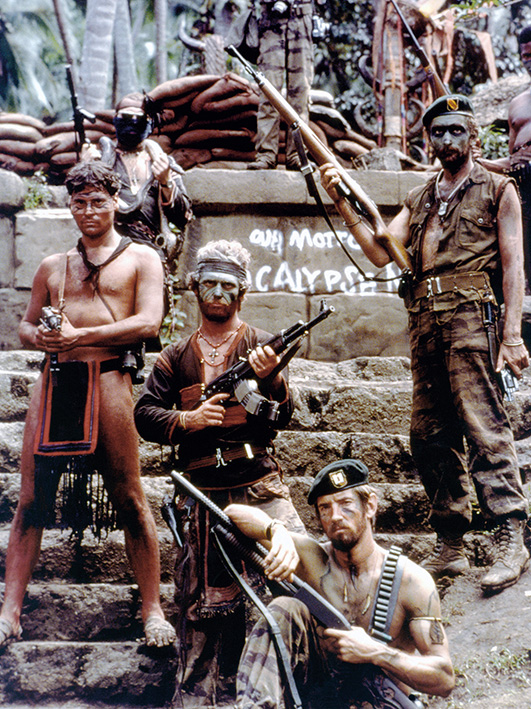
In 1979, when Francis Ford Coppola made his greatest film, it was, uniquely in the history of Hollywood, adapted from a poem. While its plot stems from Joseph Conrad’s novella Heart of Darkness, Apocalypse Now bears closer artistic resemblance to the film’s source material in “The Hollow Men”. Coppola’s title gives voice to the poem’s end-time premonitions. Colonel Kurtz (played by Marlon Brando) – Conrad’s ivory trader in the Congo revamped as a rogue commander in the Vietnam War – obsesses over and recites “The Hollow Men”, and is prominently seen reading the ethnographies that influenced its writing, James Frazer’s The Golden Bough (1890) and Jessie Weston’s From Ritual to Romance (1920). Coppola emulates the poem’s genius for unnerving hallucination. “I watched a snail crawl along the edge of a straight razor,” Kurtz says of a dream, a line more Eliotian than Eliot. Likewise, the film’s final, symbolic images: a dilapidated temple, idol-worshippers, beheadings, sacrificial cows…
“The Hollow Men” was published a century ago. How have these hundred or so lines, over the last hundred years, beguiled such a disparate array of minds? And for so long? The poem’s afterlife is all the stranger for its concern, via a tangled web of nightmarish visions, with nothing less than the end of the world. This presents a paradox. The poem’s omens of Armageddon – “this is the way the world ends”, it thunders – rubs up against its timelessness, its everlasting interest to Palestinian professors, political advisers and fictitious colonels all the same.

In 1925, TS Eliot was only 36, a Bostonian adrift in London. But he was already esteemed in the city’s literary circles as the magus of English poetry. Three years earlier he had published The Waste Land, a poem of such originality that 1922 would become known as the annus mirabilis of modernism. That meant Eliot could quit his job at Lloyds Bank and begin his career as an editor at Faber, which – in its first iteration, as Faber & Gwyer – had published his early work in Poems: 1909-1925. In this matter-of-factly entitled tome, “The Hollow Men” fatefully appeared for the first time.
From this title image the poem’s genius unfurls. The expression “hollow men” now sounds so familiar – the metaphor itself hollowed out by overuse – that it’s easy to overlook its brilliance. There are two theories about where it came from. Eliot says he melded Kipling’s poem “The Broken Men” with William Morris’s novel The Hollow Land. But it also seems impossible Eliot hadn’t been thinking of the phrase’s use in Shakespeare’s Julius Caesar, where it describes weak, witless men. Significantly, that play entwines private turmoil with civil unrest; Eliot’s poem would also, just as cleverly, link soul and society.
“Hollow men” is a phrase from Shakespeare, but it was Eliot who grimly visualised it in the form of an effigy about to go up in flames. The poem’s epigram, “A penny for the Old Guy”, puts us in mind of Bonfire Night and its timeworn rituals of pagan origin, which Eliot knew from reading Frazer and Weston. “We are the hollow men”, the poem fires open. “We are the stuffed men”. A contradiction. Are we hollow, and vacant, or stuffed, and full? But think about it this way: only something that is hollow can even be – or needs to be – stuffed. And with what? “Headpiece filled with straw,” Eliot continues: we are scarecrows in the wilderness.
Eliot invites us not just to see humankind in this cadaverous effigy, but to hear it too:
Our dried voices, when
We whisper together
Are quiet and meaningless
As wind in dry grass
Or rats’ feet over broken glass
Humans are rasping echoes of their former selves. This is the first instance of Eliot assuming the first-person plural, and thus the role of collective spokesman for Western civilisation. But the poem’s “we” is splintered. There has been a loss, a drying out, of common feeling: in lieu of a choral harmony, only dissonant murmurs.
This is intrinsically linked to The Waste Land; “The Hollow Men” was cobbled together partly from the offcuts of that bulging poem to which Ezra Pound had applied his editorial meat-cleaver. Both poems’ landscapes – ravaged, deserted – are the same. Those scuttling rodents recall Rats’ Alley in The Waste Land. Broken glass, broken stone – and in Western literature’s most evocative image of civilisational collapse – “sunlight on a broken column” all revisit The Waste Land’s “heap of broken images”, which asked:
What are the roots that clutch, what branches grow
Out of this stony rubbish?
Modernity envisioned as a spiritual desert. Those arid images hint at Eliot’s view that the West had been cut off from the wellspring of faith which once irrigated and nourished society with a common purpose and way of life. At this point, Eliot had yet to develop his influential social philosophy, or his “Idea of a Christian Society”; he was years off his conversion to Christianity. But here already one glimpses the void that those beliefs would eventually fill. One glimpses even the beliefs themselves searching for expression. In the poem’s last stanzas, the final line of the Lord’s Prayer is disintegrated and scattered like ashes. The litany is broken, but the shards are all there and might, perchance, one day be pieced together.
And that’s what happened. After 1925, Eliot’s poetry went silent; his voice really had dried. He’d been lost in the wilderness of modernity so long, there was nothing left for him to see there. He needed rehousing in a more fertile spiritual terrain. No collection or major poem would be published for five years until, after a homecoming to the Anglicanism of his Somerset ancestors, he published his first overtly Christian poem, “Ash-Wednesday”. In it Eliot speaks of “having to construct something/Upon which to rejoice”. The broken images in the crumbling temple of his soul are restored; the hollowness filled up, not with an unholy humanism – the straw that stuffed his head at Harvard – but with the lush waters of Christianity.
“The Hollow Men” proclaims the end of the world, “not with a bang but a whimper”; what this perplexing assertion seems to have meant, then, is not so much the world’s slow descent towards Armageddon but the end of Eliot’s own individual, godless envisioning of the world. “The whimper with which the poem closes,” Helen Gardner once influentially observed, “may be that first faint querulous sound which tells us that a child is born, and is alive.” All that spiritual agony was actually the pang of rebirth. In the Western tradition, instituted by the Bible – which ends with resurrection – the end of the world is actually a form of renewal.
For Eliot, how a poem “communicates” is separate from how it should be “understood”, and what his poem communicates today is radically different from what it meant to Eliot himself. In a post-religious world – shorn of biblical teaching – we do not see in ends beginnings, as Eliot so quotably did. We are blind to the rejuvenating possibilities of utopia on Earth or in Heaven. And instead of seeing in the poem’s landscape the desolation within the soul – whose existence we deny – we sense in it the destruction of our world. On Google Ngrams, which charts verbal frequencies in time, you can see how Eliot’s phrase “the hollow men” surges in popularity in 1939, and dips again in 1945. A poem of war. If the poet William Carlos Williams likened the impact of The Waste Land to an atom bomb, it’s “The Hollow Men” that has become the poem we look to in order to make sense of a world in which nuclear annihilation is plausible. This is how Apocalypse Now interprets the poem, which will certainly remain the most far-reaching reading, and it’s not without basis in Eliot’s own routine imaginings. Asked over lunch one day to predict the future, Eliot replied, like some quondam Dominic Cummings: “People killing one another in the streets.”
By drawing on Christianity, Eliot could “giv[e] a shape and significance to the immense panorama of futility and anarchy that is contemporary history”. We – without faith – know only the futility. Yet this year, as I read the poem for the hundredth time in its hundredth year – watching on TV people being exterminated like Kurtz’s brutes – something strange happened. “Lips that would kiss/form prayers to broken stone,” I read, and thought of the black stone that pilgrims kiss in Mecca, a stone that has, for millennia, been unbroken. I, too, wished to embrace it. At last, I heard the whimper as life, not death, and I felt, with Eliot, that “All shall be well, and/All manner of thing shall be well”.
[Further reading: Books of the year 2025]
Content from our partners


Related

This article appears in the 12 Dec 2025 issue of the New Statesman, All Alone: Christmas Special 2025
Join the debate
Subscribe here to comment