
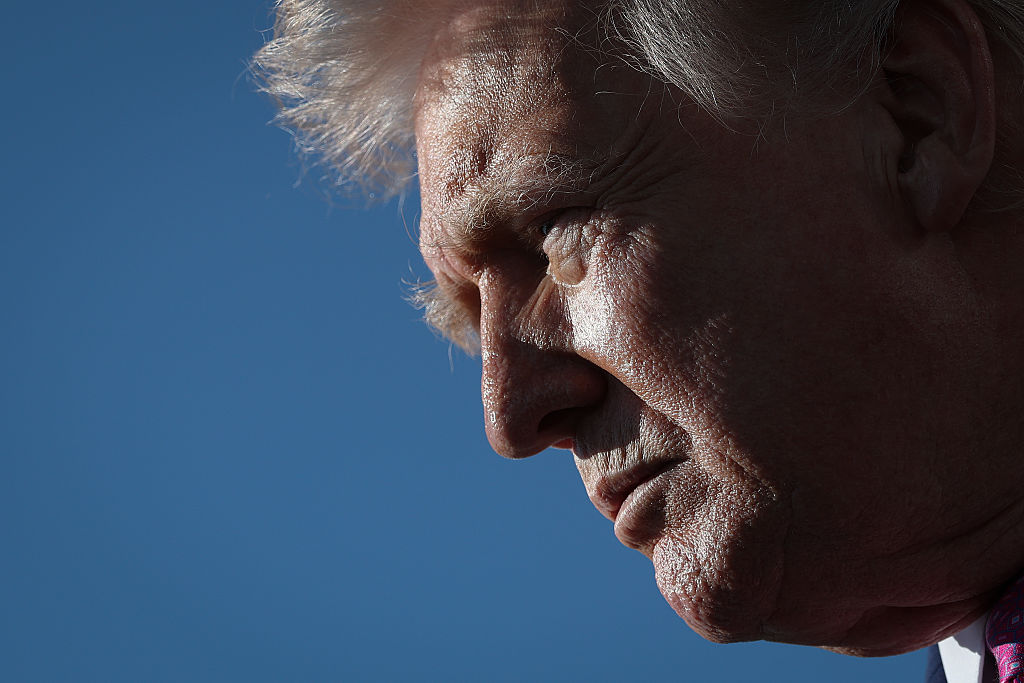
Less than 24 hours after Iran’s foreign minister declared the Strait of Hormuz “completely open” on Friday (17 April), it was effectively closed again. Iran’s top military leadership accused the US of “maritime piracy” and announced that the Strait of Hormuz had “reverted to its previous state” and was under “strict control of the armed forces”.
Two Indian-flagged ships reported coming under fire in the strait from Iranian gunboats on Saturday (18 April) before turning around. India’s foreign secretary summoned the Iranian ambassador that evening to convey his government’s “deep concern” over the “shooting incident.” Despite this, Donald Trump initially insisted that ceasefire talks were “going actually along very well”, although he also warned Iran not to “blackmail” the US. But now, as of Sunday evening, a US Navy destroyer has attacked and seized an Iranian cargo ship which broke the American blockade.
The weekend’s developments were a stark contrast to what now looks like a decidedly premature victory lap by the US president on Friday. After the announcement that the strait was open, Trump responded with a series of triumphal social media posts, writing that Iran had “agreed to never close the Strait of Hormuz again” and it would “no longer be used as a weapon against the World!” He declared it a “GREAT AND BRILLIANT DAY FOR THE WORLD!”
Trump also assured reporters at the White House that Iran had agreed to hand over its stockpile of highly enriched uranium, or what he called “the nuclear dust,” suggested that another round of negotiations would soon follow with the country’s “very reasonable” new leaders. “They’re willing to do things today that they weren’t willing to do two months ago,” Trump insisted.

Mohammed Bagher Ghalibaf, the speaker of Iran’s parliament and the head of the country’s negotiating team in talks, hit back at the president’s proclamations in his own series of social media posts that evening, writing that Trump had “made seven claims in one hour, all seven of which were false” and that the US “did not win the war with these lies, and they will certainly not get anywhere in negotiations either”. Trump’s crowing megaphone diplomacy seems to have derailed the tentative détente that was in place.
In a televised speech on 18 April, Ghalibaf said that the US must “earn the trust of the Iranian people” and abandon its coercive, unilateral approach. He, too, declared victory, insisting that by withstanding the US-Israeli assault, Iran had already effectively won. “When the enemy fails to achieve its objectives, it means it has been defeated,” Ghalibaf said.
And so, 48 hours after what was presented as a major breakthrough, the stalemate in the Strait of Hormuz has resumed. The crucial waterway, through which one fifth of the world’s oil and gas usually transits, remains effectively closed by Iran. The US naval blockade of all shipping entering or leaving Iranian ports is still in place. The mirage of an imminent end to the conflict has dissipated. The hard choices on both sides of this war remain.
Neither Iran, nor the US, seems eager to resume full-scale fighting, yet neither, so far, seems willing to accept the other’s terms for peace. Both countries’ leaders seem to believe, in the Trumpian parlance, that they still hold the crucial cards. For the US, that means the ability to decimate Iran’s energy infrastructure and destroy the country’s economy. Trump warned on Friday (17 April) that if no deal was reached by the time the current 14-day ceasefire expires on Wednesday (22 April), “we’ll have to start dropping bombs again”. Iran retains the ability to hold a significant portion of the world’s energy supplies hostage and wreak havoc on the global economy through its control of the Strait of Hormuz.
In truth, the fundamentals had not shifted as much as Trump’s euphoric declarations in recent days had suggested. When Iran’s foreign minister announced last week that the strait was open, he clarified that all ships would still have to use “the coordinated route as already announced by Ports and Maritime Organisation of the Islamic Republic of Iran”. Even then, Tehran seemed reluctant to cede its powerful leverage over the strait, which is presumably why the US naval blockade also remains in effect.
Beyond the public brinkmanship, diplomatic efforts appear to be quietly continuing behind the scenes. Tehran said over the weekend that it was reviewing “new proposals” received from the US via Pakistan. Trump said on Sunday that a delegation of US officials led by vice-president JD Vance would travel to Islamabad today for a new round of talks. The coming days could see an extension of the current ceasefire if those negotiations yield progress, and a genuine step towards an end to this war. Failing that, it is equally possible that this conflict will reignite, as both sides assess that they hold the stronger hand and move to call the other’s bluff.
In a social media post on Sunday, Trump duly reprised his earlier threats to destroy Iran’s infrastructure unless the country’s leadership agreed to his terms. “We’re offering a very fair and reasonable DEAL,” the US president wrote. “I hope they take it because if they don’t, the United States is going to knock out every single Power Plant, and every single Bridge, in Iran.”
[Further reading: We’re all stuck in Donald Trump’s cage fight]
Content from our partners



Related

Join the debate
Subscribe here to comment