
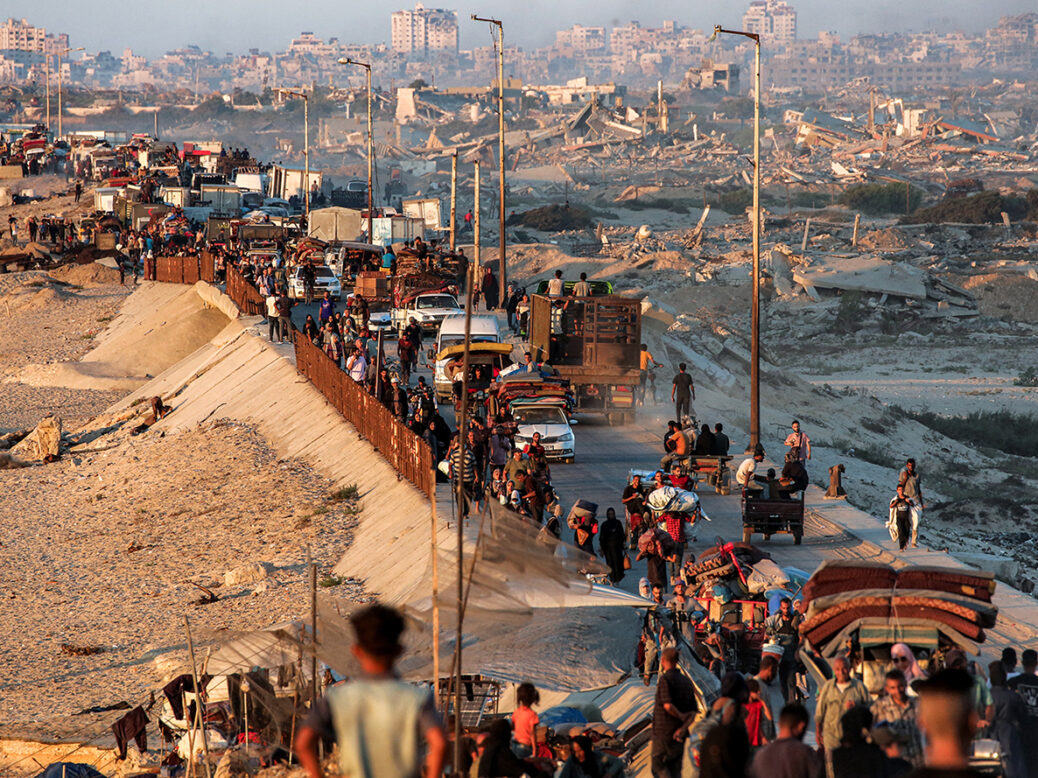
The dream of pursuing my postgraduate studies was a sliver of hope that I could give something back to Gaza. In our country, dreams demand a patience that exceeds human capacity. Universities have been destroyed, lecture halls turned to dust, and we have lost entire cohorts of academics. Everything around me reminded me that the path I want to follow is not a paved road, but a race across rubble.
I received an unconditional offer for the creative writing MA programme at Lancaster University in August, with studies to begin in October. I ended up being nearly two months late. Every day, I checked my university email to reassure myself they were still waiting for me, just as I was waiting, like thousands of other Gazans, for Israeli permission to leave the Strip to access treatment or education.
On my last day in Gaza, evearything felt heavier than I could bear. My father kept coming into my room, asking if I needed anything. He repeated: “Don’t worry… I’ll keep praying for you.” He tried to hide the trembling in his voice.
My friends surrounded me with looks that held both happiness and sadness. I kept thinking of Noor and Yasmine, the closest to my heart – one a dentist, the other a lawyer – and the war that had stood in the way of their dreams. Both are still waiting for the chance to pursue their own studies. Waiting has become part of life in Gaza, as if time itself is under siege.

At Kerem Shalom, the border crossing into Israel, I realised that while we’d been living in darkness, the world outside Gaza had been bright all along. It was 3am when I stepped off the bus with 15 other students, each of us heading to a different city in the UK. The weather was not cold, yet most students wore layer upon layer of clothing so they could carry as much as possible, since luggage was forbidden. We waited nearly two hours before we were allowed to enter the Philadelphi Corridor.
As soon as we entered the corridor, it was clear that Israel had controlled the area for years. The road was newly paved and smooth beneath our feet: a strange comfort after so long walking on shattered streets. Along the edges of the asphalt lay glass, torn bags of flour and broken tins. The road was full of stray dogs. I saw species of bird I realised I hadn’t seen in a long time.
At the first checkpoint, UNRWA staff waited. “Put on every piece of clothing you have,” they said, “and don’t carry anything in your hands except your documents.”
I was carrying a small handbag I had embroidered myself but was told it would be confiscated because it was leather with a metal buckle. I left it with the bus driver.
A man known as “The Moustache” stepped forward. He asked bluntly: “Who are you?” The driver replied: “Students going to universities in Britain.” But the moustached man didn’t wait for him to finish. He announced through his loudspeaker: “Britain… Britain…” A student joked quietly, “We’re English, mate.”
We queued up and entered a small room fitted with cameras. We were told to look into the camera and raise our hands. After that, we walked for several kilometres until we reached the crossing on the Israeli side.
There, we were ordered to remove all accessories and shoes and place them in trays, then stand on a platform, raise our hands, and look at another camera. Some female students were physically searched by female soldiers.
e travelled to Jordan to complete the visa process before flying to the UK. At the Queen Alia airport in Amman, the staff member accompanying us from the British embassy pressed a plane ticket into my hand. I glanced at it and my eyes caught writing in blue ink: “Refugee OK to board.”
I read it once, then again. Cold. Sharp. Humiliating. The air around me tightened. Tears came suddenly, without warning, like something that had been breaking inside me for years and had finally found its moment to collapse. I cried, in the middle of the airport, in front of everyone.
To me, the moment was a window into how the world sees a Palestinian: a person whose identity is shaped by imposed labels – refugee, transit, permitted entry – before they can be considered as a human being with a name, a life, a story. The word “refugee” felt like a false mirror, one that defined me by my leaving rather than living.
Every time a staff member took my ticket, they glanced at me quickly, then carried on without a word. My heart was screaming inside me: “I am not a refugee! My home is Palestine, and my father is waiting for my return!”
In Britain, everything looked far more orderly than I was used to. The only chaos was inside my chest. On the way to my university accommodation, a strange feeling followed, like I was living two days at once. A day arriving in a new country, yet still stuck on the steps of the bus where my father held my hand, in Yasmine’s embrace, in Gaza itself.
When I saw the wide, quiet spaces of the campus – almost unreal in their calm – it felt like a breath after nearly drowning. Not exactly comfort, but a faint light telling me I was capable of beginning again.
[Further reading: Syria’s fragile future]
Content from our partners
Related
This article appears in the 12 Dec 2025 issue of the New Statesman, All Alone: Christmas Special 2025
Join the debate
Subscribe here to comment