
In November 1958, the two-time president of Chile, Carlos Ibáñez del Campo, left behind the white walls of the colonial presidential residence Palacio de la Moneda in Santiago. His first presidency, more than two decades earlier, had been a military dictatorship, and in his second he had held power two years beyond the four-year tenure. In 1955, he was involved in a self-coup conspiracy, but, surprisingly, was allowed to finish his term. Since Ibáñez vacated La Moneda, no president has taken up residence in the palace – until José Antonio Kast’s victory in the 2025 presidential election. The far-right leader of the Republican Party, inaugurated on 11 March, has chosen La Moneda as his presidential seat.
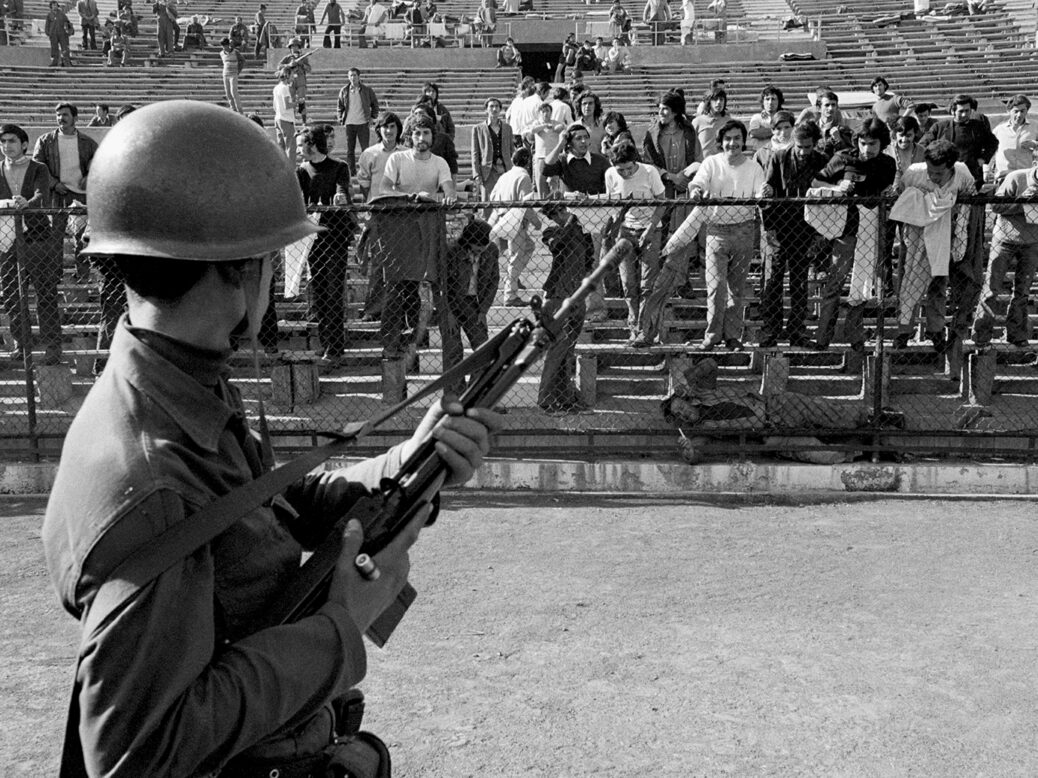
Kast sees himself as heir to Chile’s most famous leader, Augusto Pinochet. Pinochet’s military dictatorship of 1973-90 is Kast’s blueprint for successful leadership. He has praised the regime, calling it a peaceful, stable time, while omitting the brutalities of Pinochet’s secret police, the Dirección de Inteligencia Nacional (Dina). Kast does not mention the 1,200 officially known concentration camps and torture centres across the country, the exile of 200,000 people, and approximately 30,000 victims of human rights violations. The new president strongly supported Pinochet’s regime at the time, too: in 1988, a young Kast appeared in an advert calling for an eight-year extension to Pinochet’s rule. Kast’s presidency is the country’s furthest move to the right since the dictatorship. But even Pinochet, grand as he considered himself, chose to occupy a relatively normal house on Presidente Errázuriz Avenue in Santiago – not a palace.
Kast’s election was another victory for the insurgent far right in Latin America. In his previous attempts at securing the presidency, supporters would gather at political rallies wearing Maga merch. He often praises Donald Trump’s government and has been reported to have close ties to Benjamin Netanyahu, Javier Milei and Nayib Bukele. His 2025 campaign was punctuated by populist messages, promising to crack down on crime that he claimed had risen to unprecedented levels because of illegal immigration, especially from Venezuela. He pledged to offer Venezuelans a grace period to vacate Chile, before they are forcibly removed. Kast beat Jeannette Jara of the Communist Party of Chile; their run-off was an indication of how divided the country is.
A few weeks before Kast’s inauguration, I met Katia Chornik, a former Unesco consultant and now affiliated with Cambridge University’s Centre of Latin American studies. We met at London’s brutalist National Theatre on the bank of the Thames, a far cry from the neoclassical splendour of La Moneda. It was an unusually warm day for February, but a heavy cloud hung over Chornik. Like many others who grew up in the Chilean diaspora before returning towards the end of Pinochet’s dictatorship, Chornik sees parallels between Kast and Pinochet – and thinks of the new president as a step back to an era she hoped her country had left behind.

In her studies of Pinochet, Chornik chose to explore a topic that is usually an afterthought when examining authoritarian governments. She noted that art, and especially music, became a battleground between the regime’s oppression and the resistance it inspired. At the end of last year, Chornik published a book, Music and Political Imprisonment in Pinochet’s Chile. “In a very abstract way, music is something that sometimes bypasses the rational,” Chornik told me as we shared a coffee. “That capacity reaches places that other forms of communication – because music is a form of communication – can’t reach.”
Pinochet’s secret police used music as a form of torture: popular songs were played as the agents abused the prisoners. Usually uplifting songs became harbingers of pain. And for Chornik, her studies are personal. Both her parents were political prisoners in a detention centre interchangeably called Venda Sexy – Sexy Blindfold – or La Discothéque. Songs from the 1970s boomed at nightclub levels as Dina agents tortured the blindfolded detainees, as if in a twisted mockery of contrapuntal sound.
The way Kast presents himself has a similar, sinister impulse. At a recent political rally, he closed his speech with a song that became associated with political prisoners during Pinochet’s dictatorship. The vibrant and rhythmic “Candombe para José” blasting from the speakers shook the country. Some danced along; others couldn’t believe the audacity. The Candombe originated among the descendants of African slaves in Uruguay and was used during Pinochet’s regime as a vehicle for resilience and perseverance, a melody of survival. Kast seemed to be attempting to undermine the song’s associations.
Chornik told me she predicts a shift to revisionist memory politics under Kast. She expressed concern about the funding for memory sites and for educational projects, and emphasised how institutions such as the National Institute of Human Rights “are constantly having to fight for the budget. Their role is to keep up the standards of human rights [in the country].” Chornik imagines that without funding they will become “completely symbolic” with “absolutely no power” to maintain the fight for human rights. “That would leave the state with no accountability,” she stated.
Despite its employment as an instrument of torture, music was an integral part of the lives of many political prisoners during the dictatorship. “Singing was considered ‘not dangerous’ as long as the songs were neither political nor protest songs, and the lyrics had been reviewed beforehand,” Ana María Jiménez told me. Jiménez, now in her late seventies, was imprisoned in two detention centres under Pinochet’s dictatorship: the notorious Villa Grimaldi for a month and then Tres Álamos, known as the pit stop before exile, for 18 months. Jiménez was studying music pedagogy at the University of Chile when she got involved in social and political work. After spending two years “underground” she was detained by Dina in April 1975. When she was released from Tres Álamos in 1977, like most prisoners, she was exiled from Chile with a no-return ban until 1990. Upon returning to Chile, she published a memoir titled Antes de Perder la Memoria (2015) – “before losing memory”. Her memories of the 30 days at Villa Grimaldi are full of shouts, cries and groans, “Dolor. Miedo. Muerte,” she said – pain, fear, death.
Like Chornik’s parents, Jiménez was subject to torture accompanied by music. The torturers would sing “Gigi, el amoroso”, a fast and bright piece about love and the enduring bond of community, while electrocuting the prisoners. There were two moments that saved her during this time, she recalled, both related to music: singing “at the top of her lungs” while in the queue for the bathrooms and the song “Zamba para no Morir” that she sang to the left-wing agronomist Cedomil Lausic, a fellow prisoner who was severely assaulted and left to bleed out in one of the towers. Later, she found out that the last thing Lausic heard before dying was her voice.
After being moved to Tres Álamos in May 1975, Jiménez was allowed to form a group akin to a music club, where she and eight other women could sing, play the guitar and discuss music. At the end of that year they started a choir. Approximately 80 prisoners signed up – nearly the entirety of the detention centre. “Singing together was a way to resist and breathe the open air,” Jiménez said. The large group of female detainees were given leave to gather twice a week to sing in the patio of the detention centre. It was a moment of release for them.
To mark the 40th anniversary of the military coup, in 2013, an event was organised at Villa Grimaldi, now a museum. Jiménez was asked to revive the choir of Tres Álamos. “It was not an easy task. We were scattered, still marked by the years of imprisonment, and there was a lot of reluctance.” But under Jiménez’s leadership they exceeded their expectations. The choir, composed of some ex-prisoners and new members, gained in popularity, singing songs from the 1970s, mainly from the nueva canción movement. One of the most notable members of nueva canción was Victor Jara, whose tragic death at the National Stadium in Santiago at the hands of the Dina in 1973 spread quickly in international media.
Now known as Voces de la Rebeldía – Voices of the Rebellion – the choir continues till this day. “Little by little, the choir transformed into an instrument of living memory of the years of the dictatorship,” Jiménez underscored. “It was a beautiful work of resistance and resilience that allowed us to grow musically and personally.”
Jiménez has since passed the baton to the musical director Ignacio Ugarte. Voces de la Rebeldía has expanded its repertoire and collaborated with groups like the feminist LasTesis, best known for their 2019 collective performance of “Un Violador en tu Camino”. The song that calls out the violations to women’s human rights in Chile went viral on social media and has been recreated in 52 countries since. Elle has labelled it “the world’s most powerful feminist anthem”.
In the days leading up to Kast’s inauguration, women and LGBTQ+ groups flooded the streets of Santiago in protest of his presidency. “Turn your rage into dance,” the MC shouted towards the crowd. It was the country’s biggest International Women’s Day demonstration since the pandemic. Kast is a staunchly Catholic father of nine who rejects abortion and the use of contraceptives. When I asked about the new president, Jiménez told me: “I believe there will be a setback for our country and particularly for us women. All the points in his campaign related to women, from the proposal to abolish the Ministry of Women and to disregard all acquired rights, demonstrate this.”
In 2025, the writer and lawyer Philippe Sands published 38 Londres Street, an investigation into the eponymous torture centre. Kast makes a brief appearance in Sands’ book, during his second presidential run in 2021. Before life in politics, Kast was a lawyer. Sands documents his visit to Miguel Krassnoff, one of Pinochet’s most notorious Dina agents, in prison.
Krassnoff was originally sentenced to 144 years of incarceration in 2006. Since then, his prison term has been increased to more than 1,000 years at Punta Peuco as new evidence has emerged. Punta Peuco is the maximum security facility in Santiago specifically built for the perpetrators of human rights violations under Pinochet. The visit may have been related to the president’s pledge to release aged prisoners who committed crimes against humanity under Pinochet.
Kast did not mention the pardons in his latest campaign, but there is still concern he will act on those pledges. Sands said: “That would really send a most terrible signal, to let such people off the hook and to release them. It would be a shocking precedent. It would undermine the work that has been done to deal with accountability, truth telling. It would have huge implications within Chile in relation to victims and descendants of victims. It would most likely cause very serious political unrest.”
“Law and literature have a connected role,” Sands told me. “For me, law and literature are very intertwined, and you feel that very much in the Chilean context.”
Sands was impressed by Chile’s capacity to produce artistic rebellions in conditions of oppression, more vital than any possible political resistance. “What I’ve been very struck by with Chilean culture is that it dived into these issues [of the dictatorship] before there was any formal justice in Chile. They were writing about these things and making films about these things at a point when there wasn’t a general amnesty and no criminal investigation,” he said. The reclaiming of history and bringing the state to account began in art, not in the courtroom. Chile has a long and rich tradition of political art that includes, to name just a few, Roberto Bolaño, Victor Jara, Pablo Neruda and Isabel Allende.
Most of the artistic voices who dared to speak up against Pinochet’s regime are gone. There are not many left who suffered under the dictatorship. The country is tense with the panic of cultural and social regression, and the growing fear of a slide into autocracy. “There are many awful examples of governments who have come to power through democratic elections and then turned into authoritarian [administrations],” Chornik noted. We can only hope that the return of Chile’s president to La Moneda is not also a return to the country’s past. As the nation enters a new political era, the artistic responsibility will fall to groups like Voces de la Rebeldía and LasTesis. As ever, we will know Chile by its music.
[Further reading: Do you want to be part of Donald Trump’s new empire?]
Content from our partners



Related


Join the debate
Subscribe here to comment