
Skokie, the suburbs of Chicago, 1977. The village is a refuge for Jews who survived the Holocaust. The National Socialist Party of America has put in a request to march through its streets. Local village leaders file a lawsuit to prevent the march from taking place. The complaint does not allege that the Nazis would be violent, but that the display of the swastika “constitutes a symbolic assault”. If the march goes ahead, certain Jewish groups plan to oppose it with violence. The American Civil Liberties Union (ACLU) steps in to represent the Nazis in court. For 15 months the ACLU battles to defend the Nazis’ right to free speech. The man who led the ACLU at this time was Aryeh Neier, a Jew born in Nazi Germany who narrowly escaped the Holocaust.
Defending the rights of extremists was not new for the ACLU. It was founded in 1920 to protect the expression of opinion “however radical, however violent”. This was a violent time, more tumultuous than 1977. The Ku Klux Klan had 100,000 members in 1921 and influenced elections in the South, Mid-West and towards the Pacific. The ACLU thought the Klan was one of the greatest threats to free speech in the country. It devoted time to securing prosecutions of Klansmen for taking away their victims’ free speech. But it also defended the Klan’s own right to speech.
In the 1960s, the ACLU defended thousands of civil rights activists and tens of thousands of antiwar protesters. With Richard Nixon’s power grab laid bare, the ACLU’s membership reached 275,000 in 1974. All this time, its lawyers were turning up in court to represent Nazis.
Nonetheless, Neier received many letters throughout the Skokie case accusing him of propping up the Nazis in some naïve, suicidal quest for a fleeting principle. But it was some of the supportive letters which he found most disturbing. “I love free speech,” one woman wrote to him, “more than I detest the Nazis”. In Neier’s view, this comparison deployed the same binary used by those who cast him as a turncoat. In fact, he thought, the two were not just compatible, but interdependent. Protecting the rights of the Nazis was the only way to prevent the tyranny they wanted to create. “To defend myself, I must restrain power with freedom, even if the temporary beneficiaries are the enemies of freedom,” he wrote in his account of that 15-month battle, Defending My Enemy. “Freedom has its risks. Suppression of freedom, I believe, is a sure prescription of disaster.”

Whether the tolerant should tolerate the intolerant has always vexed liberalism. Karl Popper put forward this paradox in The Open Society and Its Enemies. He thought that intolerance must not be tolerated. Neier considered Popper’s a short-term, unstable settlement. In the end the element of suppression – of anyone’s freedom – would come to dominate. He pointed to the Brandenburg court case to prove his point. In 1969, the KKK leader in Ohio Clarence Brandenburg was convicted after he said “some revengeance [sic]” must be taken against a government suppressing the white race. The ACLU took his case all the way to the Supreme Court, which reversed his conviction, creating the precedent that the government could not suppress speech calling for violence unless it would lead to “imminent lawless action”. Later that year, this precedent was used to overturn convictions for leading anti-Vietnam war protesters. Upholding the rights of the hateful, in other words, had protected the rights of all.
Another prize was at stake here: the legitimacy of liberal democracy itself. Racist revolutionaries thrive when the system they want to overthrow loses legitimacy. Repression wins them sympathisers. As soon as the state suppresses one side the government will be asked to treat their enemies in the same way. A liberal democracy exposed as illiberal loses the trust of its voters. And when that happens the populace might opt for real illiberalism.
The courts eventually ruled that the Nazis in Skokie could march, but their leader, worried about a lack of support, called the march off. A Holocaust Remembrance Museum was established in Skokie.
In Neier’s words, the ACLU “defeated the Nazis by preserving the legitimacy of American democracy”. The Nazis must be free to speak, Neier wrote, because “Jews must be free to speak and because I must be free to speak.”
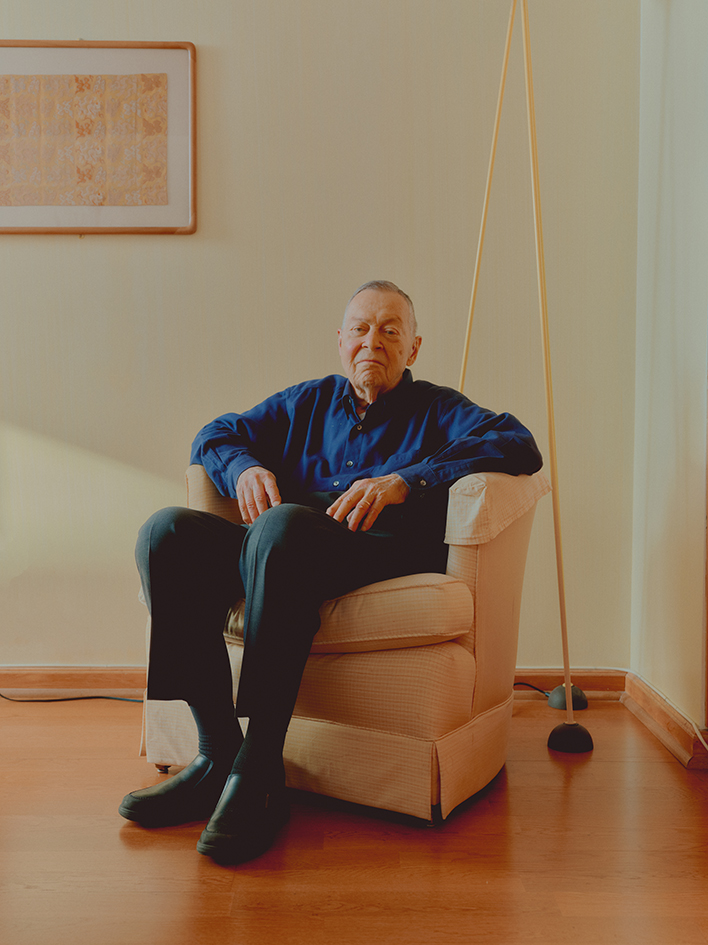
Half a century later, Neier, 88, clutching a mobility walker, his back stooped, sat down at his favourite table in a restaurant in the West Village, New York, and ordered his usual, a Caesar salad and club soda. He has lived down the road in the same flat for 60 years. Age has made his voice hoarse, but he still speaks with resolute conviction, his eyes bright blue, like Anthony Hopkins.
New York is his home. But he first took refuge from Nazi Germany in England. He arrived as a baby two weeks before the start of the war on 16 August 1939. His Zionist parents had given him a Hebrew name that meant “lion”. When their home in London was bombed, they were evacuated to the Midlands. It wasn’t until after the war, living in Northampton, that they discovered the totality of the destruction of their family. His father’s mother had been shot and killed after the Germans overran her village in Poland. His two uncles had survived Bergen-Belsen only to be killed on the eve of the camp’s liberation.
In the late 1940s, the family emigrated across the Atlantic as his older sister had married an American soldier. “The rest of the family had been destroyed,” he told me, “and therefore my parents didn’t want to be separated from their daughter.
Neier got a degree at Cornell University, then at 26 joined the ACLU, and by 33 was its national director. He rose swiftly, leading the ACLU through the Skokie case at the age of 40. He went on to co-found Helsinki Watch, which became Human Rights Watch, and was later made the inaugural president of George Soros’s Open Society Foundation (OSF) in 1993, a position he held for two decades. At 88, he still regularly writes essays for the New York Review of Books.
Defending My Enemy was reissued in September. It comes at a time when few in America believe in free speech for anyone but those on their own side. It is rare to hear someone distinguish between the right to expression itself and whether the contents of that expression contain merit. “The worst aspect of what is going on is the absence, or partial absence, of resistance in the United States,” Neier told me. “I believe that resistance works.”
Various administrations in the past have gone after those who criticise the government. Think of the Sedition Act during World War Two or the decade of McCarthyism. The difference now, he thinks, is that Trump is going after institutions, not just radicals. Large philanthropic organisations such as the OSF have become a target for the Trump administration, which he thinks will go after the OSF’s tax deductibility. Neier said he still sees Soros fairly often.
The day before our lunch at the end of September, President Trump peacocked in front of the United Nations and mocked everything the UN stands for: conflict resolution, humanitarian aid, international law. Trump was blowing boats full of people out of the water in the Caribbean. He was usurping the system whose founding and legitimacy was inextricably bound up with human rights. At a time governed by the whims of authoritarians and not rules, can the UN withstand such attacks from the very nation which underwrites its treasury and enforces its decisions?
“The international system is in poor shape. It has been in poor shape as long as I can remember,” Neier said. “It’s not the first time that the US has withdrawn that support from the UN.” He pointed to Ronald Reagan, who was “very antagonistic to the UN and the UN didn’t collapse as a consequence of that”.
The International Criminal Court, which sits within the UN system, has also long been a bête noire for Republicans who view the idea a foreign court could convict an American citizen as an insult to US sovereignty. The ICC was for several years confined to prosecuting African warlords. Yet, Neier noted, former Filipino President Rodrigo Duterte is currently being held at The Hague for the actions of government murder squads which enacted his war on drugs. The ICC has also issued a warrant for the arrest of Benjamin Netanyahu for crimes against humanity committed in Gaza.
In June last year, Neier concluded that Israel was committing a genocide against the Palestinians in Gaza. While leading Human Rights Watch, Neier made only one accusation of genocide: Saddam Hussein’s destruction of the Kurds in the late 1980s. Neier agrees that Netanyahu should be arrested but thinks it is unlikely to happen.
Someone else who has called for the arrest of Netanyahu is New York’s mayor-elect, Zohran Mamdani. I asked what Neier thought of Mamdani. “That’s a complicated question,” he said. “I’m not enthusiastic about some of his proposals. On the other hand, I’m more enthusiastic about the way he would shake up things in New York.”
Neier has little time for the idea that Mamdani is an anti-Semite. “I don’t really think there is a basis for that. I don’t see it,” he said, “I do know Brad Lander, who is the comptroller in New York, and Brad Lander is Jewish. I’ve only ever seen Brad Lander at Jewish events, and the fact that Lander is so strongly supporting him is something of a refutation of the anti-Semitism claim.”
“I think it’s almost impossible for a mayor in New York City to act in an anti-Semitic fashion. I think the number of Jews in key positions is so great that it would be very difficult for him to actually do anything that is anti-Semitic.”
Neier does not know Mamdani, but he does know his famous parents. Mira Nair, Mamdani’s mother, an Oscar-nominated filmmaker, once got money from the Open Society to create a filmmaking school in Uganda. “I dealt with her directly with respect to that, and we gave a grant, which was the principal funding for that school,” he said. “I regard [her film] Monsoon Wedding as an absolutely outstanding film.”
“I knew, separately, Mahmoud Mamdani, his father, and I didn’t like Mahmoud Mamdani. I think the feeling was mutual.” Mahmoud, a scholar of colonialism at Columbia University, took issue with an article Neier wrote after 9/11, in which Neier argued the attacks constituted an assault on modernity. “He reacted strenuously against that. I always found Mahmoud Mamdani a somewhat-demagogic person, so I didn’t care for him.”
Speaking to Neier, a human rights expert whose life demonstrates a sincere and considered belief in the principle of free speech, it is hard not to think of Keir Starmer, who has committed a similar portion of his life to human rights law, and has repeatedly said the UK is protecting free speech despite all the evidence suggesting otherwise.
The British police are zealously arresting those who voice any opinion that individual police officers – and these decisions lie within their discretion – find unacceptable. Over 10,000 people a year are arrested under two laws, one of which counts causing “inconvenience” through communications as a reason to lock them up. Starmer himself pushed for those who support Palestine Action to be wheeled off to prison. Put aside the question of whether the best way to defeat Nazis is to defend freedom tout court, the British police have knocked on the door of a grandmother near Manchester who complained about her local town councillor on a private WhatsApp chat.
This is all waved through by a political class more interested in suppressing views which they think might lead to Britain exploding into civil strife than addressing the causes of those views in the first place. What makes it worse, and what impinges on Starmer’s credibility further, is that his false appraisal of the truth is in service to his decision to align the UK so closely with the White House.
The difference between Neier and Starmer can be partly attributed to the difference between civil liberties and the broader concept of human rights, or at least its manifestation in the past few decades. There is a movement to make certain social and economic policies the law of the land under the guise of human rights in order to bypass the democratic process. This view was institutionalised under New Labour. The Human Rights Act (1998) has broadly defined rights to family life that are often used to prevent deportations, for instance, and rarely to protect free speech. In 2023 Gordon Brown wrote a report that recommended Labour adopt new “social rights” around healthcare, poverty, education and housing. In other words, policy should be taken from accountable politicians and handed to appointed experts, whether judges or as, Brown suggested, bodies such as the Equality and Human Rights Commission.
Neier told me that lots of people in the international human rights movement are “antagonistic” to him because he doesn’t espouse “economic and social rights”. He thinks these issues should be dealt with through the democratic process. “I’m for greater distribution of wealth [for instance] but I don’t think it should be through the rights process.”
Both right-wing populists such as Trump and the progressive lawyerly class typified by Starmer have departed from the principles which have governed Neier’s life. After lunch, as we walked down the street and he navigated bollards with his stroller, I thought what a rarity someone with his beliefs had become.
[Further reading: Cambridge’s new chancellor: Free speech is my priority]
Content from our partners



Related


Join the debate
Subscribe here to comment