
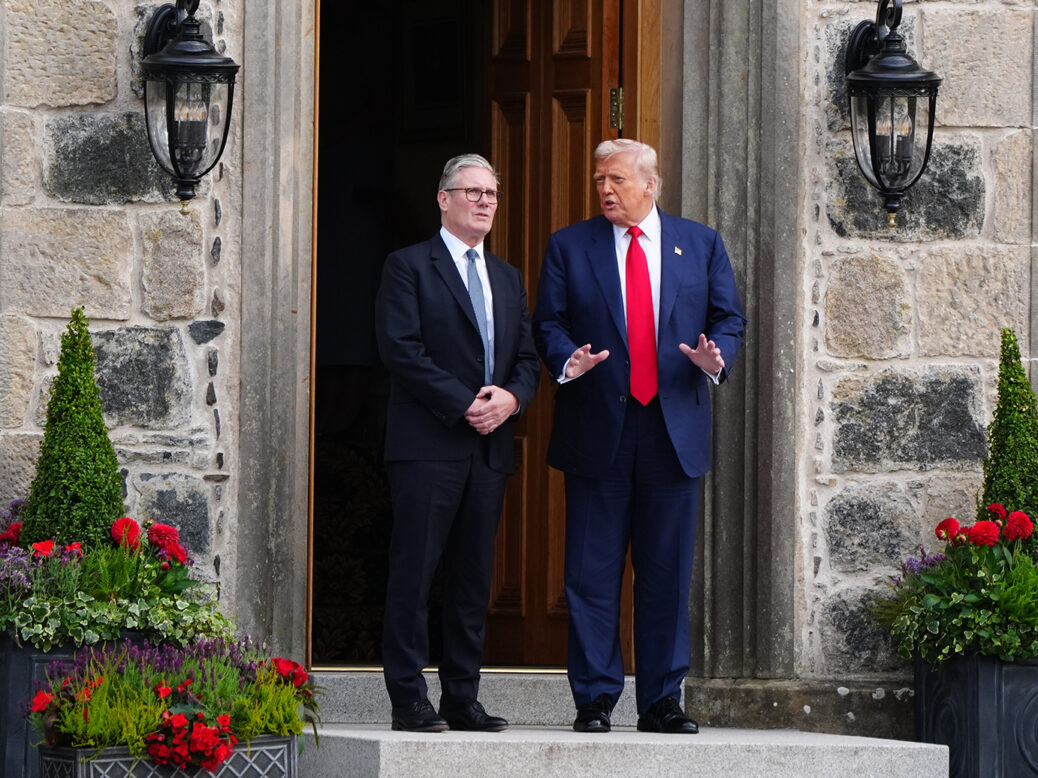
It took Keir Starmer 16 hours on Saturday to formulate a response to Donald Trump’s extraordinary actions in Venezuela. When it arrived, it was carefully worded: Britain will “shed no tears” about the fall of Nicolás Maduro’s regime, Starmer wrote in a statement, and has “long supported” a transition of power. On the glaring question over the legality of the US’s action, the Prime Minister simply wrote: “I reiterated my support for international law this morning.”
The delay was baffling to onlookers. Then, when the statement arrived, he faced calls from multiple directions to go further: from the Greens, the Lib Dems, the left of his party, even Emily Thornberry, the Labour chair of the Commons foreign affairs select committee and a respected colleague of Starmer’s. She said the UK needed to be clear that the strikes on Venezuela and the capture of a foreign leader were a clear breach of international law: “We condemn Putin for doing it. We need to make clear that Donald Trump shouldn’t be doing it either.” Even Nigel Farage said that Trump’s actions were “contrary to international law”.
Labour MPs’ inboxes began to fill up with complaints. “This is killing me with my core voters, with my members, with the very few middle class liberal voters we have left,” one moderate MP remarked. Yet Starmer won’t condemn Trump’s action in Venezuela – and most of his MPs, however unhappy they are with his performance elsewhere, don’t expect him to. Starmer is not concerned with public comments of condemnation, he is instead preoccupied with retaining some influence over Trump. Whether he still does is a different matter.
The last time Trump genuinely shocked Europe’s diplomatic sensibilities was the Oval Office dressing down of Volodymyr Zelensky last year. In the immediate aftermath, international leaders expressed their solidarity with Ukraine online. Starmer remained silent.

But behind the scenes, Starmer picked up the phone to both leaders, encouraging them to get back in the room and continue the dialogue. The Americans declined, but Starmer spoke to Trump on the phone twice in those days, fresh from his own, more successful, visit to the White House, and got a nod from the President to begin pursuing his own Ukraine peace talks with European allies. He brought forward Zelenksy’s planned visit to London, displaying his support not with words, but with a hug. Days later, on the fringes of the Pope’s funeral, Starmer was with Trump and Zelensky, as well as Macron, as we witnessed a thawing. Starmer would later explain his approach: “Action not words.” He wasn’t running around tweeting; he was brokering peace behind the scenes.
Nearly a year on, Trump’s support for Ukraine is still on a knife-edge. Starmer’s effort to persuade him to provide security guarantees is ongoing, and more fragile than ever. You don’t need to be psychic to guess what our former human-rights lawyer and Iraq-War-critic prime minister privately thinks of the US intervention in Venezuela. He isn’t saying it, however uncomfortable that is, because he needs to retain influence over Trump on Ukraine.
Starmer’s foreign policy is heavily shaped by Jonathan Powell, his national security adviser, who is referred to in Whitehall as “the real Foreign Secretary.” Powell, who served as Tony Blair’s chief of staff during the Good Friday Agreement and the post-9/11 interventions in Iraq and Afghanistan, has geopolitical experience that few in Britain match.
Britain “could adopt a declaratory foreign policy, as the French do, and win support around the world by saying things people want to hear,” Powell writes in The New Machiavelli. “But that would result in our having less influence in Washington and less ability to change anything in the real world.” He wrote those words some 15 years ago, yet they speak directly to a criticism I heard from a Labour MP just yesterday, lamenting what they call Starmer’s “doormat” approach to Venezuela and asking, “Why can’t we be more like the French?”
While Starmer and his team may shrug off the left-wing MP Richard Burgon’s description of him as “craven” in handling Trump, the real worry is whether he still wields any influence over the American president. After last year’s Oval Office row, Starmer secured a phone call with Trump immediately. This time, following the Venezuelan crisis, four days have passed at time of writing and the call, although expected imminently, still hasn’t come. With Trump fielding calls from half the American press and even from his political rival, the newly elected New York mayor, Zohran Mamdani, the delay is a stark signal of the limits on Starmer’s leverage.
Crucially, Powell does not argue for cosy ties with Washington at the expense of other relationships. He advocates maintaining closeness to both the US and Europe, and was a key architect of Blair’s vision of Britain as a “bridge” between the two. Starmer is pursuing closer alignment with the EU single market – willing even to clash with Farage over it – and has stood alongside European leaders in drawing a firm red line on the sovereignty of Greenland.
“Any British prime minister who allows themselves to be forced to choose between America and Europe is making a terrible mistake,” Powell writes. Starmer enters 2026 determined not to make that choice – but Trump is making it anything but easy.
[Further reading: America’s imperial fights are not necessarily ours]
Content from our partners


Related
This article appears in the 07 Jan 2026 issue of the New Statesman, What Trump wants
Join the debate
Subscribe here to comment