
Across from Brooke House – the brutalist tower that dominates Basildon’s concrete-covered town centre – stands one of the town’s oldest pieces of public art: a twisted aluminium and steel sculpture by AJ Poole. Installed in 1957, the piece embodied the government’s ambitious vision for one of its largest New Towns. When the Basildon project was first announced in 1948, the then Labour planning minister, Lewis Silkin, promised it would be “the best possible town that modern knowledge, commerce, science and civilisation can produce”. The sculpture was named “Man Aspires”.
Aspirational is one word for “Basildon Man”, the caricature of working-class voters converted to Thatcherism. Ed Westwick’s upstart UPVC window salesman, Vincent Swan, protagonist of the BBC sitcom White Gold (which is partially set in the town) is one of Basildon Man’s more recent portrayals. As Swan chases material wealth in Eighties Britain, he prefers a different descriptor: “ambitious”.
The term Basildon Man emerged in the aftermath of David Amess’s victory in the constituency in the 1992 election, and is a variation on a theme in British politics. Used interchangeably with the more famous Essex Man, he was a convenient shorthand to explain Thatcher’s victories in Labour heartlands. (Later, Tony Blair’s strategist would call him Mondeo Man.) Basildon Man was personified by Harry Enfield’s “Loadsamoney” sketch: a brash construction worker in gold chains, waving bundles of cash and shouting about his wealth. The stereotype has become generative: the arch-Brexiteer MP, Mark Francois, grew up in Basildon before leaving to pursue a career in the City.
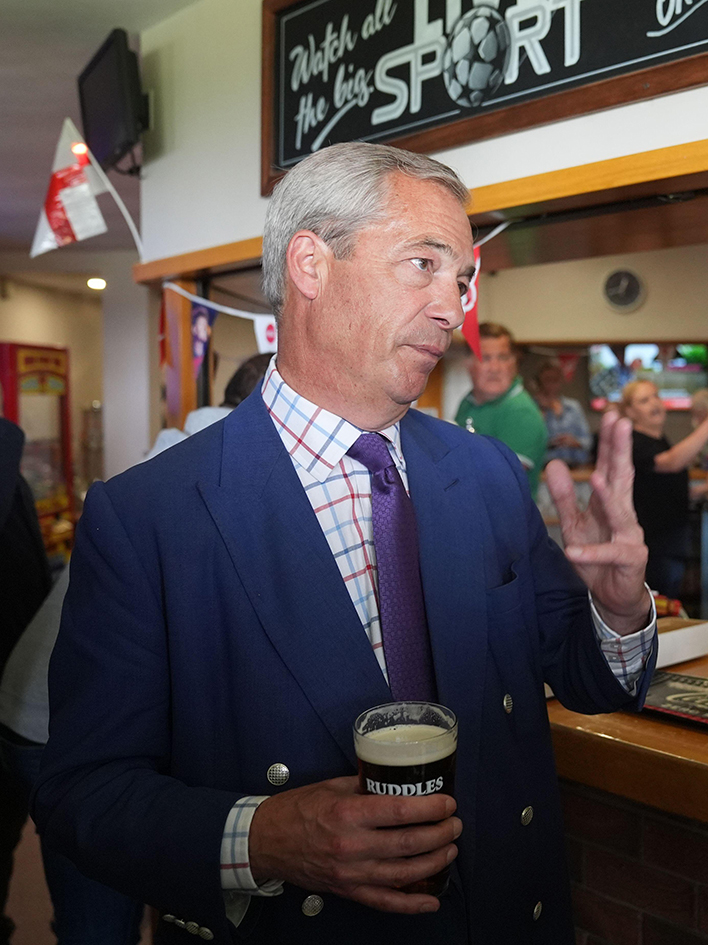
Basildon Man also has a knack for predicting elections. Basildon returned an MP from the party that formed the government at every election from the constituency’s creation in 1974 until it was redrawn in 2010. Political strategists came to believe that if you could win Basildon Man, you could win Britain. Ahead of the local elections on 7 May, Nigel Farage is set on ending a quarter of a century of Conservative governance in Essex. And polling projects that Basildon Man is about to hand Reform UK his town.

Emerging like a cement oasis along the Thames estuary, Basildon town centre’s geometric plazas and concrete residential blocks serve as a reminder of the drive for progress that underpinned the town’s brutalist design. Here, relics of a historic vision of the future meet the uninspired, newly thrown-up, build-to-rent apartments of the town’s present. Graffiti, empty shopfronts and an ageing housing stock in visible disrepair – this is what locals complain about. Silkin’s vision feels very distant.
In the town centre’s newly opened Wetherspoons, Sigered, King of Essex, Brian, 30, laughingly identifies himself as a Basildon Man, gesturing at his popped-collar Ralph Lauren polo. “Although I’m not a white-van man. Mine’s silver.” Recently relocated from east London – where many Basildonians trace their roots – his cockney twang merges with those of other patrons in the busy pub. Above us, the walls are wrapped in a print of a medieval tapestry that I can only assume is telling the story of Sigered, whose surrender in the early Middle Ages brought about the end of Essex as an autonomous region. Around us, West Ham shirts speckle packed tables.
Brian, a mechanic, says he would welcome Reform running the council because of unspecified “recent issues”. Chatter on local Facebook groups suggests that he may be referring to the council’s controversial request to delay local elections. He worries, though, about volatility. “They could usher in another Hitler,” he says, half joking. Ultimately, he would prefer to leave British politics behind entirely. “I’d move to Australia if I could. It’s a better life out there.”
Under Margaret Thatcher, parts of the south-east’s working class did grow wealthier, largely through increased home ownership and rising property values. But prosperity along the Thames estuary was uneven, and many Basildonians remained relatively poor. In 1997, nearly a third earned less than £10,000, then the average wage in the south-east. Today, Basildon Man’s personal aspirations sit uneasily among the town’s declining structures, a reminder of a collective project that has lost some of its force. The 41 storeys of Brooke House, once home to factory executives, were evacuated in 2019 over structural safety concerns.
It is at the foot of the tower that I meet CJ Clarke, a local photographer and film-maker, whose book Magic Party Place (2016) captures Basildon in the decade before the Brexit referendum. Clarke finds inspiration in the town because it is, statistically, an “everyplace”. The Economist described its residents as the most typical in Britain in terms of income, home-ownership and ethnic mix. This would make Basildon Man less a municipal feature, and something more like the nation’s median voter.
Clarke offers a potted history. “We didn’t even have a train station until the 1970s,” he says. “The planners thought people would never want to leave.” When the postwar government launched the New Town programme, Silkin joked it was an attempt to make Thomas More’s Utopia a reality. The towns were meant to be self-contained: a balance of housing, jobs and community life. In Basildon, state incentives encouraged companies such as Ford Motor Company and Carreras Tobacco to establish factories. By the 1970s, the town earned the nickname “Moscow-upon-Thames”, reflecting its industrial links to the Labour Party. And this model helped produce the conditions that make Basildon Man possible: stable work, accessible housing and a sense of collective trajectory.
Clarke and I stop in “Bas Vegas”, a leisure park once known for its nightlife. In the 2000s, it was home to six nightclubs, rumoured to draw in revellers from across the country – with one venue renowned for its all-you-can-drink offers. Bas Vegas’s last remaining nightclub closed in 2024 and the leisure park is now home to chain restaurants and budget hotels.
Basildon’s first settlers, Clarke explains, were largely East Enders chasing the town’s aspirational promise. Their “frontier mentality” was reflected in the emblem of one early tenants’ association: a covered wagon, the symbol of a rugged individualism more often associated with the US. The town’s long-serving Labour MP once reflected that Basildon felt like “a little bit of America in Essex”.
Yet the New Town’s utopian vision was fragile. By the time Basildon was built, its design was already dated and ill-suited to a changing economy. The growth of the service sector in the 1960s was the first hint of Britain’s post-industrial transformation. The 1970s brought a wave of industrial action and by the end of the 1980s, large employers, such as Carreras cigarette factory, had left town.
While a relatively significant manufacturing sector remains in Basildon today, the planners’ vision of a town where one lives and works and rarely leaves is no longer its pull factor. Rather, as London’s commuter belt continues to expand, new build-to-rent towers under construction near the train station suggest it’s Basildon’s transport links to the capital that are its biggest attraction. Clarke himself commutes to London for work.
But, the demolition of many original New Town buildings, he thinks, has weakened the town’s sense of identity. “Basildon was somewhere you could shape for yourself,” he says as we drive past the few remaining social clubs nestled in industrial estates. “That sense of self-making existed in the town’s psyche. I’m not sure how much of it still exists for young people.”
It is difficult to have a conversation with Olly Thatcher, 22, and Jude Moore, 30, inside Robin’s Pie and Mash. Teenagers interrupt to ask Olly for photos. Jude is repeatedly pulled into conversations with people he knows: how’s your mum, your sister, your dad?
In joggers, puffer jackets and caps, they may look unremarkable, but both have become local celebrities through social media: Jude through rap music, Olly through TikToks about Basildon, where he documents his favourite local spots and provides snippets of the town’s history. Olly initially hesitated to speak to me. He dislikes the reputation the town receives online, where creators amplify stories of crime and drugs, with titles like “Britain’s chavviest town”. In his work, he seeks only to showcase the positive aspects of Basildon and its residents. In their respective ways, both are documentarians of life in Basildon, de facto representatives of the new generation of Basildon Men.
“I started making videos partly for the kids,” Olly says. “There’s not really much to get excited about here,” Jude adds. “There used to be youth clubs. Now there’s less of a sense of community.” He pauses. “Well, there still is in places like Craylands Estate, where I’ve just moved from. People still knock ’round for tea, sugar.” His new song, “Council House Blues”, reflects that feeling. “I actually missed Craylands when I left,” he says. “I missed the hustle and bustle, the kids playing out.”
What they describe – fewer youth clubs, fewer places to meet – reflects a longer shift in Basildon’s social life. The same Thatcher-era changes that weakened collective institutions also reshaped political behaviour: trade unions, social clubs and local organisations declined, while a more individualised outlook took hold. Basildon Man was first coined amid a reorientation away from public life and towards the private sphere, from community organisations and family towards individual success.
That inward turn has only intensified. Social media has transformed local politics. In Basildon, much of it now plays out on Facebook, where council meetings are clipped, streamed and debated in near real time. Posts by councillors attract thousands of comments, many furious. Gavin Callaghan, Basildon Council’s Labour leader, is frustrated by the spectacle. He believes Reform’s support locally is strongest among residents in social housing. Home-ownership once defined the New Town dream: in the mid-1990s around 71 per cent of homes in Basildon were owner-occupied.
But decades of Right to Buy have transformed the housing market. Private renting has risen, and the council waiting list is approaching 4,000 households. Housing shortages have also become entangled with debates over immigration. Basildon Council does not house asylum seekers directly, but the Home Office places them in privately rented accommodation. “There are landlords who have issued Section 21 notices to convert properties into HMOs [houses in multiple occupation],” Callaghan says. The council has since tightened restrictions on new licences.
For people like Olly and Jude, the result is confusion about who – if anyone – is in control. “I’ve heard they’re prioritising people from Essex for housing,” says Olly. “They say that,” Jude replies, “but what they actually do…” Olly admits he has not paid as much attention to politics as he feels he should. “I don’t know who to trust.” Jude, meanwhile, has stopped discussing politics online altogether. “You’re just going to get called right wing,” he says.
Many residents initially backed Reform simply because it seemed different, he believes. But even that novelty is fading. “Nigel Farage is just another geezer in a suit,” Jude says. He now thinks Rupert Lowe, who has a harder line on immigration than Reform, might be the one offering real change. Like Brian in Wetherspoons, he says he would move to Australia if he could: “There’s a better quality of life, better jobs. And, I don’t mean this in a racist way, but there’s less immigration.”
Neither Jude nor Olly believe the council is especially effective. “When I was a kid there were street sweepers, people jet-washing graffiti, cutting the football fields,” Jude says. “They’ve got the money there, but they’re not bothered.” And these everyday disappointments matter, and mount. “You’re influenced by what you see every day,” Olly adds. “Cracked windows, dirty shop fronts. It changes your attitude without you even realising… I used to do reckless stuff,” he says. “But when I turned 18, I thought I’d rather do something good. Start a business.” One day, he says, he had an epiphany. “Why don’t I represent where I’m from? I’ll be the one to create the opportunities.”
In the postwar decades, long before he became a coinage, a byword for quick money and fast living, Basildon Man’s aspiration for better housing and work led him to leave the East End for the New Town. And, for a fleeting moment, his dreams became a reality. But the socio-economic conditions that permitted a project as ambitious as the New Towns have disintegrated. In its place has emerged a politics of disillusion, suspicion and the search for alternatives. Today, Basildon Man’s sons remain aspirational. But his search for those things once offered by the New Town – secure housing and work – may lead them to emigrate once again. This time, for Jude and Brian at least, perhaps as far as Australia.
If Basildon reflects the national mood, then the mood has changed. Basildonians, like the rest of the nation, polling suggests, have turned their backs on both Labour and the Conservatives in favour of new, populist parties that are predicated on the promise of change. In 2019, “Man Aspires”, like much of Basildon’s 1950s infrastructure, was in need of restoration. It was removed from public display for repair work undertaken by the council. Three years later, it was returned to its former glory, a visual reminder of the town’s promise. As we part, Callaghan tells me: “The NHS wasn’t Attlee’s greatest achievement. Basildon was.” To satisfy this claim would require both investment and will from local government leaders – whomever that may be. But, Basildon too, its residents believe, can be restored.
[Further reading: My Polymarket shame]
Content from our partners


Related



Join the debate
Subscribe here to comment