
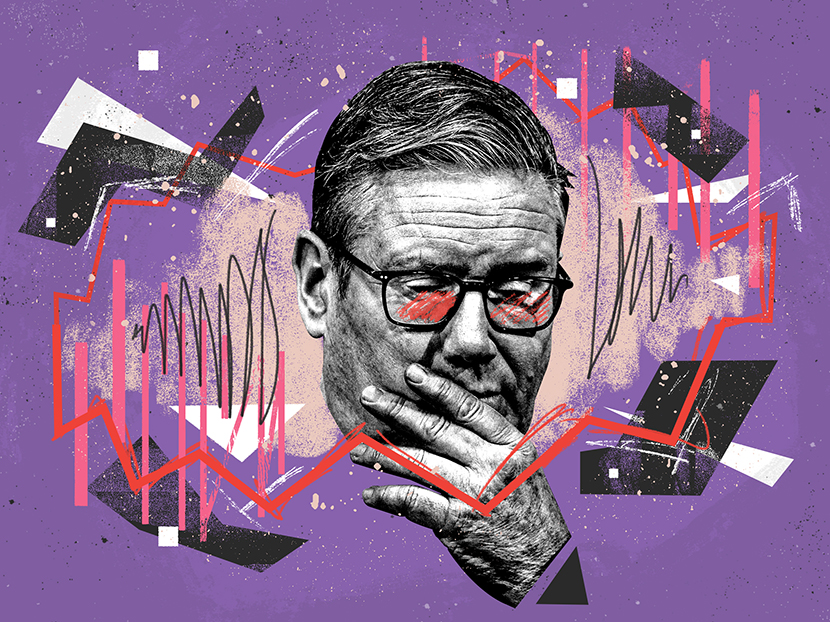
Keir Starmer entered 2026 with a New Year’s resolution – and asked us all to hold him to it. After a turbulent end to 2025, fraught with questions about his leadership and Labour’s dire performance in the polls, he went on national television to declare his new purpose: reducing the cost of living. He said people had been waiting “17 long years for their living standards to improve”, and this would be the year they would, at long last, “feel the change”. This would be the year that the UK would “turn a corner”.
Even at the time, aides and cabinet ministers knew Starmer was making himself a hostage to fortune. Just like Rishi Sunak, who had tied his own fate to reducing the cost of living in the dying days of his premiership, everyone knew that much of the economic weather is outside the government’s control, and at the mercy of international events. Yet Starmer and Rachel Reeves, his chancellor, hoped that inflation would come down, and with it interest rates, and that slowly the situation in the country would turn around. Starmer announced a freeze on rail and bus fares, extended free breakfast clubs, and promised to reduce energy bills. They felt they were beginning to see some positive economic indicators. Then Donald Trump attacked Iran.
Now Starmer finds himself in the same situation as Boris Johnson, Liz Truss and Sunak in 2022 – the year of the three prime ministers – in the aftermath of Russia’s invasion of Ukraine. War abroad is causing oil prices to spike at home. Costs will soon start to rise. And the increasingly unpopular government will be held responsible if it doesn’t do something about it. The Prime Minister might find himself wondering what it would take to make the issue go away. In that, he would not be alone. Truss, who felt much the same, is a useful parable for what happens when a PM resolves to eliminate soaring energy bills as a political issue, no matter the cost.
When she entered Downing Street, Truss wanted to “put an end to the issue for the rest of her premiership”, as an insider put it to me at the time. She had watched in horror as the end of Johnson’s premiership was dogged by repeated calls to do more after introducing a £400 energy bill grant for households, and decided, as a new prime minister, she didn’t want the cost of living to overshadow everything in the same way. At the last minute, Truss tore up plans to offer targeted support and decided it should be universal. She told colleagues she wanted to offer something “unarguable in terms of its scope and ambition” to silence calls from the media and the public to intervene further. It added billions to the cost of the package.

Because of the Queen’s death, Truss’s energy price guarantee received next to no scrutiny. Most of us remember the scenes in the House of Commons on the day Elizabeth II died, when a note was passed along the front benches to Truss and the session was suspended. But most people will have forgotten what was being debated that day: it was Truss’s plan to freeze bills for every household in the country at an estimated cost of £120-150bn. It was, of course, the biggest expense in the mini-Budget, and, coupled with her unfunded tax cuts, proved to be a major cause of the market panic that would bring down her premiership days later.
Truss’s energy intervention set a precedent that continues to shape British politics. Sunak and his chancellor, Jeremy Hunt, diluted her plans, but from such a high bar that the cost was still enormous. The highest tax burden since 1945 isn’t just a relic of Covid, but of those energy policies, which only ended in 2024.
Today, as Starmer and his team reflect on how to navigate the energy price pressures caused by the Iran war, they remember the interventions of 2022 and baulk at the cost. “It was one of the most expensive policies ever pursued by a government – almost as much as the furlough scheme,” one No 10 insider notes. That is as far as they go. There is no attempt to undo the precedent set by the three Tory prime ministers of 2022, or the expectation from voters that the government would intervene to help with energy bills.
On 15 March Starmer announced support for low-income households who heat their homes with heating oil – a relatively cheap intervention that will mostly help people in Northern Ireland and others in rural areas (a sign that Starmer is, belatedly, paying attention to lobbying from key groupings of the Parliamentary Labour Party, in this case the “Rural PLP”). That the energy price cap has already been set until the end of June means that the question of wider support for most households in the UK is on hold for now. At the moment, the top of the Labour government is in the “planning about planning” stage, as one aide puts it: looking at what it will need to have decided by when, to be ready for July.
“Who knows what will have happened with Iran by June,” one senior insider muses. “It might be a very different picture by then.” Another reflects that it is good that the energy price cap will be changed during the summer months, when demand for heating is lower anyway. But you can’t help but feel the Starmer administration is braced for a meteor coming towards it, and still doesn’t have a plan for when it hits. The PM is bound by the criteria he set at the start of his premiership and reiterated in January. He asked voters to judge him by his success at cutting the cost of living, and he will be.
[Further reading: Ed Miliband is all-powerful]
Content from our partners

Related
This article appears in the 18 Mar 2026 issue of the New Statesman, The new world war
Join the debate
Subscribe here to commentAny help from the government for those of us unfortunate to rely on oil for our heating and hot water will be too late. In January I purchased oil at 55p /litre today the price is £1.44 /litre. Most companies will only supply a minimum quantity of 500 litres so that’s £720. But the real problem is “sorry we are not delivering to your area at this time”. So even if we had the money we wouldn’t get any oil. It’s cold showers and cuddling up around the wood burner for the foreseeable future.