
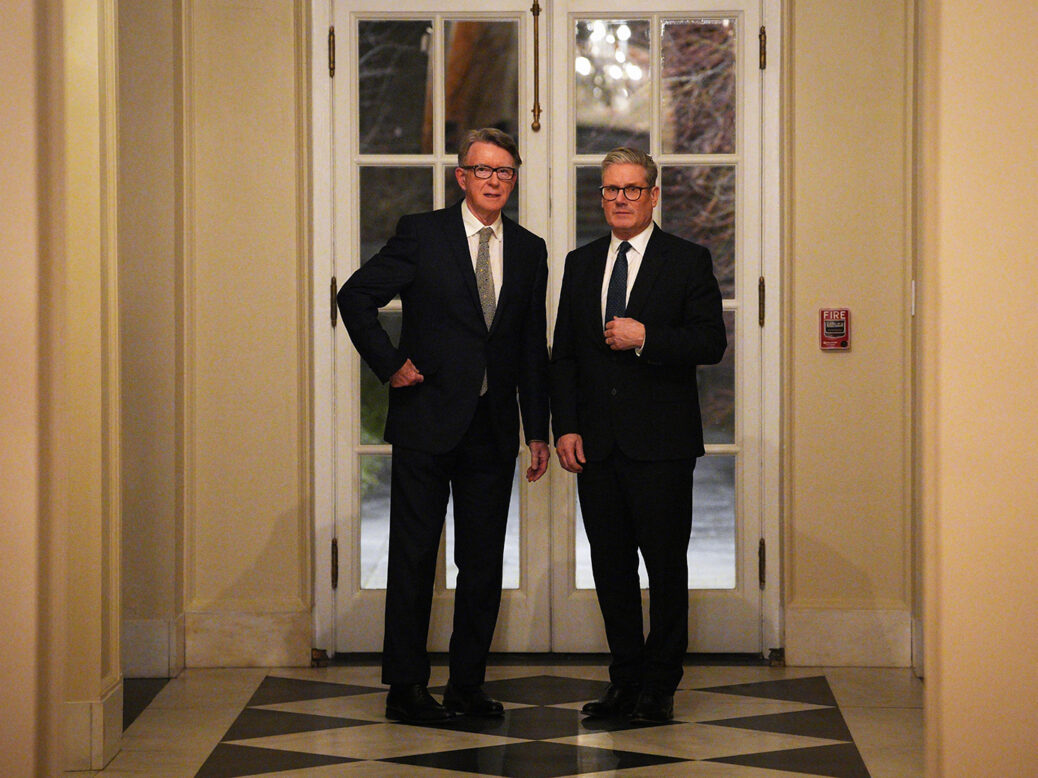
Gordon Brown was warned too. Before Peter Mandelson was invited back into the cabinet for the third time in the autumn of 2008, allies of the prime minister, such as Ed Balls, made clear the great risk he was taking. For the Conservatives, shadow foreign secretary William Hague branded it a “stunning failure of judgment”.
Mandelson’s ascent continued regardless. By June 2009, as Brown fought off an attempted leadership coup, he had become first secretary of state – described at the time as a political life-support machine (a subsequent BBC documentary was titled The Real PM?).
The former business secretary wanted to be remembered as the man who, defying laissez-faire caricature, revived industrial strategy in the UK. But he will now be remembered for giving Jeffrey Epstein – a convicted paedophile from June 2008 onwards – a direct line into government.

As if one of New Labour’s most privileged stakeholders, Epstein was briefed on market-sensitive information, including a proposed £20bn asset sale and the eventual bankers’ bonus tax (Brown and the late Alistair Darling, it is worth noting, defied the threats from JP Morgan’s Jamie Dimon that Mandelson had encouraged). The perennial critique of Mandelson – that his weakness for the rich and powerful makes him an unexploded bomb – has been vindicated again.
Fast forward to November 2024. Enough was already known about Mandelson’s relationship with Epstein that the mere mention of his name as a contender for the US ambassadorship stunned many in the Labour family. “It risks making him, and his interests, history and friendships, the story anytime the press wants. He is a walking tomorrow’s page-two story,” a former senior aide in Brown’s No 10 told me then.
Blue Labour peer and founder Maurice Glasman later warned his ally Morgan McSweeney over the appointment, privately describing Mandelson as “the wrong man at the wrong time in the wrong place”. David Lammy, then foreign secretary, and national security adviser Jonathan Powell – who saw Mandelson resign twice during his time in Tony Blair’s No 10 – were also sceptical.
But Keir Starmer, with striking symmetry to Brown in October 2008, ultimately concluded that Mandelson’s appointment was in the national interest. This is testimony to Mandelson’s undoubted political skills – until the Epstein scandal returned, he was praised by much of Fleet Street as an artful diplomat – and to the remarkable influence he has exerted over successive Labour leaders: Neil Kinnock, Blair, Brown, Starmer (Ed Miliband, in 2010, declared “all of us believe in dignity in retirement” when pushed to include Mandelson in his shadow cabinet). But for the party’s insurgent soft left, it is proof of how Starmer, in the words of a senior source, let his “deference to figures from the Blair era cloud his judgment”. There are renewed calls among MPs for McSweeney, who championed Mandelson’s appointment, to be sacked, but this would only intensify questions over Starmer’s own future.
And the spectre of Mandelson now risks haunting Labour until the next election. At every opportunity, his name will be cited by political opponents on left and right as proof of how a government that promised to break with the hyper-sleaze of the Conservative era struggled to live up to its own rhetoric. In another world, Starmer, drawing on his prosecutorial past, could assume the moral high ground – but not in this one.
Mandelson, framing his deep friendship with Epstein as an unfortunate accident, has likened it to “muck that you can’t get off your shoe… Like dog muck, the smell never goes away”. Labour is about to discover that the same is now true of Mandelson.
This piece first appeared in the Morning Call newsletter; receive it every morning by subscribing on Substack here
[Further reading: The Epstein files expose the rot of Mandelson’s Britain]
Content from our partners



Related

Join the debate
Subscribe here to comment