
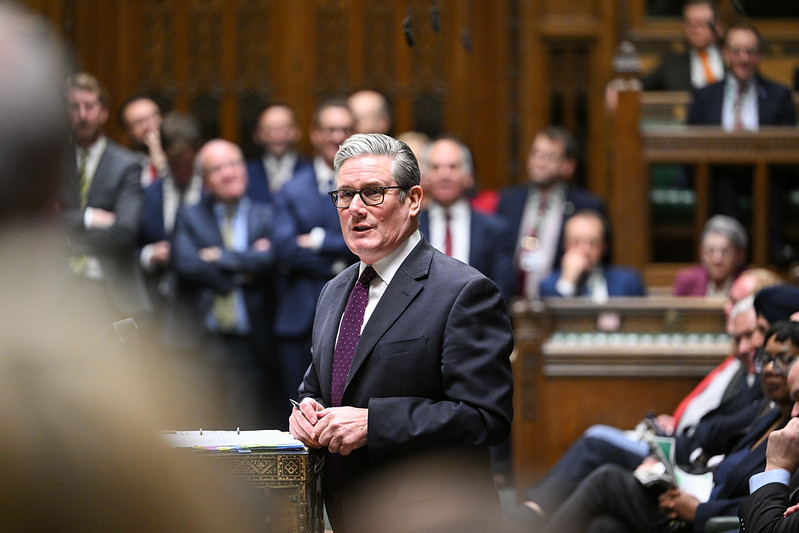
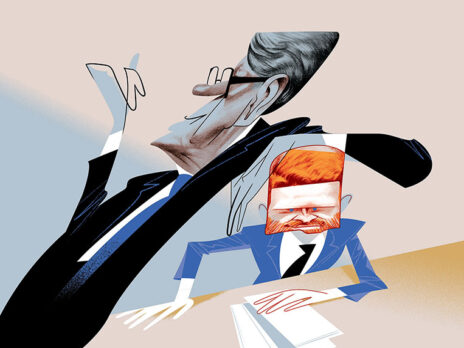
Westminster has gone back to school, with the opening PMQs of the year seeing both Keir Starmer and Kemi Badenoch oscillate wildly between attempting to appear serious and statesmanlike, and scrapping to score as many political points as possible.
The topic of the day is, of course, foreign policy. The government has committed to send British troops to Ukraine in the event of a ceasefire, and continues to deal with the fall-out from Donald Trump’s intervention in Venezuela. On both these areas – especially the former – the Conservative position is very close to that of the government. Indeed, Badenoch began by welcoming Starmer’s efforts on Ukraine and statement on the sovereignty of Greenland as Trump continues to speculate about America getting its hands on it. Her complaints were instead peripheral: Starmer’s decision not to make a statement in the Commons about the troops commitment, the lack of detail surrounding the plan, and the embarrassing fact that the Prime Minister is yet to have a phone call with the US President about events of the past four days.
On the first of these, the Tory leader made a strong start, accusing the PM of a “fundamental lack of respect” with his reluctance to update the House. Starmer’s insistence that “there will be a statement to the House at the earliest opportunity” was batted aside by Badenoch’s retort: “Why is today not the earliest opportunity?” It’s a good question, and one many Labour backbenchers are themselves wondering – not least as Stamer’s evidence distaste for facing MPs caused such frustration last year.
But then Badenoch, trying to walk a tightrope of seeming magnanimous and supportive whilst differentiating her position from Starmer’s, lost her momentum and succeeded in neither. The exchange broadened out to include a wider range of foreign policy and security related gripes: a tit-for-tat row over which party was responsible for Britain’s defence capabilities being “hollowed out” (as the former Conservative defence secretary Ben Wallace put it), arguments over the Northern Ireland Troubles bill and the extent to which it protects veterans, and the controversies of surrounding both the attorney general Richard Hermer and his Tory shadow counterpart David Wolfson.

Neither Starmer nor Badenoch performed particularly well. Starmer dodged a question on convening an urgent meeting of Nato leaders by going personal, pointing out that Badenoch had once criticised him for missing PMQs and suggested he should have “empty-chaired the Nato summit”. Badenoch in turn resorted to reminding the House that Starmer served in the shadow cabinet of Nato-sceptic Jeremy Corbyn (always a sign she feels under pressure).
The barbs about Wolfson representing sanctioned Russian billionaire Roman Abramovich (a controversy Labour was able to capitalise on over the Christmas break) clearly stung the Tory benches. The government will be relieved to have found some kind of shield next time Hermer is in the spotlight – whether for his past defence of Gerry Adams or the continuing disquiet over the Chagos deal. Badenoch’s line that the government had allocated money for welfare but not defence also resonated. But it did not do either leader much good to try to exacerbate the minor differences in their parties foreign policy – not least when the issue of Russia is one on which both Labour and the Tories are relatively strong on compared to Reform.
One person who was not about to miss the opportunity to look strong on foreign policy was Ed Davey. Trump’s antics in Venezuela are a gift to the Lib Dems, who are going into 2026 positioning themselves as the main anti-Maga (and, by exension, anti-Reform) force in parliament. Davey’s decision to quote the legal view of the head of Starmer’s former chambers (“Does the Prime minister agree with his old mentor, or has he got it wrong?”) put the PM on particularly awkward footing. (As someone who has made international law the cornerstone of his professional ideology both before and since entering politics, Starmer is in a uniquely tortuous position in trying to skirt the debate about the legality of Trump’s actions.)
Davey accused the PM of looking “ridiculous” by tying himself in knots refusing to comment on Trump – surprising viciousness, given the Lib Dems’ unofficial pact of non-aggression with the government. Starmer, for his part, argued it would be a “strategic mistake for our country” to side with Europe over the US. While the government does not have the luxury to antagonising the US, many Labour MPs wish their leader sounded a bit more like Davey.
The rest of the session was relatively muted. Nigel Farage was once again absent from the chamber, choosing the comment from a radio station rather than sit with him MPs. The inevitable Reform swipes – one from Starmer, who made a convoluted joke at the start about Reform still feeling Christmassy as “today is the day that they celebrate Christmas in Russia”; one more serious about the chicken pox vaccine and Reform’s vaccine scepticism later on – fell flat. The most significant other intervention today came from the DUP’s Westminster leader Gavin Robinson, who did a far more effective job pressing the Prime Minister on the Northern Ireland Troubles bill than Badenoch had managed, with a sombre question on protecting veterans.
But given the events of the past few days, PMQs felt something of an anti-climax. “It’s a new year, but the leader of the opposition… is totally irrelevant,” Starmer said at one point. “Nobody is listening to her.” It’s a sentiment that could apply to the whole session.
[Further reading: Starmer’s great Ukraine gamble]
Content from our partners

Related
Join the debate
Subscribe here to comment