
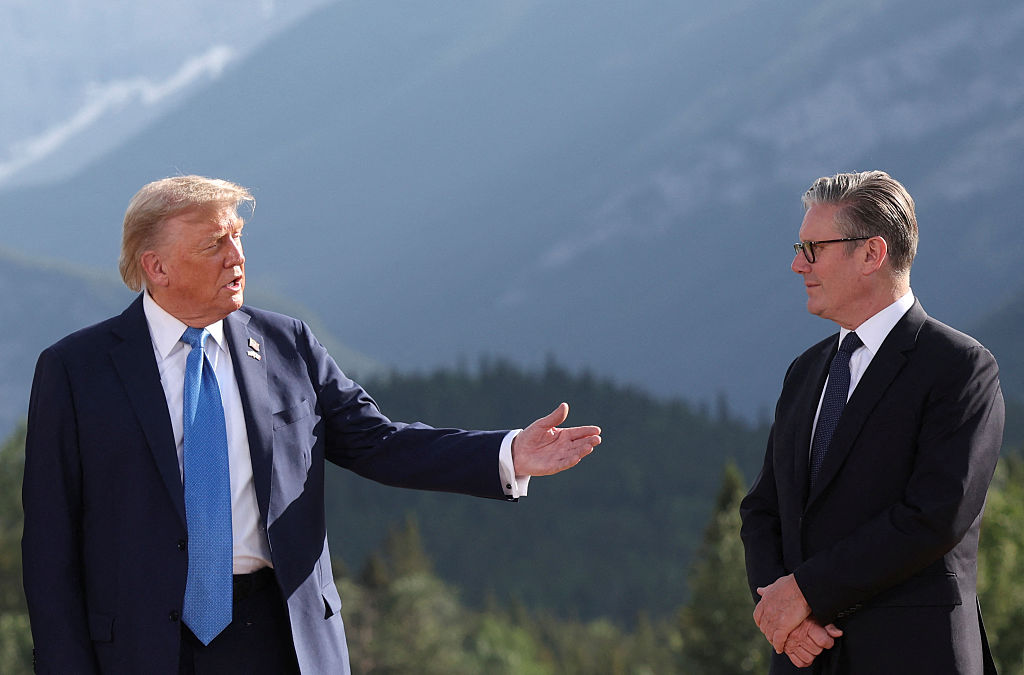
Reports of Donald Trump’s isolationism have been greatly exaggerated. On Thursday night, one Labour MP, Jon Pearce, went as far as to call Trump “a pacifist”. But while the US president has assumed many guises during his political career, that has never been one of them. Trump’s first term saw the US twice launch strikes on Syria, assassinate Iran’s General Qasem Soleimani, and drop the “mother of all bombs” on Islamic State in Afghanistan. Aggressive unilateralism, rather than pure isolationism, has been the hallmark of his foreign policy. The attempted destruction of Iran’s nuclear facilities this weekend marks an intensification rather than an abandonment of this approach.
For Keir Starmer, Trump’s actions have been politically exposing. “There is nothing the president said that suggests he’s about to get involved in this conflict,” Starmer told journalists at last week’s G7 summit in Canada. As late as Friday evening, after Trump declared that he would decide whether to bomb Iran “within the next two weeks”, government sources were confident that diplomacy could prevail. David Lammy, along with his French and German counterparts, met the Iranian foreign minister, Abbas Araghchi, in an attempt to persuade the country to seek a negotiated settlement with the US.
[STATE OF EMERGENCY: See this week’s cover story about Starmer’s troubles, by Andrew Marr]
Trump’s decision to intervene – with the UK notified only shortly before – left Starmer stranded in the middle. Britain, as cabinet ministers were swift to make clear, did not participate in the strikes. Trump made no request to use the joint US-UK airbase in Diego Garcia, a demand that some believe would have left the government in danger of breaching international law (Starmer, let’s recall, explicitly opposed the 2003 Iraq War on legal grounds).

But though it’s not a participant, Britain has been far from a critic. “Iran can never be allowed to develop a nuclear weapon, and the US has taken action to alleviate that threat,” stated Starmer. This matter-of-fact declaration has seen him outflanked from the left and the right.
Kemi Badenoch, who is close to historian Niall Ferguson (a polemical champion of US intervention), declared that “by targeting Iran’s nuclear sites, the US has taken decisive action against a regime that fuels global terror and directly threatens the UK”. Nigel Farage offered a more cautious endorsement: “Reform UK stands behind the military actions of the USA overnight.” The Greens and Labour left MPs, meanwhile, have condemned the intervention as a breach of international law.
The government, by contrast, remains in the realm of ambiguity. A Foreign Office source denies Iranian claims that Lammy “expressed regret” over the US strikes during a phone call yesterday with his Iranian counterpart, describing this as an “inaccurate” account.
But the most telling exchange came last night between Starmer and Trump. “They discussed the actions taken by the United States last night to reduce the threat and agreed that Iran must never be allowed to develop a nuclear weapon,” a Downing Street spokesperson said.
Once again, it is the neutral, passive tone that stands out. Even at a greater distance from events, Starmer declined the opportunity to offer a positive endorsement of the US intervention.
The Prime Minister has every reason to strive for “de-escalation” in the Middle East. Public opinion is firmly against British intervention, the domestic terror threat is rising, and Iran’s parliamentary vote to close the Strait of Hormuz – through which 20 per cent of the world’s oil passes – could unleash new economic turmoil.
As such, Starmer is walking a precarious tightrope, eschewing both outright support and criticism of the US. But as Trump raises the spectre of “regime change” – the very opposite of de-escalation – can Starmer keep his balance?
This piece first appeared in the Morning Call newsletter; receive it every morning by subscribing on Substack here
[STATE OF EMERGENCY: See this week’s cover story about Starmer’s troubles, by Andrew Marr]
Content from our partners


Related


Join the debate
Subscribe here to comment