
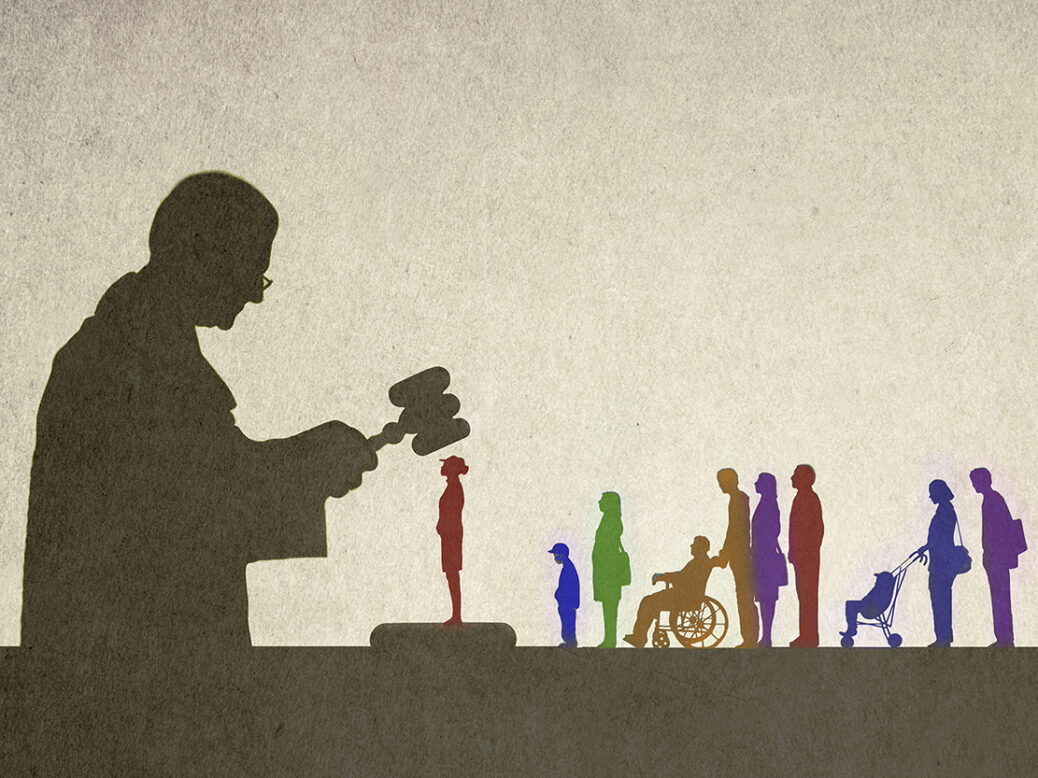
It’s hard to establish quite where the legal maxim “justice delayed is justice denied” comes from. The Justice Secretary, Shabana Mahmood, likes saying it, as did her predecessor, Alex Chalk, and his predecessor-but-one, Brandon Lewis. It’s often attributed to William Gladstone, but the notion that the timely conclusion of a legal issue is fundamental to a functioning justice system pre-dates the Victorian prime minister by hundreds of years. One such variation can even be found in Magna Carta: “To no one will we sell, to no one deny or delay right or justice.”
Echoing the sentiment is the retired judge Brian Leveson, who is chairing the government’s review into a broken courts system. Leveson recently warned that radical reform is required to tackle a backlog of almost 80,000 cases that is causing trials for serious criminal offences to be postponed until as late as 2029. Picking up on a theme trailed in recent months by the justice minister, Sarah Sackman, one of the review’s key recommendations will be to scale back a pillar of the legal system also enshrined in Magna Carta: the right to a trial by jury.
There is precedent. Less serious “summary offences” such as driving violations and minor assaults are already heard not by 12 of a defendant’s peers but by a panel of three magistrates (who are unpaid and do not require legal qualifications), or by a district judge. Serious offences, such as murder or rape, can only be heard by a Crown court with a jury. In the middle sit offences – burglary, drug possession, fraud – where the defendant can choose where they would like their case to be heard. Leveson’s proposal is to restrict these defendants’ right to a jury, setting up an intermediate court to hear some of these “either way” cases. “There’s no choice. We cannot carry on with the present system,” he told the Observer. “Justice delayed is justice denied.”
The disintegration of the justice system is one of the most underexamined crises of the past decade. In December 2019, before reports of coronavirus hit the headlines, the Crown court backlog was more than 37,400, and it already took more than a year for the most serious cases to come to trial. Then, in the early months of the pandemic, hearings were suspended completely. This came after a decade in which the Ministry of Justice became a poster department for austerity, its budget slashed and a third of court buildings sold off between 2010 and 2019 in the name of economy.

The money received into government coffers in return was pitiful: the sale of 126 courts yielded just £34m. Several of these buildings subsequently became film sets for legal dramas. In January 2021, when the court backlog was more than 54,000 and so-called Nightingale courts were being hurriedly set up to deal with it, Blackfriars Crown Court was filled not with judges, defendants and legal personnel, but with Netflix producers shooting the crime thriller Top Boy. Her Majesty’s Court & Tribunal Service even inquired about hiring the building it had once owned to hear actual cases, rather than fictional ones.
The consequences of this catastrophe are lives put on hold: defendants losing jobs and relationships as they await the chance to clear their name; victims trapped in limbo, unable to process their trauma. As trials are listed far in the future, witnesses withdraw and cases collapse, enabling dangerous perpetrators to walk free and reoffend. The witness attrition rate for rape and sexual assault is particularly dire, with 325 out of 4,317 prosecutions derailed last year – a fivefold increase since 2019.
This national scandal should be a source of shame for the Tories – but no one wants to relitigate the Covid era now, any more than they want to look too hard at whose decision it was to scale back access to justice, as though fewer courthouses would lead to a decline in crime. It is the job of Mahmood to mitigate the damage inflicted by the likes of Chris Grayling.
And so jury trials, which cost ten times that of magistrate hearings, are in the firing line. Replacing them with a judge will not be an easy case to make (not least as there is a 300,000-case backlog in magistrates courts too). Back in June 2020 when I interviewed legal professionals about the impact of the pandemic, one leading barrister warned that the “jury trial has a Magna Carterish Brexity resonance to it that brings liberals and traditionalists together; restricting it would be picking a fight with Keir Starmer and Jacob Rees-Mogg at the same time”. Five years and a doubled courts backlog later, expect the backlash to Leveson’s proposals to be furious. There will be much railing about “two-tier justice” – a favourite phrase of the shadow justice secretary, Robert Jenrick. It will be interpreted as yet another Labour betrayal, a sign of this country’s decline, the hacking away at public services to save cash.
The government will be hoping that radical reform can speed up cases and thus restore faith in a system that is failing everyone except criminals. The status quo is both unjust and unjustifiable, and the idea of trading the right to a jury for swifter trials has been backed by many legal specialists, among them five former lord chancellors (several of them Tories) and two former lord chief justices. But the public may not be so easily convinced. The risk is that, with confidence already damaged by years of deterioration, this creates the perception of justice on the cheap, removing a right etched into the British consciousness by centuries of tradition and cemented there by legal dramas filmed in the very courthouses we sold off.
[See also: Robert Jenrick and the myth of “two-tier justice”]
Content from our partners


Related

This article appears in the 09 Jul 2025 issue of the New Statesman, The Harbinger
Join the debate
Subscribe here to comment