
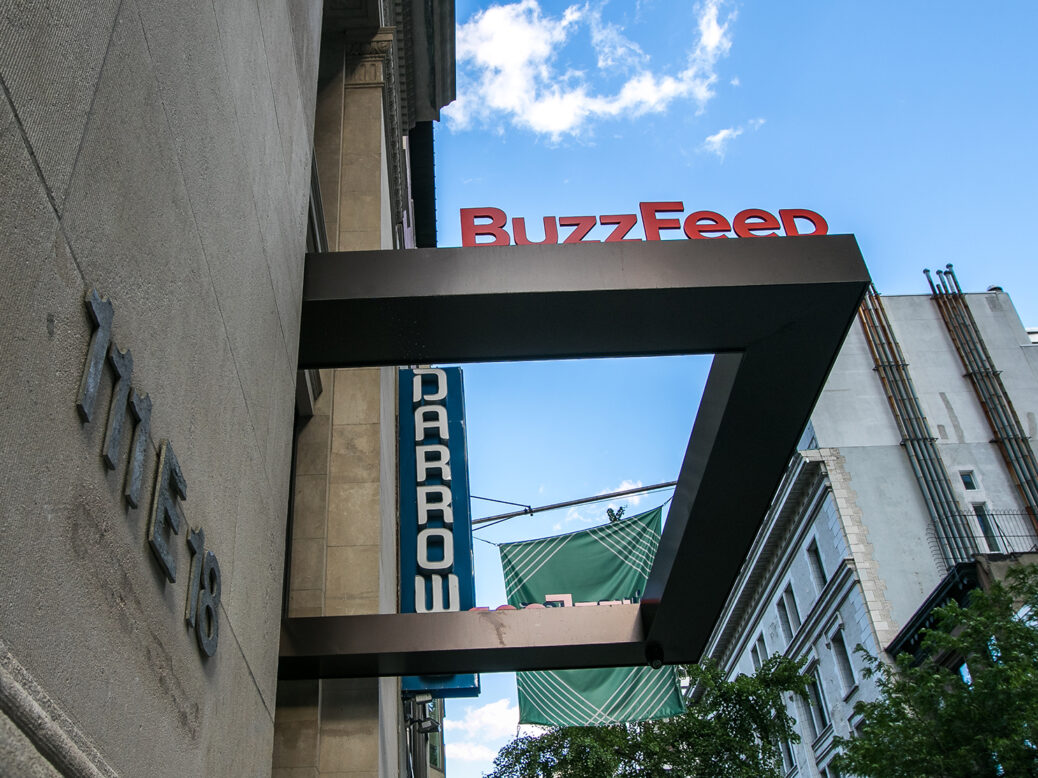
Just under 13 million people have taken the 2014 BuzzFeed quiz “What Kind of Dog Are You?” (pitbull), which is paltry compared with the 49 million who responded to “What US State Do You Actually Belong In?” (Georgia). We were two years out from 2016 – that annus horribilis for millennial optimism – and while the crash still stung, Barack Obama was in power and Brexit was not even a word. This was it: the end of history, 27 Cat Pictures that Are Never Not Funny.
2016 administered a sharp correction to that assumption. But on 21 November that year, 13 days after the first election of Donald Trump and 151 days after Britain voted to leave the European Union, BuzzFeed was valued at $1.7bn by NBCUniversal. For much of the decade, BuzzFeed dominated, setting the terms of the conversation – white feminism this, girlboss that – while corralling users on the vast, anarchic internet into a catalogue of micro-identities (“16 Pictures That Are Too Real For People With ADHD”, “27 Signs You Were Raised By Asian Immigrant Parents”, “Which Shrek Character Are You?”). The politics were intersectional, the mantra was “no haters”, and the future of the internet looked set to be free, woke and tabloid-y forever.
In 2023, BuzzFeed shuttered its news operation altogether. Since then, the website is little more than a billboard, propped up by AI and a disembowelled staff. Now BuzzFeed is on the verge of bankruptcy, as it reported this month. Its founder, Jonah Peretti – the Gutenberg of the 2010s liberal disposition – is not giving up yet. “I’m going back to founder mode, and we’re building like a start-up again,” he told the New York Times.
But BuzzFeed helped to define the spirit of an age: optimistic, twee, kitsch, cringe, sugary, earnest, swotty. Whatever BuzzFeed becomes, we know that spirit has been lost. What, exactly, have we lost with it?

“You think I’m at a regular newsroom,” a hysterical reporter says down the camera lens, “but I’m not – this is BuzzFeed!” She takes a tour of the New York office in 2015: the walls are red and shout BuzzFeed at you; there are huge yellow “stickers” everywhere bearing the company’s customary vernacular – “LOL”, “YES”. There is a games area, a ping-pong table, a giant set of Connect Four. “We sit around and have pizza, throw back a couple of beers.”
The cut sequences are jarring (do not watch if you have epilepsy), and jaunty millennial muzak plays over the entire edit. From a 2026 vantage point, it feels as dated as a Brooklyn pilsner bar with exposed brick and string lighting. I think if you told a 1980s Fleet Street hack that this was – by some metrics – the biggest news source in the world at the time, they would have laughed in your face.
But this was the cultural shorthand of the moment. BuzzFeed’s UK office opened in Hatton Garden, Farringdon, in March 2013. Within a year, the operation had recorded at least one month in which its traffic exceeded that of the BBC and MailOnline (160 million users, compared with the BBC’s 150 million). By 2015, everyone wanted to work there: one former editor recalls receiving 250 applications for a single apprenticeship; at least one journalist was rumoured to have turned down the graduate scheme at the Financial Times for a placement at BuzzFeed.
“You know the sense you get in London sometimes, that there is always a better room to be in? Somewhere where something more exciting is happening? Not with BuzzFeed,” a veteran staffer explained. Another likened it to an 18th-century coffee shop – but instead of ponderous conversations about capitalism and rationality, it was all virality, reach, traffic, identity. “At the time it felt like we were on the cusp of doing something very different.” After a flood of VC money, the London office moved into “an aircraft hangar” in Oxford Circus in 2015.
The office looked more like a tech start-up – BuzzFeed had effectively sold itself as a tech company, without any tech – than a media organisation. Staff wore hoodies and jeans and had access to snacks and drinks: “It was really wild, the amount of Brazil nuts we would eat,” one reporter recounted. In 2017, around the time of a series of redundancies, came the now-infamous oyster incident, when trays of oysters arrived at HQ for lunch – “we all remember oyster day!” But it wasn’t all lavish: “I wouldn’t want to give the impression that we were eating swan while writing memes,” a staffer told me defensively, while another recalled eating a foie gras burger at one Christmas party.
As first reported by the Press Association, tension mounted: there was a failed attempt to create a union, a round of layoffs, and an emerging fault line between the Serious News desk and the “We Make Quizzes and Sponsored Content” department. I was told repeatedly about the simmering row over live music in the office: “You would be hiding in a stationery cupboard, taking a sensitive call from the Buckingham Palace press office, and explaining down the line why ‘Five Colours in Her Hair’ was playing in the background.” In one apocryphal story, an editor mistook the band Little Mix for a group of interns.
Peretti had cracked something – the secret to guaranteed virality, the method to master the wild west of the internet. To understand how he did this, we have to look back to 1996, when he, as a student, wrote a paper titled “Capitalism and Schizophrenia: Contemporary Visual Culture and the Acceleration of Identity Formation/Dissolution”. Through a critique of Anti-Oedipus, a book on schizoanalysis by Gilles Deleuze and Félix Guattari, with a detour via Lacanian psychoanalysis, Peretti argued that capitalism would ultimately sort people into narrow identity categories, making it easier to sell them things. It was the Nineties, and he was really talking about advertising. But it is difficult not to see now that the long tail of this thinking is the BuzzFeed quiz: tell me what Frozen character I am, whether I am a picky eater, what Hogwarts house I belong in, and what historical time period would suit me best. In a complicated and scary world, Peretti never underestimated the spiritual salve a quiz could offer a millennial.
BuzzFeed had cracked the traffic code and was no longer confined to diminutive quizzes like “What Does Your Hair Say About You” or listicles such as “32 People Who Absolutely Nailed It in 2013.” In 2011, Ben Smith set up BuzzFeed News. Amid all the quotidian silliness, serious journalism gained prestige: the UK team received lobby passes, and in June 2016 they hosted a live town hall debate with Facebook between then-Prime Minister David Cameron, Scottish First Minister Nicola Sturgeon, Ukip leader Nigel Farage, and Conservative MP Penny Mordaunt. In 2014, a self-commissioned report on how the BBC could expand its online operation concluded: “Be more BuzzFeed.”
In 2012, Peretti said: “The baton has been passed from print to the traditional web, and now from the traditional web to social. The entire industry is shifting, and we intend to be the leader in social publishing.” He was right for a time: it seemed the web belonged to a triumvirate that was redefining media. Gawker traded in a publish-anything sensibility, but was ultimately undone by a lawsuit after the site published a sex tape of the late Hulk Hogan. Vice, a kind of Wario BuzzFeed, wanted its readers to feel cool – with its “global drugs editor” and dispatches from military coups in Sudan. At its height, in 2017, the company received a valuation of $5.7bn. By 2024, Vice had filed for bankruptcy.
By 2020, BuzzFeed announced it would be closing its UK operation. In 2023, BuzzFeed News stopped posting. And now, the whole thing is on the brink. The reasons are complicated. The company assumed that if it played the game set by Google, Facebook, and Twitter, it could win – and keep winning. But Facebook deprioritised news, and Twitter, now X, became tetchy about linking out to websites. BuzzFeed had the secret to traffic but could never quite make it pay. (Most of its successful UK alumni are now back behind paywalls – at the Financial Times, Bloomberg, or niche interest Substacks.)
But what we also have is a total reactionary turn away from the motivating spirit of BuzzFeed. “No haters” was a loose, slippery policy, but it was detectable in the DNA of the website. And it was of its time – when the conversation was less coarse and the politics considerably less hyper.
BuzzFeed liberalism cannot survive in a world where the right has fractured into Reform and Restore, and parts of the left have coalesced around a frothingly cross, anti-US, anti-Israel platform. When an attritional war rages on this continent’s eastern frontier, and America is contemplating boots on the ground in Iran, maybe “This Ink Blot Test Will Determine Your Personality” feels simply too frivolous for the circumstances. The world is too hard for BuzzFeed now. It pivoted to serious news, yes, but the spirit of LOL, WTF, and YES haunted it. And in its wake: 7 Reasons Why This Millennial Will Never Feel Good Again.
[Further reading: Donald Trump is my old friend – but he’s lost the plot]
Content from our partners


Related
Join the debate
Subscribe here to comment