
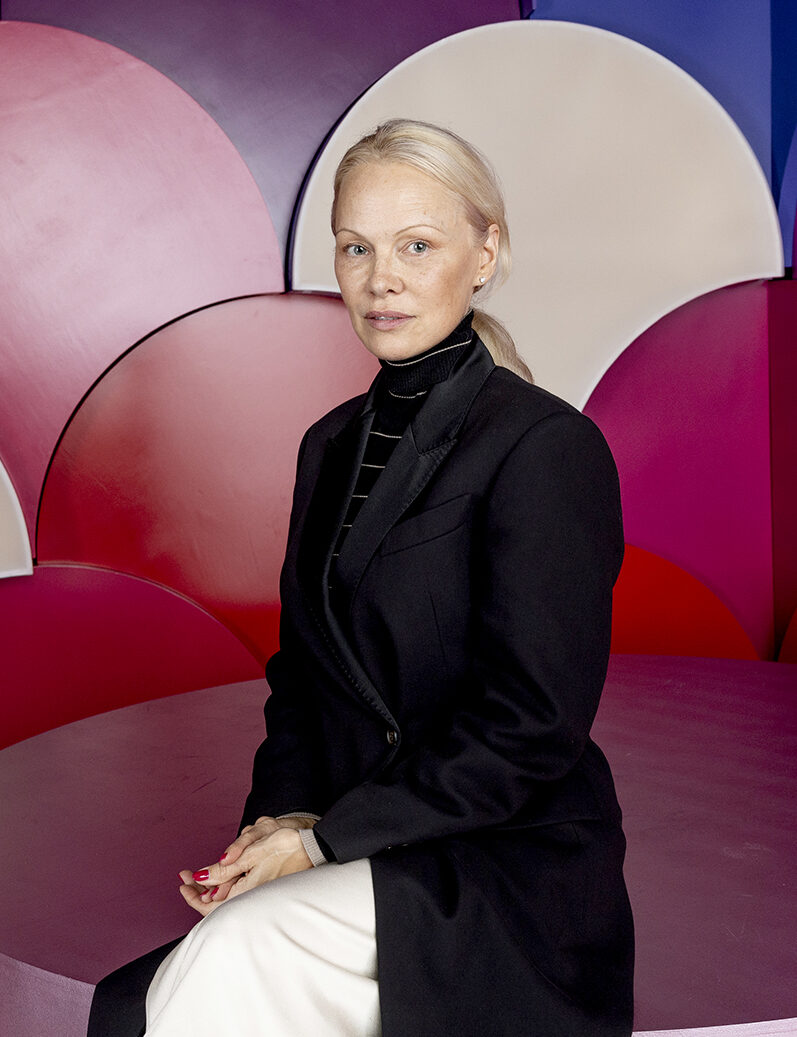
Pamela Anderson has committed a grave and detrimental error, inimical to the women’s rights movement: she dared to wear a 1960s‑style dress and no make-up to her film premiere. Harmless, you might think – perhaps even utterly trivial. But according to some of the feminist commentariat online, this was a “rancid 1960s Audrey Hepburn ‘now I’m classy, see!?’ cosplay” which was “extremely tradwife conservative‑coded”.
Lost? Baffled? Wondering why a lack of make-up is suddenly a feminist transgression? Welcome to the world of fourth‑, fifth‑ and 500th‑wave feminism, where the last dregs of a once‑powerful movement slug it out on X and Bluesky over the clothing, cosmetics and career choices of female celebrities.
If it’s not the too-conservative Pamela, it’s the hyper‑sexualised Sabrina Carpenter or the Republican Sydney Sweeney, whose “great genes” joke in an advert for American Eagle has drawn accusations over an apparent endorsement of eugenics as well as the denim brand. And that’s before we even get to the interminable debates over whether Taylor Swift is a paragon of female creativity or a mercenary capitalist.
In the West, feminism was once animated by shared objectives such as suffrage, reproductive autonomy and resistance to sexual harassment. Now, it has degenerated into a daily skirmish to produce the most ostentatiously progressive squawk in an X thread, with little to no discernible purpose that ties the movement together.

Western feminism has, in many respects, lost its way. The shift from communal, public debate to an almost exclusively online form of activism has driven feminists down sharply divergent paths. Where feminists once happily identified simply as such, the online world has fractured the movement into categories such as intersectional feminists, tradfems, radfems, ecofeminists and postmodern feminists. These factions burrow into their own convictions and subcultures, bringing them a sense of identity and shared goals. But in the process, many of feminism’s founding principles have been diluted, and former comrades find themselves battling one another. All the while, the patriarchy rearms.
It could be argued that this is because many of the early aims of the feminist movement have been achieved. This is true for some: the largely white, middle‑class, university-educated feminists who might enjoy more equal opportunities today. But herein lies the problem with many of the feminists active during the second (1960s-1980s) and third wave (1990s-2010s). When the issues ceased to affect them directly, the cause seemed to become less urgent. And so we are left where we are today: battling it out online over the merits of Anderson’s clothes or Sweeney’s jeans (and genes).
Out in the real world, meanwhile, there is much for feminists to campaign against. In Sudan, women are bearing the brunt of a calamitous war no one seems to care about. In Afghanistan, girls remain banned from pursuing education beyond the age of 12. And in Gaza, starving women are being beaten and killed every day. Whether Carpenter’s album cover is ironic or moronic is a question of stupefying luxury.
If such causes seem distant, there is no shortage of battles to wage at home. The Femicide Census reports that, since 2009, a woman in the UK has been killed by a man every three days. Data indicates that Northern Ireland is the most perilous place in Europe to be a woman, with a femicide rate three times higher than that of England or Wales. In domestic abuse refuges, 61 per cent of all referrals are refused – often due to inadequate space or capacity. Black women are 2.8 times more likely than white women to die in the first six weeks after they have given birth. This is all happening right now in the UK. But none of that is as effortless – or as gloriously low‑stakes – as performative squabbling on X.
For the feminist movement to extricate itself from this impasse, activists must care less about A-listers and more about the millions of ordinary women with no fame, money or power. There is something depressing about the fact that two of the most prominent feminist debates of the past decade – #MeToo and Time’s Up – began as campaigns centred on safeguarding celebrities in the workplace.
Less than a decade after #MeToo, we find ourselves in a world where figures like Bonnie Blue recruit gangs of “barely legal” teenage girls for gang-bangs for profit; the internet is saturated with pornography that encourages men to choke women; and serial abusers such as Dominique Pelicot record their violent sexual assaults. While the #MeToo movement was noble, it now feels – at least to me, a 25-year-old feminist in London – like a battle from a more privileged and somewhat naive era.
Social media activism serves a purpose – it is vital to monitor the insidious creep of regressive values back into Western society. But fixating on Pamela Anderson, Sydney Sweeney and Sabrina Carpenter does nothing to slow it. On the contrary, it often reinforces the right-wing perception that online liberals have drifted far beyond the realm of the relatable.
Hope still glimmers. Women such as Gisèle Pelicot, Bisan Owda, Angela Davis, Yulia Navalnaya and Narges Mohammadi continue to lend the movement credibility and honour. Feminists are capable of caring about the plight of Gazan women while also scrutinising the role models presented to young Western girls. Yet all we seem capable of producing now is more division, more argument, and more time squandered on X. Meanwhile – far from our furious typing – the patriarchy looks on happily.
[See also: The Online Safety Act humiliates us all]
Content from our partners


Related

This article appears in the 07 Aug 2025 issue of the New Statesman, Summer Special 2025
Join the debate
Subscribe here to comment