
At Labour conference, we saw two competing visions of the future for Keir Starmer’s government – a politics of community vs technocratic Yimbyism. The first is built on real lives and local places; the other is built on a policy prospectus and a promise of insurgent government. For either to win out as the government’s core message, it must not just win over the ears of secretaries of state and the algorithms of X, but also connect with a broader mood in the country.
The first, broadly defined as the politics of place, or communitarianism, is a political philosophy that underpinned the most moving sections of the Prime Minister’s recent conference speech. Starmer dotted his address with an appeal to national pride, founded on community heroes – the belongers and builders of what he calls an “ordinary hope”. He told this story not through stories of politics or policy, but through the practical actions of people in the places where they live.
And it wasn’t just rhetoric. Although hidden by the announcement on ID cards, the only really significant policy announcement to come out of this conference season was the £5bn for the government’s “Pride in place” programme, which aims to provide direct funds for disadvantaged communities to improve their own neighbourhood.
All of this connects to a mood within the country. It was best captured for me by a conversation I had with Lee Pennington, founder and director of Open Door, a local charity in Merseyside, who was attending the conference to discuss his efforts to tackle the mental health crisis among young people.

When I first met Lee a few years back, he’d told me how he’d been working as a milkman and doing removals when two of his friends killed themselves in quick succession. He decided he needed to do something to help himself and his mates deal with what felt like a crisis of isolation. He ended up renting an old warehouse on the edges of the docks in Birkenhead and invited his mates to hang out and talk – with no agenda and no training. It was about building a connection and a community that could save his friends from loneliness, and worse.
That initial community meeting in a warehouse has been built into Open Door, an organisation delivering mental health support for young people across Merseyside. It is grounded in music, art, and time with friends. Fundamentally, it’s a community that forms a sort of clinical support on the side.
This year, I bumped into Lee and his brother as they left a conference fringe panel on communitarianism. The panel marked the launch of a collection of essays that included a contribution from Andy Burnham, whose pitch to party and country is founded in what he calls “place before party”. Burnham was, in many ways, the early adopter of this kind of politics.
It was Lee’s brother who said to me that, though, like most British people, he was not political, he found himself aligning with the communitarian ideas explored: “Those essays – that’s what we do over in Birkenhead.” It was an endorsement that felt as powerful as the lines in the Prime Minister’s speech.
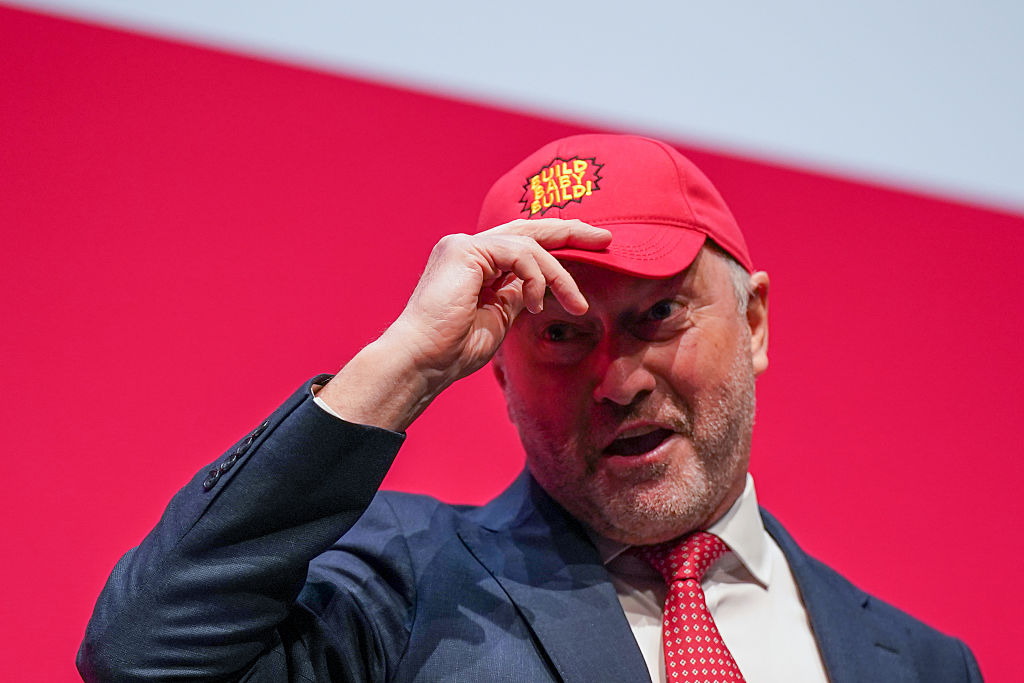
Then there are the Yimbys. Not far from where I saw Lee and his brother, I saw the energetic, red-hatted politicos and policy wonks. The Labour Yimbys. Their hats were emblazoned with “Build, baby, build” – Steve Reed’s new slogan as Secretary of State for Housing, Communities and Local Government, a role he has taken over from Angela Rayner.
Reed is leading on amendments to the Planning and Infrastructure Bill, which is currently making its way through parliament. These amendments aim to remove “blockers”, though it’s perhaps worth noting they won’t touch the earlier amendments on wildlife habitat protections.
Yimbyism is born from a very real policy challenge around housing and Britain’s failure to build crucial infrastructure. Its objective is to transform Britain through a series of policy levers to deregulate, directed from Whitehall. What remains uncertain, however, is just how this policy platform connects to the country.
Yimbyism is policy without people. And that is why it will struggle as politics. That should have been obvious for anyone at the Reform party conference, which opened with “family, community and country”. Or at the Greens’, who seem to be stealing Keir Starmer’s language of “ordinary hope”. The polling also shows the political limits of Yimbyism. In the US, Axios polled Democratic voters on what they preferred in terms of messaging: “abundance” or “populism”. Given a direct choice, 59 per cent of Democrats preferred the populist argument, compared with just 16.8 per cent for the abundance one. This is partly to do with the fact that neither term is well understood outside of highly politicised bubbles.
Of course, Labour needs to build homes. It needs to construct the energy infrastructure to deliver long-term security and meet its mission of net zero. But none of that requires the Yimbys’ apparent dislike for actual people and places. It should be noted that, with very little in the way of Yimby rhetoric, Ed Miliband has led a transformation in public approval of wind farms and renewable infrastructure. Perhaps that is because Miliband understands that leading with a story about place and people trumps leading with policy from on high.
Then there is Andy Burnham. Burnham should be held up as a hero by Yimbys. Manchester has been transformed in recent years: the skyline is a dream to those red-hatted men and women of Labour. Yet he did not build apolitical project around the construction of homes or trams. His “place before party” slogan tells a story about “business-friendly socialism” that seems to fit the mood of the country far better. Burnham demonstrates that while you may well govern at times as a Yimby, you campaign as a communitarian. With it, you build a political case that connects with the country as it is, not as you wish it to be.
As with all political battles today, the one between these competing visions will be a battle for eyeballs. On one side, the policy arguments, the Yimby long reads, the podcasts, and threads on X. On the other hand, the culture and content of belonging. Be it Big John or social media accounts like “A View from a Bridge”, a recent post showing some lads talking about growing up in small-town England, the challenges they face, and the love they have for one another. Or “hikingshawty”, who documents her walks around Britain. It’s landscape, people and places.
Labour might be tempted to think that flashy videos, long blog posts, and “Build, baby, build” memes constitute a political project. Yet nothing in the UK or elsewhere shows that to be true. As is often said, politics is downstream from culture. And the culture and content of community and belonging is in the ascendancy.
A politics that taps into this would be much more potent than any technocratic blueprint.
[Further reading: Jonathan Reynolds breaks bread with suspended MPs]
Content from our partners

Related



Join the debate
Subscribe here to comment