
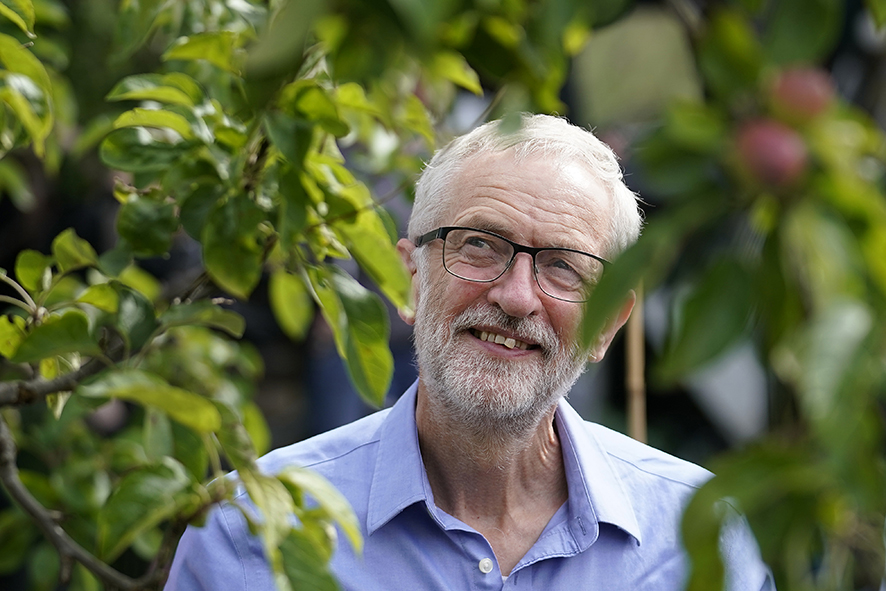
Jeremy Corbyn knows what he’s doing. Writing for the Daily Telegraph (an unusual slot for the left-wing independent MP for Islington North), Corbyn declared war on his former comrade Angela Rayner over her decision to allow councils to sell off allotments to raise money. Corbyn disagrees: he thinks these precious plots of land should be protected at all costs. Rayner’s new policy is a “nail in the coffin” of community allotments, Corbyn writes, speaking out to the many, green-fingered readers of the Telegraph’s pages. “Once lost, they never return,” Corbyn warns.
There is a personal angle to Corbyn’s rage. He is devoted to his allotment in north London and has been tending to it for the past 22 years. (“I like a good marrow,” he told the Islington Tribune in February this year, reinforcing his image as the Gromit of British politics.) He genuinely cares deeply about the protection and upkeep of these spaces for gardeners across the UK.
But the overriding drive behind Corbyn’s horticultural battle is obviously political. This marks one of the first interventions by the former Labour leader since he announced his decision to co-lead the founding of a new party alongside fellow independent MP, Zarah Sultana. That he has chosen to criticise the government on allotments, on land, planning and development – in the Telegraph no less – shows how seriously Corbyn is taking the political strategy of his new movement.
Despite its unusual home, Corbyn’s op-ed is written in the old radical-left tradition: he refers to the Enclosure Act (the one from the late 18th century) as “one of the most grotesque abuses of power by parliament”, he mentions the Diggers (a faction during the Civil War), and points out the plight of the “rural poor”. But he clearly senses that in speaking to Telegraph readers, he will likely find some sympathy among those readers of more Nimby-ish persuasions. (Let us not forget that as leader of the opposition, Keir Starmer often wrote op-eds for the Sun.)

The government has been rattled. The Ministry of Housing, Communities and Local Government (MHCLG, to whom this policy belongs) put out a statement clarifying that rules around the sale of assets have not been changed and adding, “We know how important allotments are for communities, and that is why strict criteria is in place to protect them.” But the scale of discourse over what, one assumes, Rayner and MHCLG thought would be an innocuous policy – and their speedy clarification – speaks to a wider feeling that the government has been blindsided by this renewal of Corbyn and the imminent arrival of Your Party (name tbc).
This sense of fluster was bolstered by Rachel Reeves’ appearance at the Edinburgh Festival on Saturday. In conversation with Iain Dale, Reeves aimed her criticism directly at Corbyn. “The country rejected him twice. The bloke’s got a big ego,” she said. It was a personal attack, suggesting that Corbyn’s own ambition and profile is a driving force in his renewed rise. “If he wants to give it a go, be my guest. I think the voters will have the same reaction.”
But Reeves and Rayner should proceed with caution. Labour is already at risk of losing more votes to its left than to its right. Corbyn’s popularity has helped to court publicity over Your Party, but it is not the sole reason for the interest this new arrival has sparked. Left-leaning voters are furious with the government over Gaza, over its planned reform of the welfare system, and a whole raft of other issues. And this disappointment is pushing them away from Labour. Corbyn is clearly taking this moment seriously. If the government is not careful, come the next election, they will wish they had too.
[Further reading: Inside the factions of the new left]
Content from our partners



Related



Join the debate
Subscribe here to comment