
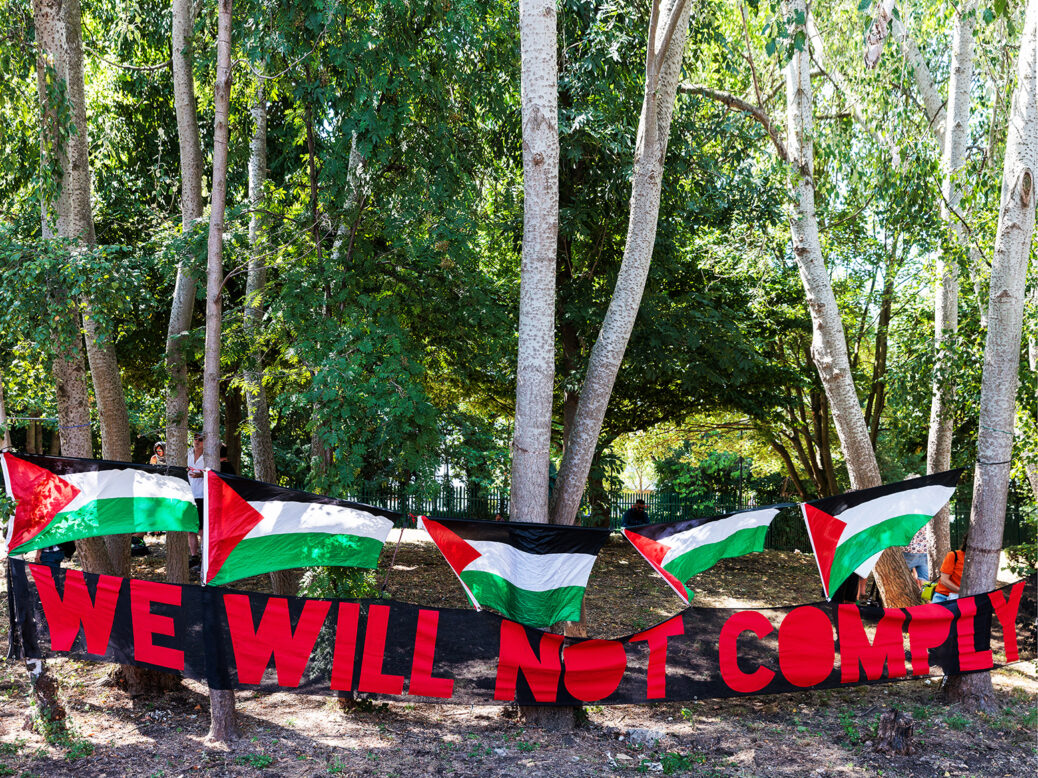
On Monday evening (4 August), the pro-Palestine movement unleashed a “siege on Labour”. Located on a side street in south London, its party headquarters is an unassuming, dusty-brown office block. But, surrounded by a mass of keffiyehs, flags and badges organised by the Palestinian Youth Movement, the area became a cacophony of noise – and confrontation. The protesters came bearing two key messages: that Labour is complicit in the destruction wrought on Gaza, and that David Lammy must resign as Foreign Secretary. There was a vengeful mood. Several carried a banner reading, “Labour supports genocide,” decorated with fresh, blood-red handprints.
With the parliamentary summer recess in full flow, there was barely anyone affiliated with the party to take notice of the groups who massed at 15 of its key offices across the country. Those suited office workers that did happen to be present merely looked on awkwardly through the glass frontage. The protestors did face some opposition: chants of “From the river, to the sea…” were met by a piercing siren purposefully set off by a disgruntled neighbour in a nearby block of flats, and lone man with a thin mohawk and skin-tight jeans also showed up to counter-protest.
Both were soon crowded out by the size and noise of the demonstration. “History will judge Labour on this,” one of the event’s leading speakers, Cat, told me as she used her keffiyeh to cover her hair in the early-evening drizzle. “They have collaborated with war criminals. They have allowed crimes against humanity to take place under their watch, knowing what was going on.” This is the voice of newly radicalised politics, one who may never forgive the Labour party – or mainstream politics altogether.
While support for Palestine was universal among those who turned up, there was a split over which MPs were adequately on the side of the cause. Jeremy Corbyn, Zarah Sultana, “even the Tory, Kit Malthouse” – who has strongly criticised Labour’s response to the war – drew praise from one protester, who cited the incoming Corbyn-Sultana party as an example of “people-powered movements rising up”. But another declared that British politics is laden with “imperialist parties”, and that “we’ve never seen a Labour MP [truly] defend the Palestinian people in their resistance-struggle.” Not even Corbyn? “When you look at the Labour Party under Corbyn, it’s the same [as now].” But while this movement has few parliamentary allies, it knows who its opponents are. “The Palestine liberation movement needs to up its game,” Seema, a protestor, told me. “We can’t just be doing A-to-B protests, we have to show who the real enemy is.”

This mentality was what drove a separate group of protesters to the heart of Tottenham, where they crowded by the metal gate that leads to David Lammy’s constituency office. The mood was persecutory. “Down with the Labour Party!” was the cry when I arrived. It soon turned to “David Lammy, be afraid / We will see you at the Hague.”
In the judgement of these protestors, Lammy is a collaborator with the Israeli government, the personification of Labour’s feeble response to the war, and its half commitment to a Palestinian state. His name came up more often in my conversations with protestors than Keir Starmer, despite the Prime Minister’s own missteps on the issue. There is equal ill-feeling towards Wes Streeting; on the same evening as the Tottenham demonstration, protestors also took to the Health Secretary’s constituency office in Ilford, nine miles down the road. And while these protests have an emotional temper, they reflect a real political splintering. “I think there’s anger, but I also think there’s sober analysis. People have woken up,” Nihal, one of Palestinian Youth Movement organisers, told me.
These protesters face a dual anxiety: fear for the potential of personal repercussions (seen in the ubiquity of face-coverings); and fear of the power of the security services, exacerbated by the proscription of Palestine Action in July. But those present last night were resolute. If the government bans an organisation, “new ones will just keep turning up”, Nihal said. “Even with today’s protest, people have called it violent. They’ve called it bullying, when we’re just standing outside of a public servant’s office, calling for accountability in a very peaceful manner. With all the pearl-clutching, you’d think that we’d be doing something that is beyond the pale. This is normal protesting in a functioning democracy.”
That may be so, but it is reflective of a restive public consciousness. In the final Cabinet meeting before Parliament split for the summer, Labour’s frontbenchers fretted over the prospect of a “summer of discontent”. From the protests outside asylum hotels to this very different display – a mass movement against British foreign policy – that summer is quickly coming to pass. Though Lammy and key figures from Labour weren’t around to hear this summer’s latest remonstration, they didn’t need to be. They already know – and the discontent shows no sign of ending.
[Further reading: Palestine Action and the distortion of terrorism]
Content from our partners



Related

Join the debate
Subscribe here to comment