
When Donald Trump’s around it’s the only story in town – even if that town is Westminster and the President of the United States is nearly 500 miles away (Proclaimers, eat your heart out) on his Turnberry golf course in Ayrshire, Scotland.
There has been loads to pore over in terms of Keir Starmer’s attempts to play nice with the most unpredictable man in the world. There’s his awkward response to Trump’s revelation that he’s “not a fan” of the London mayor – a shame, as Sadiq Khan told a podcast last November that he would love Trump to come to London: “Let me show him around our wonderfully diverse communities. Let me take him to a Pride march… Let me take him to a mosque”. There’s the will-he-won’t-he about Trump addressing Parliament during his state visit in September which falls during recess (“Maybe we should save it for another time” was the assessment of the former TV host, who knows how to leave an episode on a cliffhanger).
And, of course, there are the tariffs on steel and pharmaceuticals Starmer is hoping to avoid with this meticulous diplomatic performance. No news on that yet – although at least the Prime Minister can console himself that the UK’s position is better than that of the EU, which has been forced to accept a 15 per cent tariff deal with the US. Megan Gibson and Tom McTague dissect it all on the latest New Statesman podcast.
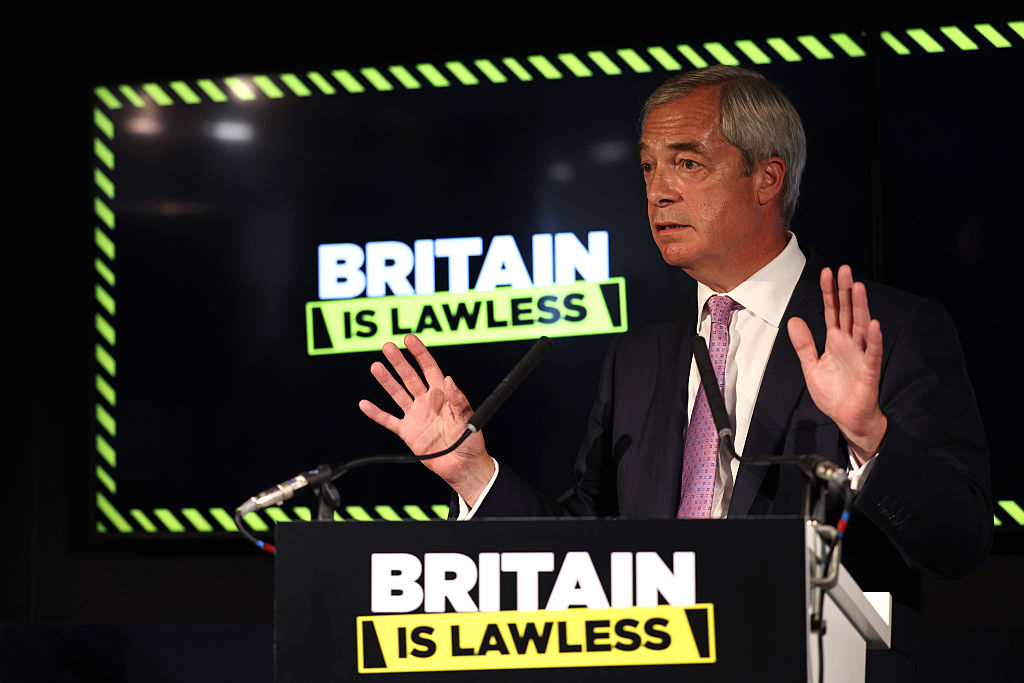
The Trump show even managed to dominate Nigel Farage’s address (now seemingly a weekly event) to the Westminster faithful on Monday morning. From the Reform HQ’s brand new “press briefing room” on the twenty-fourth floor of the Millbank Tower (once home to the Labour Party – and, more recently, Farage’s Brexit referendum campaign group Leave.EU), journalists were invited to hear all about how “Britain is lawless”, again.

What Farage wanted to talk about was his latest champion, retired DCI Colin Sutton (of the Levi Bellfield serial killer case fame), who will lead a new task force on law and order for Reform, and also how crime – in particular, sexual violence against women and girls – is linked to uncontrolled immigration. What he was mostly asked about was Donald Trump. There was a particularly uncomfortable moment when Farage, having just railed about not letting dangerous sex offenders into the UK, was questioned on whether Trump – convicted of several criminal offences and found liable for sexual abuse in a civil court – was “the right sort of person to be letting into this country”. “I think there was a civil case, not a criminal case, am I right or am I wrong? Thank you,” the Reform leader replied testily, before quickly moving on.
This is delicate territory for Farage. As we all know, Trump is not a popular figure in the UK: around 70 per cent of Brits have an unfavourable view of him. Crucially, this unpopularity extends across the political spectrum. Following the infamous Oval Office meeting with Zelensky in February, Trump’s favourability in the UK went negative even amongst Reform supporters. Farage’s affinity with the US President is one of the few attack lines against his party which actually seems to work (just listen to this exclusive podcast with polling analyst Steve Akehurst). Back in March, More In Common found that “50 per cent of Britons see Farage as ‘in Trump’s pocket’ – something that 69 per cent of Britons see as a negative thing for a politician to be, including 47 per cent of Reform voters”.
This might explain why Farage was so keen to dodge questions about his former buddy – which he did, every time a journalist tried to press him on why he hadn’t been invited up to Turnberry or what he made of the Trump-Starmer talks. And yet, there in the front row of the Reform press conference were two very visible reminders of the links Farage has with the Maga movement: US conservative pundit Ann Coulter and James Orr, the right-wing Cambridge theology professor who just happens to be a close friend of JD Vance. Their presence was noted but skirted over, with Coulter described intriguingly as an “observer”. On Friday, when Trump landed in the UK and announced “Immigration is killing Europe”, she tweeted simply “I hope Nigel Farage is taking notes”. There she was in the room three days later taking her own.
What is going on? As has become a theme, Farage is trying to have it both ways, flirting with the Maga movement – for attention, ideas, and support from US sources – while aiming to keep just enough distance to avoid repelling mainstream Brits.
Trump isn’t the only example of Reform experimenting with pushing the populist boundaries. Monday’s conference kicked off with Zia Yusuf offering a diatribe against the Online Safety Act which came into force at the weekend, suggesting it was so “dystopian” it would make Xi Jinping blush (which, to be totally honest, seems a bit unlikely). But a strong majority of British adults support age verification to view pornographic content online, and after last summer’s riots two-thirds wanted social media companies to be held responsible for post inciting violence – the very thing Yusuf was raging against. The British public love banning things, and appear to be less along the libertarian free speech spectrum when it comes to online safety than Reform.
Then there was the moment I asked Farage (and Sutton) how scrapping all police DEI roles would affect efforts to tackle the kind of toxic misogyny within forces that enabled officers like David Carrick and Wayne Couzens to abuse their positions to rape women, and what this said about Reform’s purported focus on reducing sexual violence. Sutton blamed the conduct of both men on the austerity of Theresa May’s Home Office, which didn’t quite answer the question (not least because Carrick became a Met Police officer in 2001), while Farage dodged the question entirely. It’s an area where two of Reform’s stated aims – tackle violence against women and girls, and wage war with “woke” – are in obvious conflict. The solution is to duck and fudge, hoping voters won’t notice the contradictions.
But Trump is the biggest risk, where Farage’s position puts him outside the realm of popular opinion in the UK. Reform is going into the second year of this parliament leading the polls, with both Labour and the Conservatives struggling to cut through and show the unworkable “cakeism” of it promises to invest huge amounts in public services like policing while simultaneously cutting taxes, all supposedly paid for by scrapping a few items like HS2 and net zero. Pointing out the numbers don’t add up doesn’t seem to be working to neutralise Farage. Would pointing at the Trump-shaped elephant in every room he walks into be more effective? After all, it worked in Canada.
This piece first appeared in the Morning Call newsletter; receive it every morning by subscribing on Substack here
[See also: Will Keir Starmer recognise Palestine?]
Content from our partners



Related

Join the debate
Subscribe here to comment