
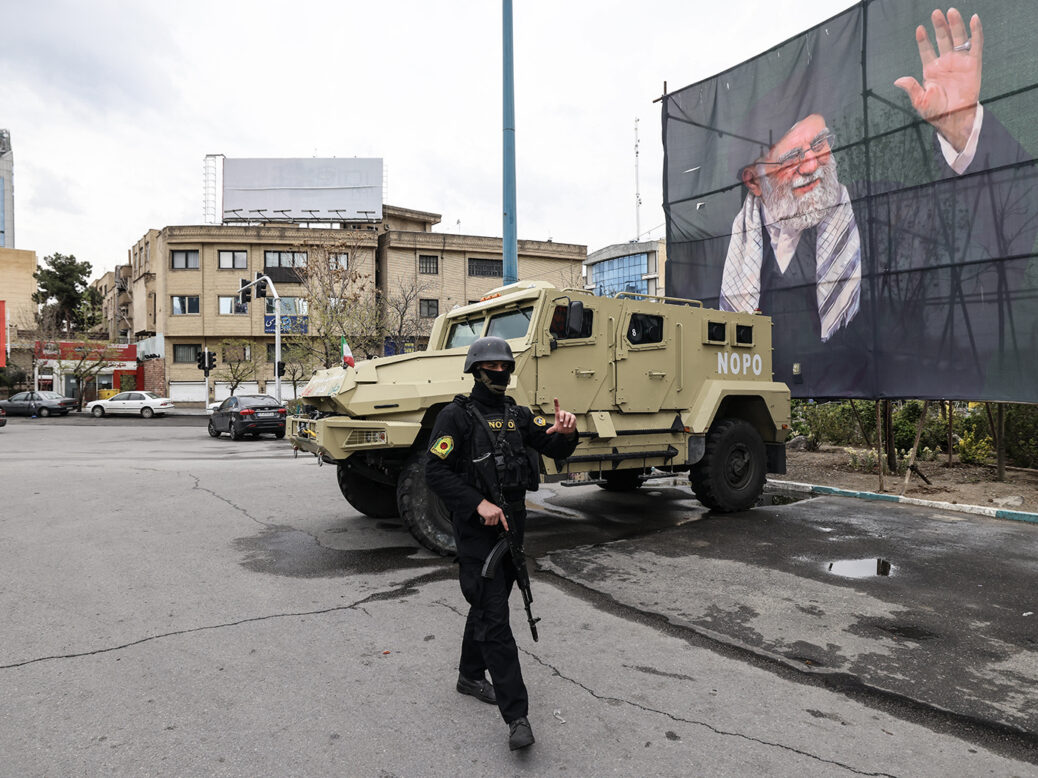
As the conflict with Iran stretches into its fifth week, Trump administration officials are increasingly looking for an off-ramp. Donald Trump has walked back his demand that Tehran reopen the Strait of Hormuz before any ceasefire, whilst US Secretary of State Marco Rubio declared that America’s war aims are to destroy Iran’s armed forces and ballistic missiles – conveniently forgetting previous promises of regime change. A “day after” is apparently in sight.
But in war, the enemy always has a vote. Iran’s pre-war political leaders are dead or in hiding. Its military is significantly weakened. But Tehran’s goals – preserving the regime and disincentivising another round of fighting – not only remain unchanged, they seem increasingly achievable as the war drags on. After two years of repeated strategic setbacks and failures, Iran may have finally found a way to realise its objectives.
Many in the Gulf states were shocked by Iran’s relentless attacks on their civilian infrastructure. But this should have come as no surprise. Since the June 2025 “12-day war”, Tehran had repeatedly threatened that it would strike any Gulf countries hosting US bases in any future round of conflict. That no one apparently believed Iran’s retaliation would correspond in scale to the chaos it has unleashed points to a key cause of the war: Tehran did not convince its rivals that the costs of renewed hostilities would outweigh any benefits. In short, it failed to project deterrence.
How Iran fights has undergone several shifts since the Hamas-led attacks on 7 October 2023. It has long styled itself as the head of “the Axis of Resistance”, a disparate network of allies of convenience and ideological fellow travellers. Its conventional military could never win toe-to-toe against Israel, or the US, let alone both. The Axis of Resistance mitigated this weakness. Tehran could use Hezbollah and Hamas to contain Israel in its own backyard, while avoiding a state-on-state war, or a direct retaliation on Iranian soil.

But the Axis of Resistance ran its course. When planning the attacks, Hamas’s leaders sought to reverse their dependency on Iran and instead have the tail wag the dog. They apparently kept Tehran in the dark but hoped to conduct an attack so unexpected and shocking that Iran would have no choice but to join in. They succeeded in the former, but not the latter. This gave Israel the legitimacy to unleash its destructive potential; first on Hamas, then on Hezbollah. Only in April and October 2024 did Iran belatedly go to bat for its allies, firing hundreds of drones and missiles directly at Israel for the first time.
This was a catastrophic miscalculation. It came too late and did too little damage to alter the conflict’s momentum. Worse still, it created a new normal of state-on-state warfare, exactly what the Axis of Resistance strategy had sought to avoid. Israelis had long feared that any war with Iran would be long, costly and kill hundreds of civilians. Despite repeated rounds of conflict in 2024 and 2025, none of those predictions transpired. Tehran’s bark looked worse than its bite and its escalation gave Benjamin Netanyahu the justification he had long sought to attack Iran. It was Iran’s own miscalculations, then, that precipitated both the “12-day war” and the current conflict.
This is why Iran is now lashing out at the Gulf states, despite the monarchies putting aside their significant political differences to lobby Washington against going to war in the first place. Iran’s strategy is simple: cause unprecedented regional chaos and global economic instability. The Gulf states – who sit on significant hydrocarbon reserves – are an obvious target. Each also boasts inward-focused development agendas that depend on regional stability to attract investment and tourism, alongside robust political and defence ties to the US. Iran has thus identified the Gulf states as both the US’s and the global economy’s local centre of gravity.
There is a method to this apparent madness. In the short term, it seeks to force the US to blink first and agree to a ceasefire without achieving regime change. This would allow Iran to claim that it has won this round. But Tehran also has a more long-term aim: by imposing unprecedented costs that would make the US think twice before trying again, Iran seeks to make this the last round of state-on-state conflict. It has even strong-armed its remaining proxy – Hezbollah – into joining the conflict as a force-multiplier in an otherwise state-centric conflict and has leant heavily on the Yemen-based Houthis to do the same.
After two years of floundering, Iran may have finally found something that works. Most Americans never backed Trump’s war; criticism will only likely mount given that gasoline prices have reached their highest levels since 2022. Trump threatened to strike Iran’s energy grid before apparently backing down after Tehran threatened to attack similar targets in the Gulf. This illustrates that despite the blows its military has suffered, Iran can still disincentivise the US from pursuing an escalation that might force Tehran to negotiate. Further, Trump’s decision to un-sanction several tankers laden with Iranian oil in order to calm energy markets was a victory that years of negotiations failed to achieve for Tehran.
Even Iran’s most resilient foe – Israel – has paid a far higher price than in any of the previous bouts of state-on-state conflict. Israel’s home front is well prepared. Unlike their American counterparts, Israelis have long been primed for this war. Yet recent polls suggest that support is dipping, while anti-war demonstrations have been held throughout the country. Before the war, Israel had the upper hand against Hezbollah, intermittently striking against its assets in Lebanon with little retaliation, regardless of a ceasefire. Now, Israel finds itself sinking into a Lebanese quagmire. Ten of its soldiers have been killed in Lebanon, whilst Hezbollah’s rockets make normal life in Israel’s northern border communities untenable.
Iran has adopted its new, morally dubious strategy out of weakness and to compensate for its past failings. Its officials strenuously deny it, but its primary targets are civilians across the region, from Doha to Tel Aviv. It can no longer rely on the Axis of Resistance, because many of its nodes are crippled or, in the case of Syria’s Assad regime, no longer exist. It is also imperilling its last reliable regional ally – Hezbollah – by forcing it to fight Israel, a fateful decision which has undermined the group’s position in a war-weary Lebanon.
Yet in contrast to the US, Iran’s war goals of regime survival and restoring its deterrence have been consistent and clear. They also correspond to its scorched earth strategy. As the US runs out of targets for its “shock and awe” offensive and the war’s physical and economic costs continue to escalate, Washington may now be looking for a way out of this conflict. For Iran, however, dragging out this war may be its best bet for stopping the next one.
[Further reading: The axis of autocracies is winning]
Content from our partners



Related


Join the debate
Subscribe here to commentThat anyone with the slightest scrap of foresight couldn’t see this coming is unbelievable.