
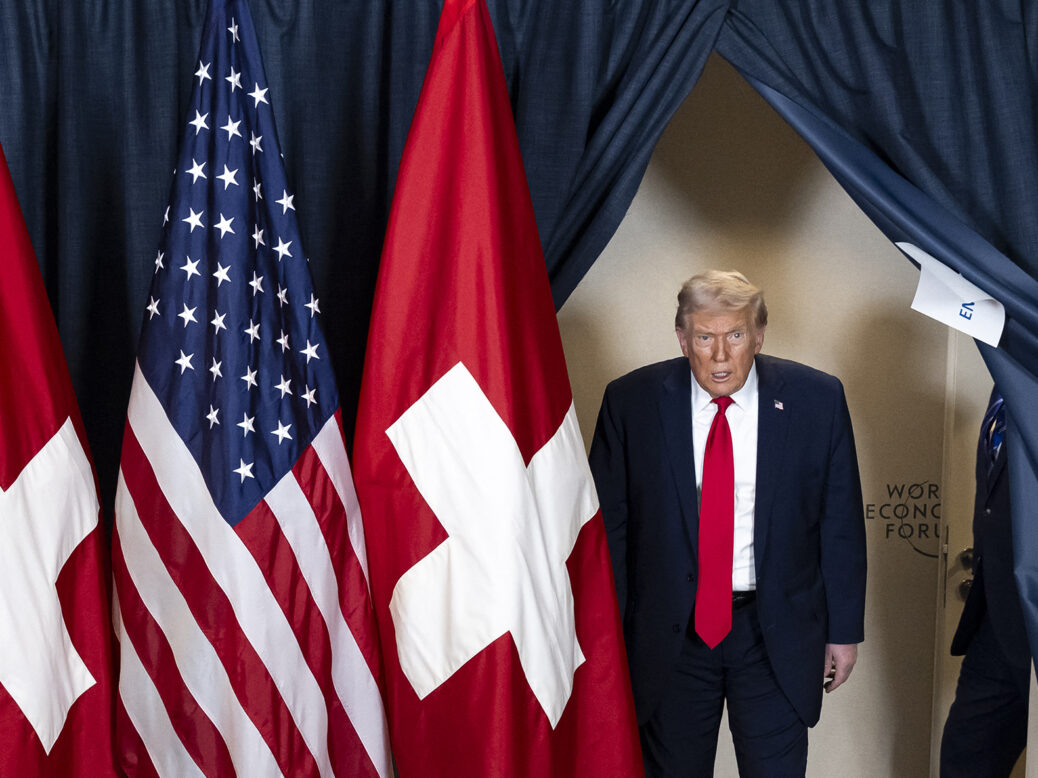
Editor’s note: This piece has been updated in light of Donald Trump’s comments on 21 January that he had reached a “framework of a future deal” over Greenland after meeting with Nato’s secretary general, Mark Rutte.
Donald Trump only has one mode of public speaking, so the assembled dignitaries in Davos first had to endure a rambling monologue about windmills, the North Sea, and his economic achievements before they would find out whether he was planning to go to war with Denmark.
“We were a dead country, now we are the hottest country anywhere in the world,” the US president assured the audience in a flat monotone. He was presiding over an “economic miracle” with the United States “growing faster than any country in history.” (There were audible sniggers in the room.) The North Sea was “incredible” but they “don’t let anybody drill.” He wanted to see Europe “go good” but it was “not heading in the right direction.” He blamed a combination of immigration and windmills. “There are windmills all over Europe, there are windmills all over the place, and they are losers,” Trump lamented. Every time a windmill turns, he said, “you lose $1000.”
So, should he say a few words about Greenland, Trump wondered aloud, clearly enjoying the collective snapping back to attention this seemed to inspire. “I have tremendous respect for both the people of Greenland and the people of Denmark,” he read from the teleprompter, before proceeding to demonstrate that, in fact, he had none.

Denmark had surrendered to Germany “after just six hours of fighting” during the Second World War,” Trump said, whereas the US had effectively won that war for everyone in Europe. “Without us, you’d all be speaking German, maybe a little Japanese,” he told the audience to several groans. (German is in fact the main language spoken in the eastern part of Switzerland, where Davos is located.) As for Greenland, and his tremendous respect for the people living there, well it was “hard to call it land,” Trump explained. “It’s a big, beautiful piece of ice.”
The main point of this part of the speech was apparently to assure European leaders and global financial markets that he was not planning to use military force to seize Greenland, which he did in a grudging, strangely self-pitying manner. “We probably won’t get anything unless I decide to use excessive strength and force where we would be frankly unstoppable,” Trump said. “But I won’t do that. That’s probably the biggest statement because people thought I would use force. I don’t have to use force. I don’t want to use force. I won’t use force. All the United States is asking for is a place called Greenland.”
Apparently satisfied than he had done his bit to generate the required headlines and halt the previous day’s precipitous stock market decline – the US markets duly rallied – Trump then returned to his core argument about why the US must have, and indeed should rightfully already have, Greenland.
“We already had it. We gave it back,” Trump claimed. What actually happened was that the US deployed troops and built military facilities in Greenland during World War Two as part of the Allied war effort and in agreement with Denmark’s ambassador to Washington. The US was never given sovereignty over the island. But Trump was not going to let the facts hold him back. “All we’re asking for is to get Greenland, including right, title, and ownership,” he said. “You can’t defend it on a lease.” (This will presumably be unwelcome news to all the other US allies that like Denmark, have a defence agreement with Washington.)
“This enormous unsecured island is actually part of North America,” Trump continued. He dismissed the idea that the real draw was Greenland’s reserves of critical minerals and rare earth elements, insisting that the US needs the territory to build its “Golden Dome” missile defence shield and for “strategic national security.” “What I’m asking for is a piece of ice, cold and poorly located,” Trump said, apparently having already forgotten that anyone actually lives there. “It’s a very small ask compared to what we have given them for many, many decades.” (He seemed to be talking about Nato.) “We want a piece of ice for world protection and they won’t give it.”
“You can say yes, and we will be very appreciative,” Trump said, now seemingly addressing Denmark. “Or you can say no, and we will remember.” (Denmark and Greenland had already said no repeatedly and unequivocally.) Confusingly, at several points in his speech, Trump referred to Iceland when he appeared to mean Greenland, presumably because he has taken to talking about the self-ruling democracy as a “piece of ice.” Unlike Canada’s prime minister, Mark Carney, whose speech the previous day was greeted with a standing ovation, Trump left the stage to a half-hearted smattering of applause and the first murmurings of optimism that perhaps, having rescinded his previous threats of force, Trump was, characteristically gracelessly, beginning the process of backing down.
Several hours later, Trump announced on his Truth Social account that he had held a “very productive meeting” with Nato secretary general, Mark Rutte, and reached the “framework of a future deal with respect to Greenland, and in fact, the entire Arctic Region.” The tariffs he had threatened against Denmark and its allies were off, and the details would be negotiated by the US vice president, JD Vance, secretary of state, Marco Rubio, and, of course, his special envoy, Steve Witkoff, who is also simultaneously tasked with negotiating peace deals in the Middle East and between Russia and Ukraine. Speaking to reporters that evening in Davos, Trump described the framework as a “concept of a deal” which would involve mineral rights for the US and last “forever”. He said he would provide a more detailed explanation “down the line.”
Whatever has or has not just been agreed – no further details were available at the time of writing – it is important to be clear about what has just happened here and resist the temptation to file this crisis under Trumpian histrionics and move on with a collective sigh of relief. If Trump has taken the threat of US military force off the table, and with it the worst case scenario of an armed confrontation between Nato allies, along with the forced assimilation of the population of Greenland, then that is unequivocally good news. But European leaders must not forget that, just hours earlier, they were dealing with a US president who believed it was perfectly appropriate to threaten Denmark, Greenland, and the continued existence of the North Atlantic alliance to get his way.
Trump appears to have ruled out the use of force and proclaimed a triumphant deal after Denmark rushed troops to Greenland and the financial markets panicked, but who knows what he will announce on his social media account later tonight or next week if he is unhappy with how the promised negotiations are shaping up or a new prospective deal-making opportunity catches his eye. In his recent exchange with Norway’s prime minister and in recent interviews, the US president has made all too clear that he is acting on the basis of his emotions and what he believes is “psychologically needed” for his own success. He has stated plainly that the only constraint on his behaviour is, “My own morality. My own mind.”
This is why, in the hours ahead of Trump’s Davos speech, Greenland’s government was urging people to ensure they had enough food and water stored in their homes for five days, and the ability to heat their houses without electricity. It is why the head of the Royal Danish Army has deployed to Nuuk with the latest contingent of combat troops. There is reason for cautious optimism that the most dangerous phase of this latest crisis may now have passed if Trump has indeed accepted a face-saving “framework of a future deal”. But the only certainty of Trump’s second term as president is that there will be more crises to come. He has only been back in the White House for a year.
The real message to take from the circus at Davos and the extraordinary events of recent weeks was encapsulated in Mark Carney’s necessarily stark address on 20 January. “We are in the midst of a rupture, not a transition,” Carney said. “The old order is not coming back.” Instead of looking to Trump for encouraging signs that he does not really mean what he says and the transatlantic relationship might yet get back on course, we should be clear that the only language he really understands is strength and resolve, and act accordingly. Invoking Vaclav Havel, Carney said it was time to stop living “within the lie” that the so-called “rules-based international order” still functions and acknowledge “the world as it is.” As he put it: “Nostalgia is not a strategy.”
[Further reading: The special relationship is dead]
Content from our partners


Related
Join the debate
Subscribe here to commentTrump showed this week more than ever that he is truly a piece of human gar-bage – full of grievance, power crazy, racist,vindictive and malevolent.
Unfortunately he fully represents the unsightly underbelly of the U.S. along with 30% or so of the more bigoted or cynical American population.