
At a regional summit in 2010 China’s then-foreign minister Yang Jiechi summed up his county’s world view in blunt terms. “China is a big country, and other countries are small countries,” Yang said as he defended Beijing’s increasingly assertive actions in the South China Sea. “And that’s just a fact.” Donald Trump shares this view of the world. There are big countries like the United States, Russia, and China that deserve his respect, even admiration – hence his excited announcement that “THE G2 WILL BE CONVENING SHORTLY” ahead of his meeting with Xi Jinping in October, and his unshakeable belief that Russia will ultimately defeat Ukraine.
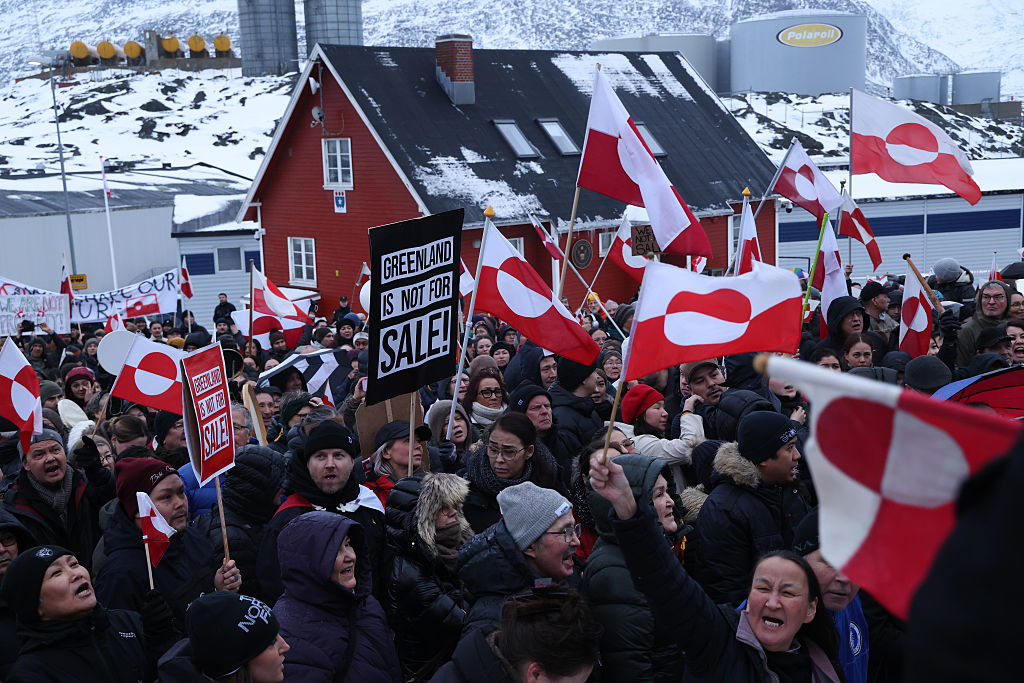
Then there are the small countries and weaker powers like Denmark, the UK, and the rest of Europe that can be humiliated and pushed around. Hence Trump’s announcement on Truth Social on 17 January that the eight European countries – Denmark, Norway, France, Germany, the Netherlands, Sweden, Finland and the UK – that have sent troops to Greenland in recent days will all now face 10 per cent tariffs. If they do not capitulate by 1 June, he wrote, the tariff will increase to 25 per cent. These tariffs will remain in place until “a Deal is reached for the Complete and Total purchase of Greenland”.
These countries are all long-standing US allies and members of Nato. Most sent troops to fight, and in many cases die, alongside the US in Iraq and Afghanistan. But Trump, as he has now made all too clear, does not believe in alliances. Multi-lateral organisations are for suckers. “It is time for Denmark [and the rest of the EU] to give back,” Trump wrote in his social media post. “World Peace is at stake!” To secure that peace, Denmark must give Trump Greenland, even though both Greenland and Denmark have made clear, repeatedly, that there is no world in which either of them would agree to this.
So Trump is attempting to bully his supposed allies into submission. In his world, everything has a price. Never mind all that talk about sovereignty and self-determination and Greenland’s prime minister, Jens-Frederik Nielsen, stating plainly on 13 January that if his country has to choose between the US and Denmark, “we choose Denmark”. Eighty-five percent of Greenlanders said in a 2025 poll that they did not want to join the US. “One thing must be clear to everyone,” Nielsen stressed. “Greenland does not want to be owned by the United States. Greenland does not want to be governed by the United States. Greenland does not want to be part of the United States.” (Asked about Nielsen’s comments the next day, Trump responded: “I don’t know who he is… but that’s going to be a big problem for him.”)

Denmark and its allies have responded with admirable resolve to Trump’s threats so far. Deploying a multinational force to Greenland, if only with small numbers and limited capabilities, demonstrated both a willingness to address Trump’s purported concerns about Arctic security and deterring the Russian and Chinese vessels he claims, falsely, are “all over” Greenland. Copenhagen has emphasised that these troops are taking part in a pre-planned exercise and invited the US to send its own forces. But the European contingent is also intended to complicate Trump’s options and deter him from launching a swift and presumably unopposed takeover by making it clear that Danish soldiers intend to fight. (Rasmus Jarlov, who chairs the Danish parliament’s Defence Committee, told the NS the same last week. “There would be a war, and there would be fighting,” he said, “and [the US] would have to shoot people to get Greenland.”)
Trump seems to have interpreted this as insolence, which must be punished with tariffs – his preferred solution for most foreign policy problems – to bring those disobedient Europeans to heel. But if he was expecting to evoke shock and awe in European capitals, he must be disappointed with the immediate response.
“No intimidation or threat will influence us — neither in Ukraine, nor in Greenland, nor anywhere else in the world when we are confronted with such situations,” French President Emmanuel Macron posted on X. “Tariff threats are unacceptable and have no place in this context.” European Commission president Ursula von der Leyen warned that Trump’s tariffs would “undermine transatlantic relations and risk a dangerous downward spiral”. EU ambassadors are due to hold an emergency meeting in Brussels today to discuss the crisis, with some officials already suggesting that the EU-US trade deal agreed last summer could be halted unless Trump drops his threats.
Keir Starmer, whose imagined role for the UK as a “bridge” between Europe and America now looks more like a canoe without a paddle, drifting forlornly up a creek, has promised he will be “pursuing this directly with the US administration,” which does not inspire a great deal of confidence. Punishing US allies with tariffs “for pursuing the collective security of Nato allies is completely wrong,” Starmer said, summing up the sheer inanity of this moment, and the grave peril Nato now confronts.
Despite Trump’s bravado, there are three important factors to bear in mind, and reasons for European leaders to hold their nerve. First, it is far from clear that Trump has the legal authority to apply these tariffs. It is not even clear on what basis he is planning to do so, beyond the characteristically rambling stream of consciousness on his Truth Social account. Last week, his own treasury secretary, Scott Bessent, did not know that he was planning to announce 25 per cent tariffs on all countries that trade with Iran, which includes China and would almost certainly blow up their hard-won truce and any prospect of a deal. The Supreme Court is expected to rule imminently on whether he had the power to introduce his “Liberation Day” tariffs in April 2025 under the International Emergency Economic Powers Act (IEEPA). If he loses, his administration might have to refund the approximately $200 billion in tariffs US importers have already paid. Despite his apparent belief to the contrary, dispensing threats on social media does not make them legal or enforceable.
Second, there is the fact that Trump does not have the legal authority to “buy” Greenland, even if it were for sale, or to annex new territory to the United States if he did succeed in taking it by force. Congress would have to appropriate the funds needed for any purchase, and approve the addition of any new land or state. The president cannot redraw the map by himself. Even in its current, supine state, there are bipartisan efforts underway in congress to prevent Trump from being able to take military action against a fellow Nato state. A bipartisan delegation was in Copenhagen, assuring lawmakers there that, despite appearances, Trump does not represent the entirety of the US government.
Finally, there is the fact that Trump does, sometimes, back down. There are two pressure points, in particular, that have proved decisive within the past year. The first was when the bond markets shuddered after “Liberation Day”, which caused Trump, by his own admission, to swiftly change course. Imposing ever more tariffs on imports to the US also hurts American consumers. This could hurt the president at home, at a time when inflation is already creeping up and American voters are already angry about the worsening affordability crisis that many of Trump’s voters thought they were electing him to immediately solve. So Trump is not invulnerable to the economic consequences if he follows through on his threats.
Unlike most other countries, China punched back against Trump’s 2025 tariffs, threatening to bring trade between the world’s two biggest economies to an effective standstill. Beijing also leveraged its extraordinary dominance over critical minerals, including rare earth elements, and therefore US production lines, forcing the Trump administration to negotiate a truce. Sadly, Europe does not have its own critical mineral chokehold to deploy, but the continent’s leaders must now quickly show that, in the Trumpian vernacular, they too have cards to play, and, crucially, be prepared to play them.
Europe’s reckoning over Greenland is here. Whatever happens next – and we should be clear that this could well get much, much worse – the leading member of Nato is now openly threatening its fellow allies with economic warfare unless they submit to Trump’s predations and allow him to seize a self-ruling democracy, and sovereign European territory, against its will. It is hard to see how the North Atlantic alliance, which has endured for more than 80 years, can survive such a concerted attack from within. Vladimir Putin must barely be able to believe his luck – the fearsome Western alliance he has loathed for so long appears to be destroying itself.
Ukraine, too, stands to lose even more than it has already done since Trump’s return for power. Under an intensifying Russian bombardment, Ukrainians must now prepare to have weapons and intelligence cut off by a US president who will view them as leverage in his contest with Europe. Yet more good news for Putin, who will only be more encouraged to press ahead with his efforts to subjugate Ukraine. If he was ever seriously interested in negotiating a ceasefire or a genuine peace agreement – and there is no real evidence he was – he is not anymore.
This is an entirely self-inflicted crisis. There is no imminent Russian or Chinese threat to Greenland. The security concerns Trump keeps invoking are mostly fictional, and those that are real could be far better addressed within the existing security arrangement, and within a robust, functioning Nato. Trump says he needs to own Greenland to build his “Golden Dome” missile defence shield, but the US already has a massive radar station there and could easily build another if he so desires.
The more logical explanation for his actions is, as he told reporters in the Oval Office on 7 January, because “that’s what I feel is psychologically needed for success”. Pressed as to whether he meant for him, or for the country, he clarified: “for me.” Perhaps Trump thinks this is all just part of the game; that, as the leader of a big country, he is entitled to act accordingly. He should get to take what he wants from the smaller powers. According to his world view, it has always been a jungle out there. We all live in that jungle now.
[Further reading: Rasmus Jarlov: If the US attempts a military takeover of Greenland, “then we are at war”]
Content from our partners



Related

Join the debate
Subscribe here to commentDonald Trump Become mad
Great article.
Appeasement doesn’t work. The only good thing which might come if this is that perhaps our leaders are waking up to this notion. Trump is apparently going to throw around the threat of tariffs whenever he wants something, so it’s time we look towards the actions of Canada and dare I say it, China.
Mark Carney has repeatedly shown us that he’s the only allied politician with his eyes wide open when it comes to the giant orange baby and that he only responds to nations willing to face him down. If Trump is going to throw tariffs around like wanton threats, we need to de-fang (as much as we can) the ability of these tariffs to derail our economies.
Let’s face it, this economic bullying is coming at some stage whether we like it or not, best get on with it before there are more Venezuela’s that will only embolden him.