
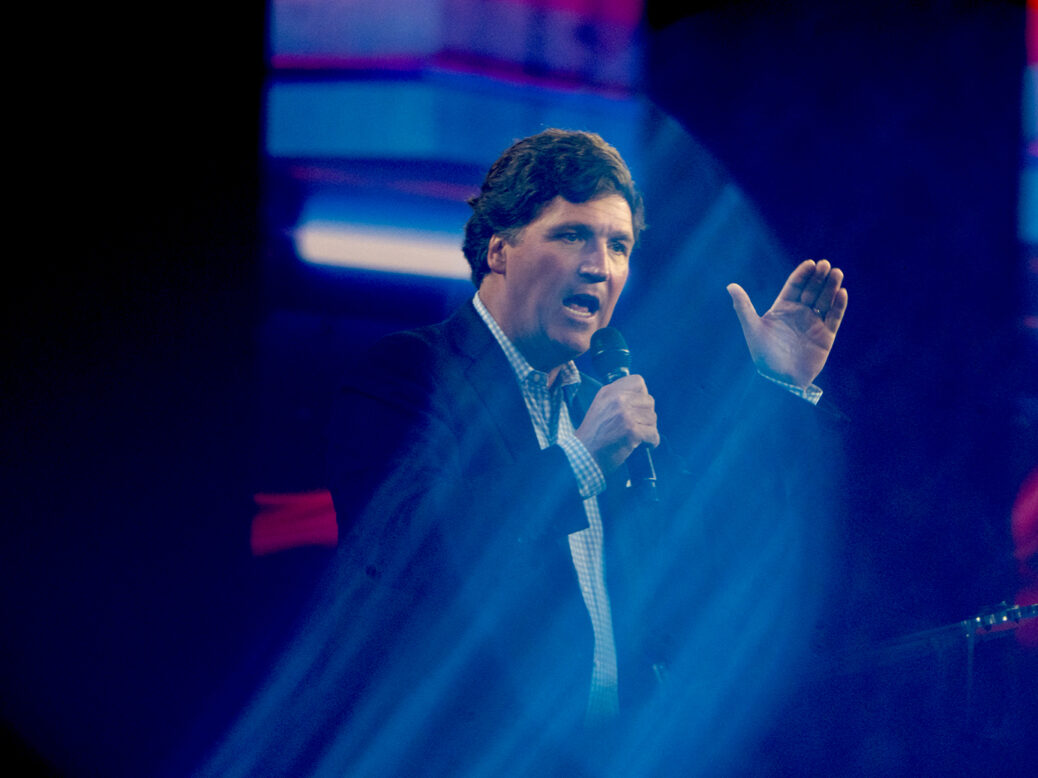
If you’ve ever wondered how a Donald Trump speech might read with all the rapier sharp wit and easy charm stripped out, then I can heartily recommend the Tucker Carlson piece published by the Spectator last week under the headline “The Strange Death of England”. (If you have any paint you urgently need to watch dry, then it can probably wait.) The transcript of a monologue made on his X show – you can tell – it begins with a question: “Whatever happened to Britain, or the UK, or England, or whatever they’re calling it?” Then Carlson adds, with bafflement that’s somehow audible even in text form: “We can’t even agree on what it’s called.”
This is not entirely unreasonable – better men than Carlson have struggled with the whole three-and-a-half-nations-in-one-state thing – but nonetheless, this sounds like a him problem. Luckily for all of us, Tucker doesn’t let his inability to actually name a country prevent him from launching a broadside against it. “After winning the two biggest wars in human history,” he goes on, “Britain has shrunken, not just physically, but in some way that’s hard to describe. Its culture has changed, some might say has been destroyed, and it’s become something completely different.” For some reason, my dog just started barking.
There’s more – goodness me, there is so much more. The most grimly fascinating part, if only by virtue of being the most offensive, is when he compares the state of the UK to the plight of the noble indigenous American. (The problem, apparently, “is not necessarily the immigrants,” he adds. “The problem is what mass migration does to the people who already live there.” Well then.)
Much of it, though, would be familiar to anyone who’s had the misfortune of encountering the views of the American right about the current state of what they call – don’t ask me to explain this – the “Yookay”. The transformation from globe-spanning empire to sad, grey land of litter and graffiti. The role of condoms and abortion in plummeting birth rates. Free speech panic, concerned in this case with the arrest of a pro-life campaigner caught praying outside a family planning clinic. Throw in a few references to Sadiq Khan’s sharia law, or teenagers street fighting with machetes, and you’d have a full house.

Few residents of Airstrip One would deny we have problems, some of which – the grubbiness, the demographic crisis – Carlson even manages to identify. (Personally, of course, I’d put the blame on austerity, the financial crash and housing shortage rather than “brown people”, but you do you). Literally no one would deny our global status has declined somewhat since half the globe was pink, even if there is some disagreement over whether or not this was actually a bad thing. And yet, the Britain seen through the eyes of the American right is like a reflection in a hall of mirrors, identifiable but grotesquely distorted. Why, to mangle a quote from a work of great American literature, are they so obsessed with us?
One explanation is surely the same as that for most of the other terrible things in the world today. The world’s most divorced man, Elon Musk, is frequently online at hours in which the English-language internet is dominated by Brits; he’s the only person on Earth who thinks Keir Starmer’s problem is that he’s too left-wing; and because he owns a platform that’s radicalised half the planet, his views have spread. Bummer.
A related factor – on X, but also not X – must be the rise of short-form video. For a long time, the vision of this county most likely to reach American screens came with a sort of sepia filter: the Britain they saw was the one of Harry Potter, Downton Abbey and Paddington, all massive houses that still manage, somehow, to be cosy. When they actually got to see the reality of modern Britain – with its graffiti, crime, houses the size of postage stamps and, yes, brown people – perhaps it’s understandable it might come as a shock.
I think, though, there’s something else going on. The uncanny valley is the hypothesis that there’s something deeply unnerving about things which are almost, but not quite, like you. Brits have often been lulled by a common language and some shared culture into thinking Americans are basically us, only to start gibbering when they encounter someone who seems normal yet genuinely loves both the Republican Party and guns. Perhaps this is just the same process happening in reverse, and it’s simply more shocking for US right-wingers to be faced with people who love socialised medicine and hate guns when they’re from the country that birthed their own.
Then again, perhaps this is over complicating it. The wheel turns, and this too must pass: ruling classes have often been haunted by visions of what has happened to the people they replaced. Perhaps this obsession is entirely natural.
What seems rather less natural, though, is the behaviour of the British right. Such people would surely be offended by the suggestion they were anything less than patriotic – yet there they are, allying with foreigners against their own countrymen, colluding to spread nightmarish visions of a Britain in decline. Perhaps those hysterical Americans were right – and Britain really is in danger from an enemy within, after all.
[Further reading: Americans don’t care about Britain]
Content from our partners


Related

Join the debate
Subscribe here to comment