
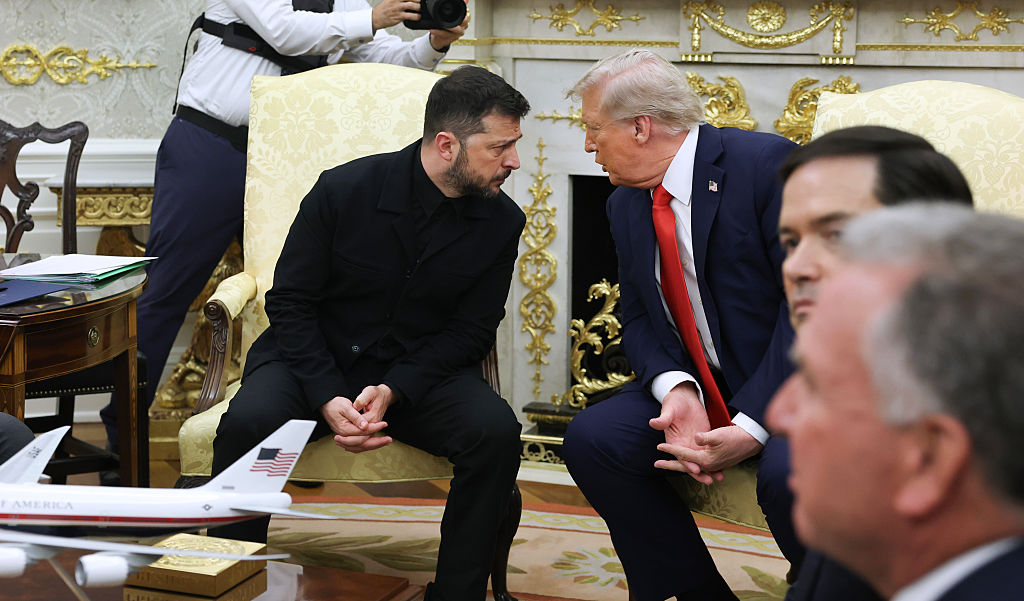
Perhaps the most consequential meeting of the Ukrainian war took place last night at the White House. Volodymyr Zelensky was with Donald Trump in the Oval Office before both leaders met with the top flight of European leadership.
Since January, President Trump’s Oval Office has been a sort of proverbial torture chamber, where he courts flattery and humiliates those who refuse to bend to his will. Sometimes these meetings can feel like a hazing ritual at a frat house, an initiation ceremony into the new world order. When Zelensky visited in February, JD Vance and Trump chastised him for not being grateful enough and a pro-Trump journalist mocked him for not wearing a suit and tie.
This time, however, Trump played host. Zelensky didn’t lose his temper. Sporting a black jacket, he made sure to thank Trump straight away and offered him a letter thanking Melania for her support – a wily move given Trump’s Slovene first lady has become a White House critic of the Russian president, often pointing out to her husband that Putin reneges on his promises to stop bombing Ukrainian cities. Meanwhile, JD Vance stayed shtum on the sofa and later glad-handed Keir Starmer in the East Room. The atmosphere was congenial, poised and anxious.
That Zelensky was escorted by European leaders has been spun as a show of unity. Which is true with regards to Europe. But remember that this extraordinary move to cancel their summer plans in order to fly to Washington DC was only necessary because Trump had been so chummy with Putin in Alaska.

European leaders addressed him as “dear Donald” in the hope that obsequiousness would sweeten their demands. The two key European requests were that the US provide a security guarantee for Ukraine, and that a ceasefire be agreed before a full-blown peace deal is thrashed out.
The German chancellor, Friedrich Merz, said the credibility of their meeting in front of the world’s press depended on a ceasefire being in place before the next one. He didn’t want to march up the hill only to let an opportunity to end the war slip by. Emmanuel Macron, sitting next to Trump, reiterated the point. Starmer stuck to the British strategy: meekness in public affords strength in private. He stuck to calls for unity. Trump had once promised “severe consequences” if Putin did not agree to a ceasefire, but after Alaska he now thinks a ceasefire is unnecessary – evidence, yet again, of Putin’s influence over the US president.
One Washington insider told me recently that the administration wants to pivot away from Europe in order to deal with the Chinese. Europe should police its own continent, in other words, because the US has bigger threats to handle. There are two problems with that. First, European military capacity is weak. The UK, for instance, would probably have to move troops from the Baltic in order to guard Ukraine’s eastern flank. Also note this morning’s Financial Times, which reports that Trump might get another $100bn from the Europeans in exchange for American weapons for Ukraine. The opportunity cost is investment in Europe’s own military industrial base.
Second, what happens if European troops get into a shooting match with the Russians across the ceasefire line? Would the Americans back them up? Trump has said he will support a European-led security guarantee, but the details are hazy and the promises untrustworthy. His Truth Social post last night spoke only about American “coordination” of the security guarantee.
The reset in tone is significant, at least. There is growing momentum behind a peace deal. Any breakthrough now looks likely to take place at a mooted summit between Zelensky and Putin.
At one point, Trump was caught on a hot mic saying: “I think [Putin] wants to make a deal for me – do you understand? As crazy as it sounds.” This either means Putin is genuinely ready to end the war, or Trump has yet again been duped by the manipulator-in-chief. In any case, yesterday showed that Trump sees himself merely as a mediator between Europe and Russia, as the Putin-whisperer with a hotline to the Kremlin, not as Ukraine’s ally in the face of Russian aggression.
This piece first appeared in the Morning Call newsletter; receive it every morning by subscribing on Substack here
[See also: Trump reverses course on Ukraine, again]
Content from our partners



Related

Join the debate
Subscribe here to comment