
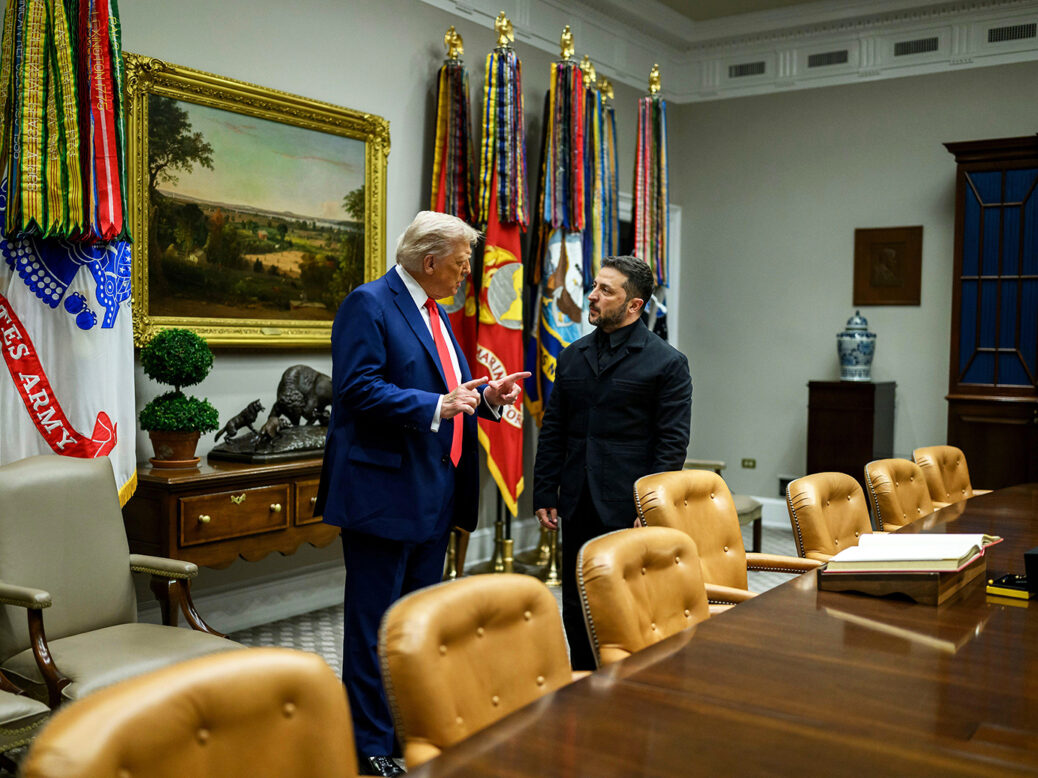
The most telling remark during Donald Trump’s 96-hour push to end the war in Ukraine was captured on a hot mic at the start of his meeting with European leaders on 18 August. “I think he [Vladimir Putin] wants to make a deal for me,” Trump confided to France’s Emmanuel Macron as the other leaders took their seats inside the White House. “As crazy as that sounds.”
With those 15 words, Trump revealed just how little he understands the Russian president, and his war on Ukraine. Putin is a former KGB operative who has been in power for a quarter of a century. During that time, he has fought multiple wars, crushed any semblance of domestic opposition, and had his critics and perceived enemies assassinated, at times with the use of chemical weapons on British streets. He has compared himself to the 18th-century emperor Peter the Great and presided over the rehabilitation of Joseph Stalin and Ivan the Terrible. He is not, most observers would agree, a sentimental man.
It is a testament to both Trump’s faith in his personal charisma, and Putin’s apparently endless ability to beguile his US counterpart, that the former appears to have emerged from their encounters with his regard for the latter wholly intact. Not for nothing has Putin described himself as a “specialist in human relations”.
On one level, the Kremlin seemed to be openly trolling Trump’s efforts to halt the conflict. Russia’s foreign minister, Sergei Lavrov, arrived at the summit in Alaska on 15 August wearing a sweatshirt emblazoned with “CCCP”, the Cyrillic rendering of USSR. Russian journalists on the flight to the US reported they had been served “chicken Kyiv” for lunch. Then there was Putin’s suggestion to Trump that the Ukrainian president, Volodymyr Zelensky, whom he has previously dispatched hit squads to kill, would be welcome in Moscow for talks. More seriously, Russia has kept up its bombardment of Ukrainian cities, and targeted an American factory in western Ukraine on 21 August, as if set on disproving Trump’s claims that Putin wants peace.

And yet, the US president still seems in thrall to Putin and what he insists is their “great relationship”. On 22 August, Trump talked about inviting the Russian president to the 2026 World Cup. “He’s been very respectful of me and of our country, but not so respectful of others,” he told assembled reporters in the Oval Office.
Trump’s stubborn credulity when it comes to Putin has prompted years-long speculation that the Kremlin must have some sort of kompromat or other illicit hold over him. But the most obvious explanation is more prosaic: Trump simply admires Putin, whom he views as a strong leader and one of his few genuine peers in the world. As he put it in a Fox News interview immediately after their recent summit, boasting of the size of their respective nuclear arsenals, “We’re number one and they’re number two in the world.”
During their meeting in Alaska, Putin told Trump what he wanted to hear. The 2020 election was “rigged” through the use of postal ballots, said Putin, who knows a thing or two about rigged elections, and he would never have invaded Ukraine if Trump had still been the president. “I can confirm that,” Putin said during their joint appearance in Anchorage, where he spoke first and looked pleased with himself. Though Trump went into the meeting insisting that a ceasefire was essential, he emerged from it convinced it was not necessary to agree a ceasefire, “which oftentimes does not hold up”. No wonder so many European leaders rushed to the White House alongside Zelensky in the following days to try, ever so diplomatically, to counteract the Russian talking points.
Trump’s determination to see the best in Putin is compounded by his ignorance about the war. He does not seem to understand how the conflict started and that Russia is the aggressor, indicating on multiple occasions that he believes Zelensky – and to some extent also Joe Biden – are to blame. He does not understand that there is more at stake than the control of land, breezily describing Russian-occupied regions of Ukraine as “prime territory” and vowing to try to get back some “ocean-front property” as though the war was little more than a property deal turned sour.
Trump does not understand that Putin is sanguine about the number of soldiers who die each day while the US president seems genuinely aghast at the “waste of life and humanity”. He seems to believe that ending the war is just a matter of setting up the right meetings in the right order and applying the requisite amount of pressure. He cannot seem to fathom that Putin would be driven by obsessions with history and legacy, or that Ukraine is fighting for its sovereignty. This failure to grasp even the basic contours of the conflict does not bode well for the prospect of peace.
Nor does Trump’s pattern of threatening “very big consequences” if Putin does not agree to halt the war. One has to ask why the Kremlin would take him seriously at this point when he has failed to follow through on every threat to date. Instead, he has repeatedly advertised his impatience to extricate the US from any involvement in defending Ukraine beyond, perhaps, agreeing to sell Europe weapons, at a profit.
Lenin famously counselled probing with bayonets. “If you find mush, you push,” he said. “If you find steel, you withdraw.” Despite the blitz of summitry, Putin detects no steel in Trump’s approach to Ukraine, only mush all the way down. That is no way to compel him towards a peace deal.
[See more: Disdain and apathy in Washington DC]
Content from our partners



Related
This article appears in the 27 Aug 2025 issue of the New Statesman, The Gentle Parent Trap
Join the debate
Subscribe here to comment