
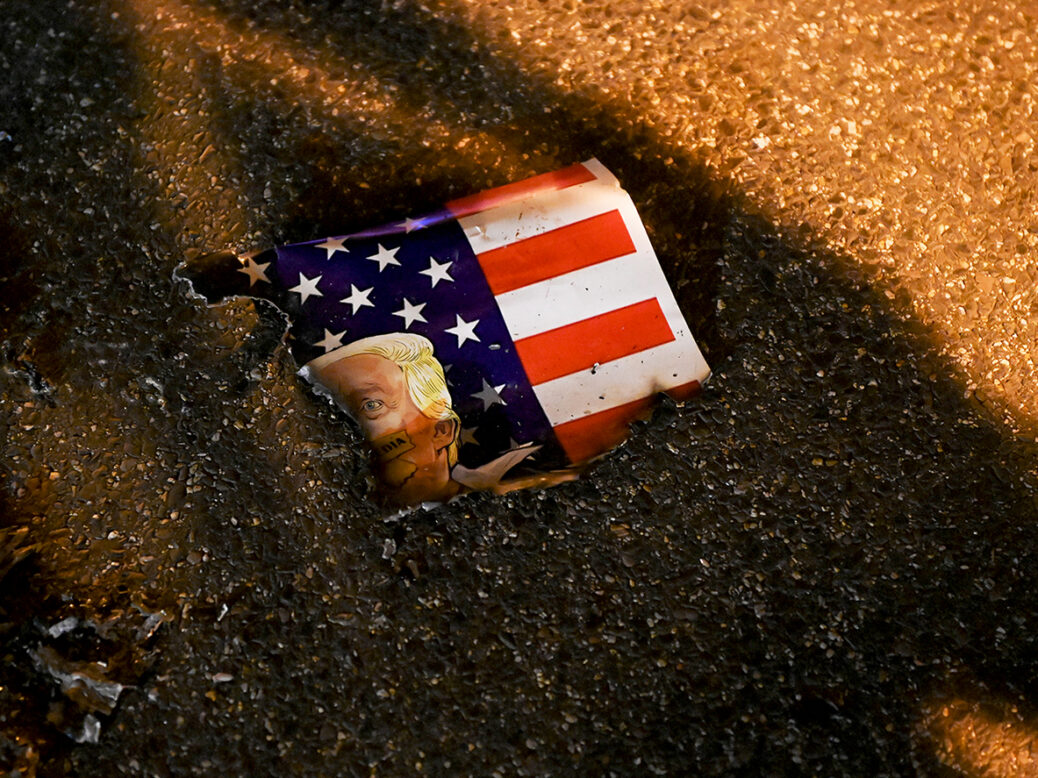
I had never been to a protest where no one turned up. But on a recent evening in Washington DC, there was just me and the three organisers. It was an awkward situation, like a group waiting for the arrival of the friend they all like most; more solitude than solidarity. The situation was surprising, given the issue. The leaflets the organisers had been handing out the week before promised a “15-minute noise disruption” to “BLOW THE WHISTLE ON ICE”. Ice, or Immigration and Customs Enforcement, is Donald Trump’s migrant deportation army, which has a larger budget than the Italian or Australian military.
The organisers even chose an opportune spot, outside the entrance to a subway station in the NoMa neighbourhood, a gentrified Lego box of French restaurants and beer gardens and fairy lights just north of the Capitol. It’s like Shoreditch without the history. Federal employees, lawyers and charity managers populate the cookie-cutter apartment blocks – emptier today after Trump’s purge of the old regime. Call it liberal flight.
I asked one of the organisers whether the power vacuum at the top of the Democratic Party might explain why no protesters had turned up, even in this progressive quarter. Kamala Harris had planned to do her victory speech last year a short cycle ride up the road. The day after the election, when she finally appeared, her obliviously cheery tone jarred with the funereal atmosphere. The politics of joy – that sickly, inane slogan, which captured the substance of her campaign – crumbled on contact with reality. Since then, the Democrats have been petrified by failure.
But the organiser didn’t want to get into that. He had an arid look in his eyes. He confessed regret at the turnout, then stressed that this was the first of many protests to come. His badge read: “I am the resistance,” with a stinging literalism. As we spoke, his expression became panicked. Perhaps this was because he was talking to a reporter. But if I organised a protest under the name Refuse Fascism and no one turned up, I would be panicked too.

Disdain for democracy, rather than apathy, might explain the dearth of protesters. A few days before, I was in a bar in the neighbourhood talking to a man who had been an entrepreneur and was now a corporate manager. His deltoids looked like dumbbells and his favourite author was Malcolm Gladwell. He had a wife, decent money and a drive to succeed. He squirrelled down book recommendations as if he would actually read them. He also thought assassination was the only route out of this tyrannical age. One or two tech billionaires, he impassively evaluated, had to be shot as a warning to the oligarchy. I noted his own, personal success. He shook his head while sucking on a prawn tail and said I didn’t get it.
“Have you heard of fuck-it money?” he asked. I had.
“And fuck-you money?” Yes: enough to quit work whenever you want.
He said the tech barons had “fuck-you-I’m-going-to-control-your-mind money”. In a country where the median salary is around 25 per cent higher than in Britain, money here is really a question of power. The American middle classes remain the most prosperous people in human history. And yet, there is a hunger for a violent reckoning growing among the well-off, fatalist left.
At the protest in NoMa, commuters skulked out of the subway station, irritably declining to exercise their First Amendment rights. They looked drained at the idea of another year shouting on the pavement. The sun was unrelenting, but most chose not to wear sunglasses and scowled at the concrete. It was as if these liberal professionals feared a deportation van would screech around the corner as soon as they hoisted a placard. After a decade of Trumpian drama, they seemed to have lost their energy for resistance. In the summer heat, any residual hope sunk into the tarmac.
I escaped to a bar down the road so as not to intrude on the organisers’ embarrassment. When I returned after my first cocktail, they were still alone, blowing whistles into the wind, rocking back and forth as if they were praying at the Wailing Wall.
If this is the level of opposition on the street, is there any more energy in the Democratic Party? Earlier that day, I had attended a round-table lunch with a member of Congress. The dining room teemed with Washington’s establishment journalists.
There is a split among Congressional Democrats between those who see Trump as an aberration to endure, and those who think his presidency means the death of democracy – which, in turn, justifies a dirtier form of opposition politics. In other words, do you meet Trump on his own terms and accept the tawdriness of American politics today, or loyally abide by the mores of a dying regime?
Many Democrats still think, as Norman Mailer put it, that politics is “no more than a quarrel among engineers”. At another round table a few months ago, I asked whether the gathered Democratic elites actually wanted to be the party of the working class, and was met with resentful silence. Then, someone muttered a theory about controlling the “uneducated masses”.
“Lots of [Democrats] want to bring a knife to a gunfight,” the member of Congress said disapprovingly at the lunch. They were very much in the existentialist camp, and spoke about a figurative insurgency against Trump. “If you don’t have an RPG [rocket-propelled grenade] to hit a tank, then you use a shotgun, you throw some barbed wire on the ground.” They wanted the party to revolt against its obsession with process, which deadens its appeal to voters. The weak opposition to Trump’s budget bill in March was the moment this divide calcified. Some Democrats thought voting “no” would help Trump. At the lunch, they said they thought Democratic hopes lay in forcing “the [bureaucracy to] work for your big bold idea, instead of being absolutely owned by the bureaucracy”.
Yet Zohran Mamdani’s victory in the Democratic primary for New York mayor, the most significant irruption in the party in the past six months, shows something else. Mamdani offers what we might call polite, middle-class populism, conducted in a suit and fought on social media. Mamdani, a self-proclaimed socialist, manages to pit himself against the marauding Wall Street class without adopting Trump’s brash, indecorous type of politics.
That many party leaders want to break with bourgeois decorum – a last refuge of progressive dignity – speaks to their desperation. One Democratic staffer in Congress told me their colleagues were “very disappointed and disengaged”. Where five years ago Democrats “were running up and down the Capitol’s corridors trying to oppose Trump, lots of them now feel like it doesn’t matter”.
At a bar in Georgetown, north-west DC, I met a senior administration official well-versed in Magaworld, and recounted the lonely protest over a few beers. The White House considers most protests an inevitable reaction from progressives, and without political power – they are something to taunt, mock and goad. But some flickers of opposition are causing concern.
“The only protest movement with any energy now is the Third-Worldist pro-Palestine, pro-Hamas and Groypers protest movement,” the official told me. (For the uninitiated, the Groypers are a crop of online young men who follow the white-nationalist streamer Nick Fuentes.)
The war in Gaza is fracturing Maga in two ways. First, many feel the special relationship between the US and Israel is incompatible with America First. Bending to the whims of a small state in the Middle East does not sit well with the movement’s hard-line nationalists. “The benefit of doubt that everyone, I think rightly, gave Israel after October 7 has been, if not entirely squandered, then at least stressed,” the official told me.
Second, anti-Semitism is prevalent among the online right, and dovetails with the ongoing Jeffrey Epstein conspiracy-scandal. “The angriest reactions to Epstein are rooted in opposition to Israel,” the official noted. (Tucker Carlson has suggested that Epstein was working under Mossad orders to blackmail the world elite.)
Trump supporters’ anger at the White House over Israel and Epstein shows that when Maga breaks with the president over a certain issue, the movement shifts right, deeper into the conspiratorial online frenzy. Recall the disdain directed at Trump over the success of his Covid vaccine programme, an America First victory he has chosen to forget. Or the pushback when the president proposed slowing the deportation of undocumented migrants working on farms. As Steve Bannon once put it to me, Trump is a moderate in this world, a sea wall against what is on the horizon.
US presidential elections don’t really start and end in Washington; they are simply the never-ending ambience of American life. Striving Democrats are already conducting covert campaigns. Ditto Republicans. Names that frequently arise in the latter party for 2028 include JD Vance, Marco Rubio, Tucker Carlson and Don Jr (Trump’s eldest son). Unlike the Democrats, Republican governors are scarcely mentioned. It’s unclear whether Trump will crown a successor or invigilate an Apprentice-style rivalry.
Looming over the chatter is Trump’s mortality. The president turns 80 next year. Though he has deified himself into a messianic figure for his supporters, he cannot be resurrected. What follows will be a fight for succession that will be quasi-religious as much as political.
Legacy is certainly on Trump’s mind. Republicans have proposed renaming the opera house in the Kennedy Center after the first lady, Melania. The White House has announced plans to build a grand, gold-dripping banqueting hall, partly funded by Trump, which would replace the East Wing. The real-estate dealer is reconstructing the country’s icons of democracy in his own image. Even in death, Trump will haunt America.
[See more: How anti-migrant politics came for Deliveroo]
Content from our partners


Related
This article appears in the 07 Aug 2025 issue of the New Statesman, Summer Special 2025
Join the debate
Subscribe here to comment