
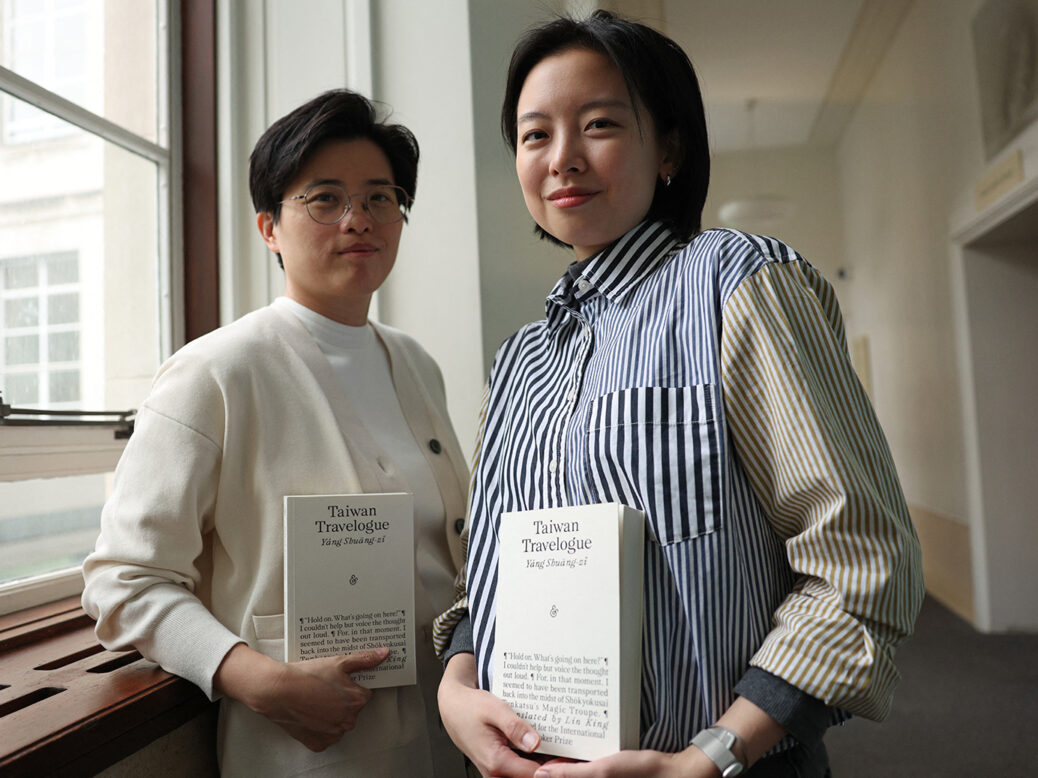
This week, Taiwan Travelogue, a book rejected multiple times by publishers as it was deemed untranslatable, won the International Booker Prize. It was a historic first for Taiwan, and for a book written originally in Mandarin Chinese. Conversations about Taiwan in the Western world today are often dominated by questions around the island’s relationship with China, an issue which has been in debate for over half a century. But Yang Shuang-zi’s layered work (translated into English by Lin King) looks to another period of imperial rule: life in Taiwan under Japan.
Aoyama Chizuko, the book’s greedy protagonist, is a Japanese travel writer on a tour around Taiwan. She deems that to understand this island properly she must consume as many local dishes as possible, as if by absorbing its food she will absorb a deeper knowledge. But although Japanese has been imposed in formal settings, Taiwanese is necessary to obtain what Chizuko really desires – and so she needs a local translator, O Chizuru. Maybe a friend, maybe a lover. Never an equal.
When published in 2020 in Taiwan, Taiwan Travelogue presented itself as the rediscovery of an old Japanese text, written by Aoyama Chizuko, translated by Yang Shuang-zi. Some Taiwanese readers were angry to discover this was purely a literary device, feeling deceived they labeled it a scam. The challenge for Lin King to bring it into English meant finding a way to smoothly acknowledge that this was a story coming through three layers of translation, to bring 100 years of historical context to a new audience.
I sat down with Yang Shuang-zi and Lin King this week to discuss their win and what it means for understanding Taiwan’s history and future. Fittingly, parts of this conversation have been translated.

Catharine Hughes: How does it feel to be the author and translator of the first Taiwanese and Mandarin book to win the International Booker Prize?
Yang Shuang-zi: At the moment, it all feels pretty dreamy even though we won the National Book Award in 2024. I’m still taking time to digest how it feels.
Lin King: It’s very surreal. It’s strange seeing this eruption of online discourse, especially back in Taiwan or in Taiwanese diasporas around the world, because I think when the book first came out and in 2024 with the National Book Awards, nobody knew that this was happening.
CH: Taiwan Travelogue was first published in 2020. Could you speak about the journey of bringing it into English, first in 2024 and then now to the UK two years later?
LK: In Taiwan, the book was deemed untranslatable, and the general consensus in the Taiwan publishing industry prior to this book was that we should find stories that would resonate more easily, that would seem more relatable. I took this on entirely on my own accord, no fee, just a passion project and also my master’s thesis. And then pitched it directly to publishers in the US. In terms of reception, you know, as you can probably tell from the way that the book is, it was meant to be a sort of niche. It’s experimental, a bit avant-garde. I didn’t expect it to have a super broad reach. But I think, given everything, and maybe because it does carry the significance of being the first Taiwanese work to get this sort of recognition abroad, it’s become very widely read. And that is really unexpected for me personally.
CH: Throughout the last century, Taiwanese people have shifted between Taiwanese, Japanese, Mandarin, and other dialects and languages. Do you feel that translation is an inherent part of Taiwanese culture, and what does this mean for passing history down throughout the generations?
YS: During the Japanese wartime period, the national language policy required everybody to learn Japanese. And then, post-World War II, there was another national language policy that was applied to everybody for adapting to Taiwanese Mandarin or Mandarin in general. These two National Language Policies meant we could no longer speak our most commonly used languages; it was a complete cultural upheaval. We have lost our language twice throughout recent history. Because language, the way of thinking, and consciousness are all closely intertwined and connected, being cut off twice throughout our history has changed how we think and a complete cultural reset. A hard reboot. Taiwanese people have tended to feel sort of inferior about their own language, which is then reduced to the idea of a dialect that you’re only allowed to speak at home. There has been a tendency towards the worship of the language used by whatever higher class is present in that moment. We lost confidence in our culture over the last 100 years. Now we’re starting to regain that in believing that there is power in our language or there’s power in ourselves.
CH: As well as being a book about travel and food, Taiwan Travelogue is also a love story. I was at your talk at SOAS the other day, and I heard you say that food is political. I was wondering if you also thought that love is political?
YS: Love is political. Let’s define politics first. Because the politics we’re talking about now has many, many layers, I think we should first talk about the strongest element inherent in politics: power. So why is love related to power, to politics? If we’re talking about heterosexuality, there’s even an imbalance of gender power. There’s inherent power inequality between heterosexuals in the operation of society. In a same sex relationship, even if the gender power inequality has been resolved, the question of whether there’s a power hierarchy still exists. It might be more about the power inequality between individuals. For example, in a story like this, even if we say it’s not a romance or a love story, there’s still a power imbalance based on the nationalities of these two people.
CH: I was recently in Taiwan, and I saw the book prominently displayed in bookstores. How has the reception evolved over the past six years? Has the international excitement influenced the reception at home?
YS: From 2020 to 2024, we sold just about 4,500 copies. Which is already pretty considerable for contemporary fiction in Taiwan. Then, after winning our first award, the National Book Award in 2024, we sold about 40,000 copies. And then how do Taiwanese readers think about the book? It’s pretty bipolar, I would say. People either love it or they find the book really subpar.
CH: Taiwan was not Japan’s only colony in the early 20th century. There was also Korea. The relationship between Korea and Japan has been tense pretty much up till now. And this is also something that’s been reflected in popular English language literature such as Pachinko and Flashlight, which was nominated for the Booker last year. Why do you think Taiwan’s relationship with Japan differs, and why do you feel keen to present this relationship between coloniser and colonised in a more nuanced light?
YS: Leading up to Japanese colonisation, Taiwan and Korea had very different histories. Korea was colonised by the Qing dynasty, and then they were able to achieve independence and develop the Korean Empire. And then after that, they were colonised by the Japanese Empire. This is very different from our historical development as Taiwanese people. Taiwan, as an island, started with Japanese colonisation. Then, following this was the Republic of China (ROC) regime. We simply went from the Japanese colonial regime to the ROC colonial regime without independence, in the way the Korean Empire did. Even though, uh, we’re both East Asian countries, our historical developments are so different that our perception of being ruled by the Japanese and the politics around this are completely different. This is a book that would never be published in Korea or written by Koreans. It would only happen in Taiwan with Taiwanese people.
CH: The only other language Taiwan Travalogue has been published in is Japanese. What has the reception been like in Japan?
YS: The Japanese readers who picked up the book are people who actively self-reflect on colonisation and then also reflect on the relationship between Japanese people and Taiwanese people right now.
LK: The Japanese translator and the publisher invited me to go to Tokyo for an event, which was interesting because I was a bit confused as to why they wanted me to go. And their answer, I found interesting, was that there are very few Japanese readers who are invested in Taiwanese literature. But they are very aware of the prizes in the US and UK, which may be understandable because there are Japanese writers winning these prizes every other year. And so the publisher explained to me that people want to see the American, so that’s why they brought me.
CH: Lin, you said that in 2022, after Russia invaded Ukraine, you made the decision to only translate Taiwanese work, as opposed to writing under the wider Chinese language umbrella, for the foreseeable future. How do you both see the connection between Taiwanese literature or just Taiwanese cultural exports in general and its political situation?
LK: Realistically, we are very geographically small. In terms of population, we are small. And so we are always reliant on greater military powers, whether it is to support us, to sell us weapons, or to lend us their resources. But soft power, or cultural output, is something that can really transcend your physical size or your numbers. South Korea, for instance – I don’t even need to explain their cultural impact. This means when anything does happen politically, if people have personal experiences, emotional attachments to a specific culture, the barrier of entry to empathy is going to be much lower because you already know things about this culture or this language or their history. I imagine if you’ve read Pachinko, and that’s your favourite book when you’re a high schooler learning about world history, you’re going to sympathise a lot more with the Korean perspective.
YS: I fully agree with Lin. If I were to add any further thoughts, I would say I wish to see more people learning about our diversity in Taiwan, rather than seeing this book as the only representation of Taiwan.
CH: While you’ve been here in Britain on this book tour, Donald Trump was in Beijing with Xi Jinping. Was this something that you were following closely?
LK: I hold dual citizenship, I am Taiwanese and American, and I vote in both places. On a larger level, I find it really disturbingly voyeuristic when the US, or the Economist, or a lot of Anglophone outlets comment on “the Taiwan question” as if Taiwan is solely responsible for maintaining this peace, as if any sort of declaration of dissent against this so-called status quo is a provocation, trying to upset the world order. It was entirely the decision of the West to take Taiwan’s sovereignty away. As of the early 1970s, we were recognised as the Republic of China government, the only “government of China”, following the Chinese Civil War, which, because the Republic of China was part of the Allies. The Chinese Communist Party wasn’t, and the People’s Republic of China (PRC) didn’t even exist.
Technically, it was the government that had relocated to Taiwan that fought alongside the Allies in World War II. And then Nato, the UN and the US chose to denounce Taiwan and claim the PRC as the new and only China, the new and only legitimate government. So it wasn’t our choice. There were a lot of protests in Taiwan when this sovereignty was taken away from us by the West. And so now, for Western outlets or policymakers or government officials to say Taiwan should stand down, stop provoking China, this is a situation of the West’s making. On a more, you know, contemporary note, I don’t think the US president has exhibited any sort of consistency in his foreign policy.
There’s no saying what he’s going to do from one day to the next. He could pull off a Venezuela, right? It could be an Iran situation where a war is launched without congressional approval and seemingly has no end in sight, but the White House refuses to even call it a war. I think with all these inconsistencies, it’s just impossible to predict. It seems like when he did visit Xi there was quite a lot of bear hugging. I don’t know if that’s going to change. Let’s say when he comes across King Charles again, and Charles says, “No, no, you know, that’s not what we want, right, Donald?” Politics has been reduced to the personal and personalities, it seems to me in this day and age, especially in the US and here in the UK. But it’s sort of pointless to speculate, because it’s just based on a few people’s whims.
YS: As a Taiwanese person, I feel powerless and anxious. I’m speaking on my own behalf here when I say that we cannot trust a single nation, nor can we trust a single politician. Rather than relying on the two powerhouses, Taiwan as a country should consider focusing on ourselves, our sovereignty, our autonomy, and then find our own way of survival. Before coming to London, I actually met with our former president, Tsai Ing-wen. I did ask her about my concerns, which were that I didn’t know what I, as a novelist, could do in this political and international situation. Her idea was that we should all just do the best we can. So I thought, well, as a novelist, doing what a novelist can do might be the only thing I can do.
[Further reading: America is rising against Trump]
Content from our partners


Related


Join the debate
Subscribe here to comment