
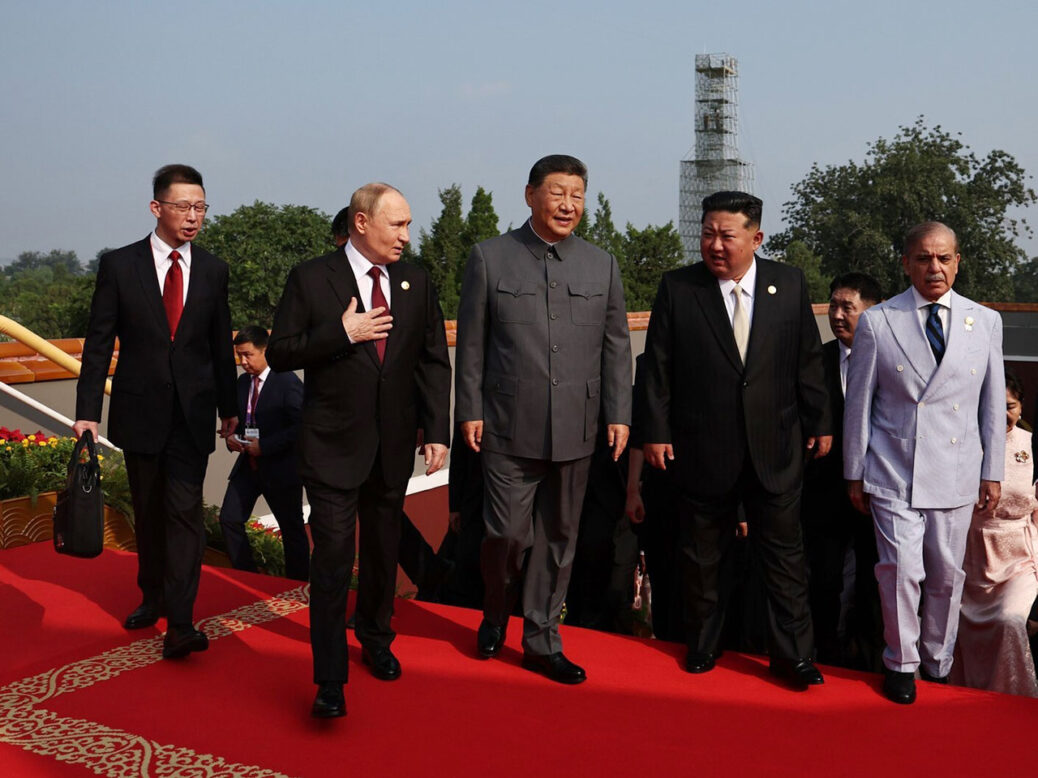
In another era, the rogues’ gallery of dictators and aspiring autocrats attending Xi Jinping’s vast military parade in Beijing on 3 September would have been viewed as evidence of the Chinese leader’s enduring weakness. Flanked by Vladimir Putin and Kim Jong Un, along with the Iranian president Masoud Pezeshkian, Myanmar’s military junta chief Min Aung Hlaing, and Belarus’s leader Alexander Lukashenko, the event could be read as a failure of Xi’s decade-long project to command global appeal and respect for China’s system of governance.
But since Donald Trump returned to the White House earlier this year and embarked on an erratic foreign policy that has included threats to cut off access to the US market and steep tariffs on allies and adversaries alike, Xi’s claim to represent a “force for stability in this volatile world” no longer sounds quite so ludicrous. While most Western leaders declined to attend the festivities, the assorted heads of state that did show up – and a wider group, including India’s leader Narendra Modi, that travelled to China earlier in the week for a meeting of the Shanghai Cooperation Summit – were united by their scepticism, or outright hostility, to US dominance of the international order.
At the parade, Xi, Putin and Kim walked side-by-side on the red carpet, the first time all three leaders have met at the same time. Nominally to mark the 80th anniversary of the end of the Second World War, the parade was a formidable display of China’s growing military strength and Xi’s aspiration to lead a new world order no longer centred on America.
“The Chinese nation is a great nation that fears no tyranny and stands firm on its own feet,” Xi declared in his speech in Tiananmen Square. “When faced in the past with a life-and-death struggle between justice and evil, light and darkness, progress and reaction, the Chinese people united in hatred of the enemy and rose up in resistance.” He said the world was once again confronted by a choice “between peace and war, dialogue and confrontation, win-win cooperation, or zero-sum games”. China, he vowed, would never be “intimidated by any bullies”, an apparent reference to Trump, and the nation’s “great rejuvenation”, which is generally held to include reclaiming Taiwan, was “unstoppable”.

Apparently watching the event on TV in Washington, where he held his own – much smaller and rather shambling by comparison – military parade earlier this year, Trump posted on Truth Social that Xi should thank the US for its “Bravery and Sacrifice” during the war. He added: “Please give my warmest regards to Vladimir Putin, and Kim Jong Un, as you conspire against The United States of America.”
This is not to say that all was quite as it seemed at Xi’s big parade. For all the goose-stepping soldiers marching through Tiananmen Square and the advanced hypersonic missiles and new-generation drones on display, the Chinese leader is in the middle of a wide-ranging purge of senior military officials that suggests either systemic and deeply rooted corruption within the People’s Liberation Army, or Xi’s growing paranoia about the loyalty of his generals. Perhaps both. Two successive defence ministers have been dismissed, as well as more than two dozen military officials and defence contractors, within the past two years in the biggest crackdown since the days of Mao Zedong. So while Xi might be proud to show off China’s burgeoning military strength, he has reason to question its efficacy in a real conflict.
This matters because, contrary to Xi’s claims to be promoting “peaceful co-existence” and abiding by “international rule of law”, it is China’s own actions – such as militarising artificial islands in the South China Sea and ramping up military exercises around Taiwan – that has done the most to destabilise the region, and unite many of Beijing’s neighbours against it.
It was also ironic to observe the Chinese leader solemnly commemorating the 80th anniversary of the end of the Second World War while standing alongside the man who is waging the bloodiest war in Europe since 1945. Indeed, Putin was surrounded by many of the key facilitators of that war at the ceremony in Beijing, including his “dear friend” Xi. Nato has designated China a “decisive enabler” of Putin’s war against Ukraine because of its “no limits” strategic partnership with Moscow, announced on the eve of the war in 2022, and its supply of dual-use technology that has helped to prop up the Russian defence industry. Kim has supplied troops, missiles and millions of artillery shells to sustain the Russian assault. Iran has sent lethal drones that have been used to terrorise Ukrainian civilians.
Yet, there they all were, seated prominently atop the Gate of Heavenly Peace, listening to Xi extol the lessons of the last world war and the importance of “valuing peace” and working together “to create a brighter future for humanity”.
Xi, Putin and Kim have long drawn heavily on their respective versions of the history of the Second World War – in the latter’s case, also the Korean War – not only to shore up their own claims to power but also to explain why they must build up their nations’ military strength and, in Russia’s case, invade Ukraine. These historical narratives are heavily distorted, strictly policed, and in the North Korean manifestation, partly fictional. All three leaders share an understanding of the potency of national myths and wartime history to secure their domestic legitimacy and justify aggressive foreign policy. But their greatest gift in advancing these arguments has been the advent of Donald Trump.
In his speech to members of the Shanghai Cooperation Summit (SCO) on 2 September, Xi referenced the “profound lessons from the scourge of two world wars” and the supposed “historical trends” of peace, development and cooperation in the 80 years since. But he warned that “the Cold War mentality, hegemonism and protectionism continue to haunt the world” as we enter a “new period of turbulence and transformation”. He didn’t mention the US by name; he didn’t have to. The answer, he said, was a “more just and equitable global governance system” that pays more attention to the voices of developing countries and the needs of the global majority, rather than the privileged minority.
Xi has been making a version of this pitch for more than a decade, but with Trump now embodying the role of the unpredictable global hegemon he has long warned about, these complaints are now drawing a wider audience. It was notable that Modi, India’s prime minister, arrived at the SCO summit on 1 September holding hands with Putin and made sure to be photographed clasping hands and talking animatedly with both the Chinese and Russian leaders. It was his first visit to China in seven years – during which time Indian and Chinese soldiers have been involved in deadly clashes along their disputed border – but after being hit by 50 per cent tariffs from the US, purportedly over purchases of Russian oil, Modi was clearly keen to broadcast that he has other options beyond the West.
Despite the public display of bonhomie and solidarity among the autocrats descending on Beijing this week, considerable friction and deep fault lines remain among the members of this “axis of upheaval”. China, Russia and North Korea, for instance, do not share a unified world-view and each harbours its own suspicions and long-nurtured historical grievances of the others. But, for now, they agree they share a common enemy in the US and Trump’s erratic presidency. That is reason enough for Xi to celebrate.
[See also: Trump’s fantasy diplomacy in Russia and Ukraine]
Content from our partners

Related
Join the debate
Subscribe here to comment