
In 1940, John Maynard Keynes cut a frustrated figure. It was clear to him and many others that Britain was not equipped to fight the war in which it found itself, despite a decade of warnings. Confronted by determined adversaries that boasted mobilised planned economies and technologically advanced war machines, British state capacity looked perilously weak.
In the wake of the Wall Street Crash of 1929, the country sought to chart a path of comparative stability, as European neighbours made radical lurches to left and right. Yet by the time the Second World War began, many feared this “steady as you go” approach – an unwillingness to confront the failure of orthodoxies long past their utility – had left the country exposed to invasion and potential collapse.
The largest party, the Conservatives, were the party of fiscal orthodoxy, and the Treasury had shuddered at the cost of rearmament. The political class clung to a vision of international relations based on law and arbitration, albeit with some carve-outs for the empire. The population was equally unprepared for a repeat of the type of sacrifice they had made in the Great War. Mass Observation surveys showed that national morale was low. Against that backdrop, appeasement had commanded widespread support.
But the shock of 1939-40 was profound and far-reaching. The ethical as well as strategic edifice of British foreign policy came tumbling down in March 1939 when Hitler marched into Czechoslovakia. By the summer of 1940, the European balance of power was wiped out by the collapse of France. It was a stark warning for Britain in more ways than one. Though not published until 1946, Marc Bloch’s book The Strange Defeat told an excoriating tale of the institutional, political, societal, technological and military failures in a country that had been totally unprepared for war. By the time of Dunkirk in June 1940, the fable of unpreparedness, political indolence and national collapse was well understood on this side of the English Channel.

How, then, to pay for the war? And what were people being asked to fight for? By 1940, Keynes hoped that his ideas might fare better with the Labour Party, which went into a new national government with Winston Churchill just as the old consensus collapsed. Yet, initially at least, Keynes found Clement Attlee, Labour’s leader and Churchill’s deputy prime minister, and Ernest Bevin, minister of labour from May 1940, to be surprisingly conservative in their thinking. They assessed that their traditional supporters would baulk at the idea of increasing financial contributions to the state to pay for the war – and certainly not for some vague promise of getting more back from central government when hostilities came to an end. These working-class communities viewed their savings, held in Post Office holdings or local cooperative banks, as their safety net for times of unemployment or poor health. Historically, Labour politics was orientated around trade union rights and collective bargaining rather than any great demand for an increase in the size of the state, or a more active role for central government in their everyday lives.
Nor did Britain’s intellectuals look any more capable of meeting the moment. George Orwell believed that their snootiness and lack of patriotism gave them very little understanding of the priorities of ordinary working people. “England is perhaps the only great country whose intellectuals are ashamed of their own nationality,” he wrote. “In left-wing circles it is always felt that there is something slightly disgraceful in being an Englishman and that it is a duty to snigger at every English institution, from horse-racing to suet puddings.”
The war, it turned out, was to change everything. Rearmament came just in time to stay in the fight. The British state was transformed in the pursuit of survival and victory, with the promise to create a “New Jerusalem” on the other side. Even the intellectuals played their part, from great historians like Arnold Toynbee who put all his energies into postwar planning to HG Wells and his visions for the new world order. By 1942, Keynesianism reigned supreme – with full employment, almost unthinkable for generations past, in turn, creating the conditions for William Beveridge to re-imagine the whole basis of social welfare. After 1945, Attlee’s government locked down a new social contract with universal social insurance based on the principle of voluntary contribution and a national health service free to everyone at the point of use.
From a dangerously inauspicious start, Britain’s performance in the Second World War was ultimately highly impressive. A sprawling empire was mobilised in pursuit of war with great skill and ingenuity, even if this was to be its last great hurrah. For better or worse, as Churchill discovered in 1945, people’s expectations of what the state could deliver for them had been transformed. The political economy of modern Britain had changed irrevocably in the space of just a few years, though only under immense duress and during an existential threat to the nation’s survival.
Today, those contemplating the national malaise that seems to have beset this country – and many other liberal or social-market economies in Europe and beyond – ask themselves what is needed to turn the ship of state around. Do we need another major crisis, or perhaps even another war, to shake us out of our funk?
One hopes we can do better than wishing the crisis upon ourselves, through self-harm or fatalistic plodding towards great-power conflict. I would go so far as to say that if we are forced to mobilise the homeland like we did in the Second World War, we would have already lost. But if that is something we want to avoid, we had better get on with it. For history tells us that the act of getting a grip is a multi-year project, in which the slaying of shibboleths can’t be done in a single night of the long knives.
What is more, the coming change is not one over which we have as much agency as we may like – and much less than we had in 1914 or 1939. There are external actors and historical forces that will play a considerable or perhaps decisive role in determining our future. We can choose, as the current government has done over the current Middle East war, to try to sit on the subs bench. But the lived reality is that we cannot exclude ourselves from its effects.
What, then, is to be done? As Machiavelli wrote, there are actions we can take to prepare ourselves for the raging river of Fortuna, from flood defences to dams, and canals to channel its force. But there are times when the force of the water can overwhelm even the best-laid plans and the most skilful statecraft. The response, nonetheless, should not be a counsel of despair. The history of the modern British state – its emergence and evolution over the last 250 years – underscores the importance of both sides of Machiavelli’s equation.
On the one hand, it is true that the United Kingdom has been forced – often against its will and with great internal strife – into major evolutionary spurts at times of challenge, crisis or upheaval. On the other hand, that history tells us that bold and vigorous action – foresightedness and feats of ingenuity, risk-taking and planning – can be deployed to great effect.
In his 1975 book on political thought in the Atlantic world, JGA Pocock introduced the concept of a “Machiavellian moment” to describe a point in time in which a republic confronts its vulnerability and instability in the face of decline, decay, internal tumult or external threats. Importantly, he also described how the most effective responses to such moments came through a careful interrogation of the lessons of history and an appeal to the civic religion that binds us together in a shared fate.
Can we fix all our problems in one parliamentary term or with the unfurling of a pristine new national plan? Most certainly not. Can we do better than we are doing now, with a coherent and cross-cutting programme of radical change – of the type that is never found in a party manifesto and will never emerge, without prompting, from the stakeholder state? Surely the answer must be yes. Most important of all, what do we lose by trying when almost every political conversation in this country ends with broad agreement that “it can’t go on like this”? At the very least, to invoke Dwight E Eisenhower, plans may turn out to be worthless but planning is essential.
The aim of what follows is to put forward a historical framework for understanding our present moment. It is a story in which the outside world will have an outsized influence on our future. But it is about the British past, present and future rather than yet another sermon on the crisis of world order. The argument is that we are in the midst of the Fourth Great Disruption of the modern British state – and that our politics, across every part of the political spectrum, is lagging perilously behind the realities we face.
Fellow historians will no doubt find some loose threads to pick at. They may even view me as guilty of succumbing to a condition best described as “Substack brain”. This is the tendency to put forth sweeping theories of historical change, sometimes set against the backdrop of techno-futurist scenarios and laced with potent droplets from political philosophy – a little James Burnham here and some Carl Schmitt there – with the understandable desire to distinguish oneself from the Rory Stewartisation of flabby centrist dads. (To live up to the caricature, I currently have a copy of Nick Bostrom’s rather heavy-going book, Deep Utopia, in my bag).
So let me proceed with the caveat that I may be guilty of some over-simplification. But equally, there should be no apology for the application of historical knowledge – even in an abridged form – to help us light the path in the contemporary world.
The first great disruption in the modern British state can be dated, roughly, from the time of the American Revolution to the end of the Napoleonic wars. The first British empire was brought to an end by the 1783 Treaty of Paris, which declared the independence of the 13 colonies after the end of the American War of Independence.
Humiliation and defeat precipitated a crisis of national confidence and calls for fundamental reform of the political system. A Machiavellian moment occurred. In his History of the Decline and Fall of the Roman Empire, produced in six volumes between 1776 and 1788, Edward Gibbon identified the erosion of civic virtue as being central to the steady decline of Rome. Some of the great parliamentarians of the era, such as Edmund Burke, a staunch defender of the American Revolutionary cause, warned that Georgian Britain was not immune to the same fate. Demands for parliamentary reform, the tackling of “old Corruption” and greater meritocracy in the armed forces and diplomatic corps followed. The Foreign Office was formed in 1782 as a response to what the historian Brendan Simms calls “the greatest train wreck in British diplomatic history”. Indeed, it is often forgotten that the general defeated in America – Lord Cornwallis – was sent to India and then Ireland, where he became an advocate for reform and modernisation of an empire that he thought was chaotically and self-defeatingly run.
If the American Revolution heralded the start of the reckoning, it was the French Revolutionary and Napoleonic Wars that caused the greatest ideological strain and forced major structural changes upon the state. While Burke and others argued for an ideological war of counter-revolution, William Pitt and his cabinet were engaged in what they believed was a fight for non-negotiable security and commercial interests, to which the mission of putting the Jacobin genie back in the box was a secondary consideration.
Would Britons seek to mimic the revolutionary fervour on the continent? After all, it had not been that long since they cut their king’s head off. Fears of domestic radicalism and potential invasion prompted the mobilisation of a volunteer force of yeomanry and a fierce crackdown on domestic dissent, known as “Pitt’s terror”. Those fears were always more acute in Ireland where dissent – not only from the large majority Catholic population under penal laws but a highly radicalised Presbyterian population in the north – reached a crescendo with the 1798 rebellion. At several points, the French sought to take advantage of this discontent by landing troops in Ireland, the Achilles heel of the British Isles. The largest of these invasion forces had turned up at Bantry Bay off the coast of Cork at Christmas 1796 but failed to land due to a providential winter storm. Watching from the shore had been Robert Stewart, the future Lord Castlereagh, who was to become chief secretary of Ireland, war secretary, and then arguably Britain’s most important foreign secretary from 1812-22.
Raison d’état demanded previously unthinkable measures. It was no coincidence that those at the forefront of the geopolitical struggle – Pitt, Castlereagh and Cornwallis – were the greatest exponents of radical constitutional change and state formation, as the principal advocates of an Act of Union between Britain and Ireland, which came about in 1801. Crucially, partly because a third of the British army was Irish, they believed that this must be tied to Catholic emancipation and an end to the penal laws to make it work. They met the trenchant opposition of King George III, who regarded such a liberalising measure as a violation of his coronation oath. Almost 30 years passed before the Union was completed as it had originally been envisaged but by then it was already too late.
Under the strain of domestic turbulence and foreign wars, the fiscal basis of the state transformed to meet the challenge. Income tax was introduced as a temporary wartime time measure in 1799 – only to become a permanent fixture of British political economy, despite a hiatus from 1816-42 and the efforts of some Victorian economic liberals, not least William Gladstone, to shed the burden. While most of the wartime funding went into a huge increase in naval power, the army grew to its largest size since the Duke of Marlborough had commanded it at the start of the 18th century. This was never to the extent of the great European armies – who confronted France directly in the field – but to allow Britain to establish a foothold in places like the Iberian Peninsula, where it encouraged a guerrilla war that became Napoleon’s “Spanish ulcer”. By 1814, it gave Castlereagh great confidence that Britain could finally put more than 100,000 men on the field in western Europe, in the death throes of the Napoleonic regime. “What an extraordinary display of power!” he remarked. Crucially, however, this was in pursuit of an elaborate diplomatic plan and a set of clearly defined war aims laid down by Pitt after the collapse of the Peace of Amiens in 1803. It had taken six coalitions to assemble the group of nations that finally ended French dominance on the continent, with only Britain consistently on the other side.
The long-term implications of this grand strategic shift were epochal. The state that emerged from the start of the first great disruption to its end in 1815 had increased six times over in its size and expense. In the characterisation of the historian John Brewer, after Waterloo Britain was left with a “fiscal-military state” alongside a system of European congress diplomacy to manage foreign relations, from which it was soon to divorce.
As soon as the war ended, the governing class understood that the fiscal-military state would need to be reformed – starting with the painful process of demobilisation. The Victorian era brought forth much disruption of its own, from breakneck industrialisation and commercial advancement to the building of an immense maritime empire. One should not fall into the Whiggish trap of presuming all was steady progress, accompanied by sagacious and reasoned constitutional change. There was much that was fraught and deeply divisive – the Corn Laws, Chartism, the Irish question, imperial policy, the social question and debates over the disestablishment of the Church. But the essential basis of the Victorian state and Victorian political economy was neither fundamentally threatened by the world around it, nor irrevocably changed by the forces within it, in the main because of its success in the creation of wealth.
It was partly the perceived success of this Victorian state – and the desire to preserve its essentials against alternative historical forces – that set the context for the second great disruption that was to define the Edwardian era. The starting point for this period is harder to pinpoint, though one can see its origins in the mid-1880s and an end of sorts – albeit one which left more questions than answers – around 1918.
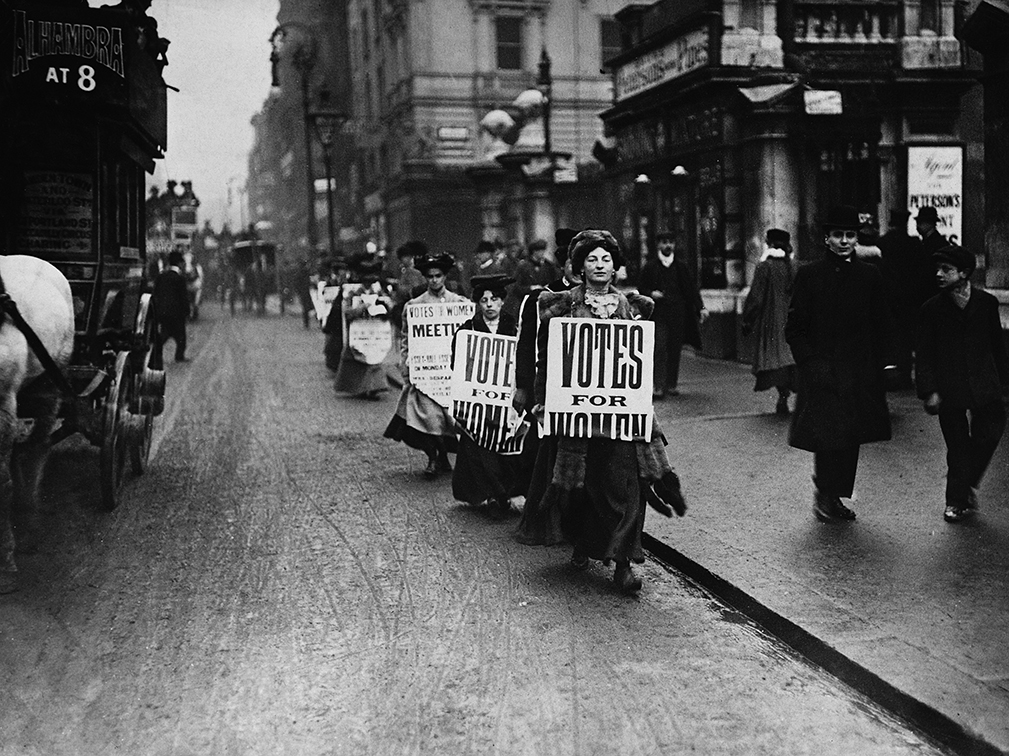
The extension of the franchise, the rise of organised labour and the Suffragettes, as well as the increasingly violent Irish question all fed into a sense that the economic, social and constitutional model was coming under strain. But once more, external events were far more consequential in bringing about an internal reckoning.
Britain’s empire had grown exponentially since Waterloo, to the extent that cross-party parliamentary committees and several prime ministers urged an end to further expansion. At its strongest, the empire was a vibrant system of commerce underscored by maritime power – providing vast markets, raw material and manpower. Yet already, by the 1880s, its geographical dispersion presented a unique type of strategic vulnerability. What is more, Britain’s status as the predominant superpower was coming under sustained challenge from those who sought empires of their own.
Germany’s ascent posed a new type of foreign policy challenge on the European continent, upsetting the balance of power that Britain sought to preserve. Relations with France and Russia remained fraught as Britain still avoided entangling alliances and sought to remain aloof from deep involvement in European affairs. The rise of Japan in the east and the US in the west presented challenges from major powers outside the European neighbourhood for the first time in its history.
In essence, others had caught up and threatened to surpass Britain in the race for modernity. Disconcertingly, they had not done so by mimicking the model of Victorian Britain with its ideas of scientific progress, constitutionalism, free trade and a laissez-faire state. American industry thrived under protectionism. Germany was unified by war and authoritarian state control, using welfare to maintain social harmony and becoming far more proficient in technical and scientific education. Churchill admired Bismarck’s evocation of blood and iron, as well as the strengthening of his nation through social reform. Meanwhile, Britain’s once seemingly unassailable lead in shipbuilding, engineering and innovation was whittled away – along with the “two-power standard” set out in the 1899 Naval Defence Act, requiring the Royal Navy to maintain a fleet that was at least equal to the combined strength of the next two largest navies.
What was dawning on the country was a sense that it was falling behind in the developmental race – the survival of the fittest, in which those nations that fully harnessed modernity would find themselves on top. Ideas loosely derived from Darwinism fed into almost every aspect of policy, from international relations to social affairs. The chastening experience of the Second Boer War of 1898-1901 – in which the comparative physical condition of British troops was measurably worse than their opponents – gave further impetus to movements for national efficiency and social reform, as well as soul-searching about the methods of war, from scorched-earth policies to the institution of concentration camps.
But a greater role for the state in national welfare and education would cost the Exchequer money, at a time when British economic competitiveness was in decline. Laissez-faire and free-market principles went hand in hand during the peak of Victorian self-confidence. In the Edwardian era, these shibboleths – a form of political economy that triumphed from 1815 to the Repeal of the Corn Laws in 1846, even in the face of the Irish famine – began to be questioned. It became more common for politicians like Churchill to cross the aisle in search of a new national strategy. Popular regional figures such as Birmingham’s Joseph Chamberlain entered the scene to challenge the status quo at Westminster. In the face of protectionism from the US and Germany, he began his campaign for tariff reform, to protect domestic industry and create a system of “imperial preference” within the British empire. The argument split the Conservative Party, paving the way for an experiment in so-called New Liberalism after 1906.
As a result of these dilemmas, the decade before the First World War saw a profusion of radical new ideas – from Fabianism to “Tory democracy” to imperial preference – about how to reorganise the state for the new century. In 1911, HG Wells satirised Edwardian politics in The New Machiavelli, a novel based on a morally dubious politician who shifts his politics from Liberal to Conservative. But it also expressed a yearning for order and a new form of statecraft to bring constructive design to an unregulated and chaotic world. It was only in hindsight, in a book published in 1935, that George Dangerfield identified the four horsemen of what he called The Strange Death of Liberal England in the era before 1914: constitutional crises over welfare spending; Irish Home Rule; Suffragette militancy; and industrial unrest.
The Great War strained all these assumptions to breaking point – bringing the second great disruption into the homes of every Briton, though it left no clear new consensus in its wake. Volunteering, conscription, the blood sacrifice of hundreds of thousands of young men, and a new female labour force changed the whole basis of the social contract and the expected balance between rights and responsibilities. Economic warfare became an essential part of the conflict, as outlined in Nicholas Lambert’s masterwork, Planning Armageddon: British Economic Warfare and the First World War (2012). The notion of “grand strategy” began to take shape, moving from a military term of art to one that embraced questions of commerce, industry and social cohesion. In any grand strategic competition, no matter how deft your diplomacy or strong your armed forces, if the industrial or technological basis of your national power was not attended to, you risked being knocked out.
The second disruption was in many ways the most traumatic and the least satisfactory – in political, social and intellectual terms – in that it never settled into a new equilibrium in domestic or international affairs. Demobilisation was a particularly painful experience. Promises made to the citizens who had been conscripted were not delivered upon. The postwar years were followed by high levels of unemployment and industrial disputes, with the Labour Party beginning to emerge as a major force.
Geopolitical problems did not go away either, even as the fighting stopped. Germany bristled under the terms of peace. Despite near bankruptcy and heavy indebtedness, the British empire that emerged from 1918 was larger than it ever had been. But its size and scale could not disguise the fact that its fundamentals were under increasing strain. There was hope that a “new world order” would remove or at least manage the causes of the international competition that had led to catastrophe. But the only potential keystone of that order, the US, stayed aloof, even as the rest of the world became more dependent – dangerously so – on American financial power. The League of Nations, to borrow Mussolini’s formulation, was “very well when sparrows shout, but no good at all when eagles fall out”. This was why, by 1939, EH Carr described the period from 1919-39 as The Twenty-Year Crisis.
From this came the third great disruption – described in the opening of this essay. If there had been any doubt, the realisation that a viable equilibrium had not been reached was brutally affirmed by the great financial crash of 1929. A series of acute domestic and international crises followed, and so did the emergence of pockets of radical new thinking on first-order principles of political economy. Ramsay MacDonald’s betrayal of the Labour Party in 1931 and the configuration of the National Government that followed meant that the space for these ideas to be seeded into national policy was constrained. On the right and the left – from Oswald Mosley to Beatrice Webb to Stafford Cripps – a series of study groups and intellectual cells flirted with ideas that mimicked various continental models, with variations on Mussolini’s Italy or Soviet Russia or the French Popular Front. None of these congealed into a coherent whole.
One such endeavour worth highlighting, though, is the creation of the technocratic group Political and Economic Planning (PEP), which was in many ways Britain’s first domestic policy think tank. Its founders were not politicians but a combination of biologists, chemists, industrialists, financiers, engineers, environmentalists and former civil servants. They professed no political allegiance, though they sought to influence the politics of Harold Macmillan and the National Government. To modern eyes, they entertained ideas more commonly associated with socialist command economies but that is not how they viewed their interest in planning. In many ways, they considered the various groups feeding into the Labour Party as retrograde, or insufficiently “modern”, in their commitment to ideas like guild socialism.
Prominent PEP members included Julian Huxley and Max Nicholson, the latter of whom launched the project with a 1931 essay on “A National Plan for Britain”. The PEP archives at the London School of Economics are a treasure trove of mid-century ideas of strategic thinking and the science of planning.
Their essential proposition is one that resonates today. Too much political energy was spent decrying the state of the world or the country, they argued, and not enough was invested in articulating detailed plans by which one could take a different path. “No living and growing nation or group of nations can be bound precisely as to its development by a detailed written plan, however soundly and elaborately it may be worked,” a 1933 PEP pamphlet conceded. On the other hand, “Without a fairly thorough written plan being put forward, criticised, or digested, there is not the slightest hope of accustoming our minds to the nature and scale of the changes which have simultaneously to be made in many fields.”
There were, and there remain, very good reasons to be suspicious about the unintended consequences of such technocratic missions, conceived in the minds of people with no democratic support. Indeed, it was after being invited to a “National Plan” meeting in 1931 by his brother Julian that Aldous Huxley wrote his dystopian novel, Brave New World, about a future in which scientific advances were astounding but people were manipulated by eugenics and social control at the behest of an unelected rationalist elite. It was a warning about what he had seen.
Yet many of these ideas did find their way into government policy as the third great disruption worked its way through the British state. By 1940, as Keynes entered centre stage, Nicholson joined the civil service, moving through the Ministry of Shipping and the Ministry of War Transport, and attending the Yalta and Potsdam conferences as part of the British delegation. In 1945, he became private secretary to Herbert Morrison (the wartime home secretary and then Attlee’s deputy prime minister) and chaired the Festival of Britain in 1951, before later founding the World Wildlife Fund.
There was, in this story, a realisation of an even higher form of national strategy. In 1942, two former army officers, HA Sargeaunt and Geoffrey West, captured the essence of this in their small book Grand Strategy: The Search for Victory. A “Sandbag solution” – by which they meant a strategy of quick rearmament, narrow military victory, stopping bombers getting through but no fundamental change in economic orthodoxy – would not be enough. Instead, true grand strategy needed to take account of the “totality of a nation’s assets and political characteristics”. “The base from which victory will arise,” they wrote, “is built not only of material resources or of military and industrial techniques, but also of social organisation, religious ideals, methods of education and so forth, all of which must be maintained in times of peace.”
The story of the postwar consensus that emerged after the Second World War has been told many times before. Suffice to say that the new domestic and international equilibrium found after 1945 had a far longer life than the one that emerged in 1918.
This begs the question – when did the fourth great disruption come? There is a good case to argue that it began in the mid-1970s. Some of the best writing on the history of the postwar international order stresses the extent of the major structural changes in the international economic system that took place in this decade. In the UK, of course, it was Margaret Thatcher, elected in 1979, who set out with a conscious mission to bring an end to the postwar consensus in Britain, which she felt was the cause of political and economic stagnation. The social fabric in much of the country was altered by a process of deindustrialisation that changed the economic balance within the country definitively and perhaps irrevocably towards services over manufacturing.
In recent years, there has been a revival of interest in the “Stepping Stones” report, sent to Thatcher by policy advisers John Hoskyns and Norman Strauss in 1977. It was essentially a political communication strategy by which the Conservatives hoped to win a mandate for a radical approach to economic affairs. The first line read, “The task of the next Tory government – national recovery – will be of a different order from that facing any other postwar government. Recovery requires a sea-change in Britain’s political economy.”
Today, some on the right – in both the Conservative Party and Reform – see the report as a potential model for their own plans for government. There are those on the left – such as the Future of the Left project – who rebuke the Labour Party for having no such plan following the general election of 2024. “Stepping Stones” was predictably allergic to economic planning – and was also hostile to a Labour argument that growth could be achieved by drilling for more North Sea oil – but it was a pitch for systematic and strategic thinking to address the malaise.
Nonetheless, I would argue that the Thatcher revolution does not quite meet the bar for the fourth great disruption in the history of modern British policy. It was not a Machiavellian moment. Instead, I would characterise this period as one of a radical reform, or course correction, of an existing and deeply ingrained status quo. Think of it as a series of forcible Ozempic shots on a gout-ridden body politic. But it was not so much a re-imagining of the future as a reassertion of a pre-existing form of political economy, one more based on laissez-faire and the free market, that was already woven into the British historical experience. In terms of the proportion of GDP spent on things like welfare or defence, there were not radical shifts. In fact, spending on the NHS increased considerably over this period, and the Falklands War, it is often forgotten, was preceded by quite radical defence cuts. Notwithstanding the Cold War context, there was relative stability and predictability in the international system. That included constructive if sometimes fraught relationships with the US and Europe and even Gorbachev’s Soviet Union.
While benefiting from the effects of the economic shock treatment exerted by Thatcher, there was no great structural counter-revolution under Tony Blair or Gordon Brown, either. In fact, in a period of relatively steady economic growth, a series of rebalancing efforts were made which took the sharper edges off Thatcher’s reforms through redistribution and other ameliorative measures – trickle-down economics and constitutional tinkering. The language and fundamental assumptions about our domestic and international security – from the NHS and welfare state to Nato and the UN – were not radically altered from that which Thatcher inherited in 1979. Wars were fought in defence of a “rules-based system”. Modest trade-offs were made between welfare and defence spending but nothing approaching the scale of what Attlee did at the time of the Korean War.
The final reason I do not think the Thatcher years qualify as a great disruption is because I believe they will pale in significance compared with the one that is to come, accompanied by a technological revolution that may surpass that which defined Victorian Britain.
Future historians may date this fourth great disruption back to the financial crisis of 2008 and, in that respect, there may be similarities to the impact of the crash of 1929. Another factor may have been the long tail of the post-9/11 wars. But whatever the starting point, we are already in the midst of a series of structural and ideological changes, at home and abroad, that are incomparable in their scale to anything we have seen in almost 80 years.
The conundrum facing the UK today is all the more disorientating because there are few countries that were more comfortable in the post-Cold War status quo, and happier to embrace the dominant forms of international political economy that it gave rise to.
As such, the end of the current political order also brings about an end to the circumstances that allowed for the longest period of sustained economic growth since the Second World War. This is why the Treasury is full of people who believe – and have the spreadsheets to prove it – that low-skilled immigration is just about the quickest route to economic growth, and that dreams of reindustrialisation through increased defence spending will never meet a value-for-money test.
The fidelity of our political and official classes to the current order comes from an assumption, deeply ingrained in the generation who are coming close to retirement, that liberal or social-market economies were the only possible future and that the rest of the world was destined to become more like us. It is partly why austerity – like appeasement – had far more political support than we care to remember. It is why we spent 0.7 per cent of GDP on development assistance at the start of the last decade and barely 2 per cent on defence. It is why, after 1989, we added even more international and human rights law on top of the international legal order crafted out of 1945. It is why Brexit was such a psychological shock to this world-view. It is why we sometimes look like the last man at the bar at Davos, nursing a cocktail as the lights go off and facing a treacherous and icy route to an unclear destination.
So as one world collapses around us, what are the shape of things to come? Here are some hard truths. The current social contract – particularly around welfare, health and pensions – is unsustainable on current levels of growth. A domestic and international legal system that does not allow us to control our borders has lost legitimacy at home. We have the highest energy prices in the Western world, just at the moment when energy is vital to our ability to take advantage of relative national strengths in technology. And there is currently no route to higher defence spending – which is inevitable unless the nation is content to continue on a path towards greater insecurity and irrelevance – without major cuts elsewhere in the public spending stack.
At moments of relative political equilibrium these are problems of policy for specialists in each of those areas. At moments of great structural upheaval, these are grand strategic problems that can only be confronted as a coherent whole.
Rather than dark premonitions about our future, consider the world through another lens – that is, the conditions that are common to each of these great disruptions. The sources of national and international power are being drastically transformed. Those who are best able to harness and deploy these new forms of power – a combination of technological, military and economic prowess – are the ones who will be best able to protect and promote the interests of their citizens.
As it stands, the likelihood of a catastrophic crisis – or at least a series of overlapping contingencies that become unmanageable – is increasing. But there is nothing inevitable about a descent into war or further anarchy. A new equilibrium is not beyond the wit of man. Nor should we give up on the idea that new norms can be established to allow us to create the conditions for domestic growth and harmony, and more stable and predictable relations between nations. On both sides of the Atlantic, an interesting conversation is beginning about what comes after the current crisis. Might a new economic and security “commons”, based around a re-contracting of interests rather than perfect ideological harmony, be possible to construct?
Yet crucially, even in this more benign scenario, we have to confront the reality that we are in a vast renegotiation of everything: the basis of social contract; the underpinnings of political economy; the legal and constitutional basis of national and international life; the division of responsibilities within our alliances; the inputs and outputs expected from the national security state; the areas of geographic focus for our diplomatic efforts; the terms of international trade; the level of tariffs, export and import controls; the foundations of our energy policy; and our ability to generate or access the benefits of the technological revolution that is the essential precondition of our future security and prosperity.
In this world, process-based punctiliousness is no substitute for being able to move things around on a map. The lesson of the past great disruptions is this: if you want to protect Enlightenment values, a dose of realism is necessary. As a young Lord Castlereagh said in 1792, at the time of the first great disruption: “The language of reason, of enlarged and enlightened policy, has not yet penetrated thoroughly the cabinets of princes. Power and importance is necessary almost to procure a hearing. I am afraid we should cut a sorry figure and exhibit an appearance not very imposing, were we to appear before them simply clad in the garb of our insular dignity and abstracted freedom.” Those words could well apply today, not least with regard to our ability to influence events in the Middle East.
My own time as an adviser in No 10 was bookended by two chiefs of staff – Dominic Cummings and Morgan McSweeney – who intuitively understood the source of much of this malaise. But here’s the thing: so do the British people, who keep on generously providing political mandates to governments to do something about it. One blockage, as we often hear, are the assumptions and structures in a civil service built for an era that is now gone. But this is not only a matter of engineering. The British empire rose and fell before management consultancy was invented.
All planning is political. And the lessons from great upheavals in the past is that it required sustained political leadership – including repeated and spectacular failures – combined with the assembling and deployment of sources of national power by effective, technocratic means.
The attraction of a document such as the Political and Economic Planning’s “National Plan” of 1931 and “Stepping Stones” in 1977 is that they are rare in British political history. Anyone contemplating revolutions in political economy could do worse than study the processes – the harnessing of intellectual energy and the discipline of writing things down – even if the prognoses do not fit for today. As the authors of “Stepping Stones” defined it, the essence of strategy was “the careful thinking we wish we had done two years ago, but don’t have time to do today”.
At this point of our history, it is no longer excusable to have a politics based primarily on critique. Instead, our intellectual and political energies should be focused on what HG Wells called “constructive design”. Arguably the greatest danger facing this country is that the next political configuration with the responsibility for governing this country – a new prime minister, perhaps after May, or a new party with a different mandate – takes power without a plan.
[Further reading: How politics went hyper]
Content from our partners



Related

This article appears in the 11 Mar 2026 issue of the New Statesman, The Great British Crisis
Join the debate
Subscribe here to commentA long commentary on the history of the UK (as you would expect from a history professor) but apparently devoid of any serious way forward.
The focus on the Tory based ‘Stepping Stones’ document rather debases any other arguments.
Where we are today is a reflection of the core ‘worker v capital’ conflict, that has across the western world moved to reward ‘Capital’ at the expense of the workers.
You only have to see the mass of minimum wage workers who can only survive with a top-up from Government, and which was beautifully summed up by Hannah Spencer after her election.
Depressingly the current Labour Government is trapped by the finance lobby and whenever the Chancellor threatens to shift from their pocket-filling orthodoxy she is ‘called to order’ by the ‘bond market’.
Unfortunately now there is no easy way out. Desperation seems to suggest the route is to vote in a looney Government (take your pick of Green or Reform) and blow up the system.
John Bew’s essay, “Don’t let Britain decline: The Fourth Great Disruption is here” (New Statesman, 13 February), is best read as an intellectual warning rather than a programme for renewal of the state. His survey of past crises in Britain’s evolution is compelling, and his central claim, that the country is entering a new structural disruption, deserves serious attention.
Bew rightly identifies that challenges from social welfare to defence, energy and borders cannot be treated as isolated policy questions. They are interconnected questions of national power and therefore of grand strategy.
Yet the essay stops at this recognition. Bew cites earlier efforts at systematic thinking, notably Political and Economic Planning in the 1930s and the Conservatives’ 1977 “Stepping Stones” report. But the crucial step beyond diagnosis, that of designing institutions and mechanisms capable of sustaining strategic thought and action, is left unexplored.
Meeting a disruption of the scale implied in the essay would require both institutional reform and a shift in mindset among our governing elites. Grand strategy should not be episodic or improvised; it needs consistent application over time and demands institutions staffed by those capable of planning, coordinating and adapting national economic, technological and military power as a coherent, integrated and dynamic programme. Such characteristics seem currently to be absent from our political leaders, administrators and institutions, which seem mired in bland, unresponsive, technocratic managerialism.
The question for Britain is, therefore, whether we have the time, energy and imagination to create the required capabilities before the challenges of the fourth disruption overwhelm us.
For someone calling for a new national plan Professor Bew’s assertion that Brexit was simply a psychological shock for the Davos class is ludicrously superficial. But then he is one of those (sadly many) Northern Irish Unionists who believed it would help their cause rather than doom it, a failure of perspective and judgement so crass we must hope no one in power listens to his advice on our wider national existential crisis of identity and destiny.
Should we see Britain’s predicament in an international context, lads?
France and Germany are hardly in a better state…