
In the early 1780s, on the Île-d’Aix, a small island off France’s western coast, Pierre Choderlos de Laclos began writing his best-known work, Les Liaisons Dangereuses. It would have been difficult for Laclos to imagine that a theatre production of the novel would captivate audiences close to 250 years on. After all, he was a failed playwright; his comedy-opera libretto Ernestine (1777) received only a single public performance, albeit one attended by Marie Antoinette. However, his epistolary novel, a malicious tale of seduction and betrayal, was a succès de scandale, not least because it is often considered to be an attack on the ancien regime itself. But the new adaptation at the National Theatre proves that it is much more than that.
For lack of better entertainment, the Marquise de Merteuil (Lesley Manville) and the Vicomte de Valmont (Aidan Turner), two amoral lovers whose relationship has curdled to rivalry, turn to amusing themselves through sexual conquests and the ruin of others. The performance opens with a ball. Manville enters with an air of superiority and elegance before breaking into a blend of Baroque and contemporary dance. Throughout the show, actors fall into these intermezzi, choreographic sequences between scenes that serve to heighten the emotions. Introductions are made to Cécile de Volanges (the astounding Hannah van der Westhuysen), a victim of Merteuil and Valmont’s twisted entertainment. Later, we meet Madame de Tourvel (the ever-graceful Monica Barbaro), a pious – and married – friend of Valmont’s aunt on whom the unscrupulous Casanova sets his sights.
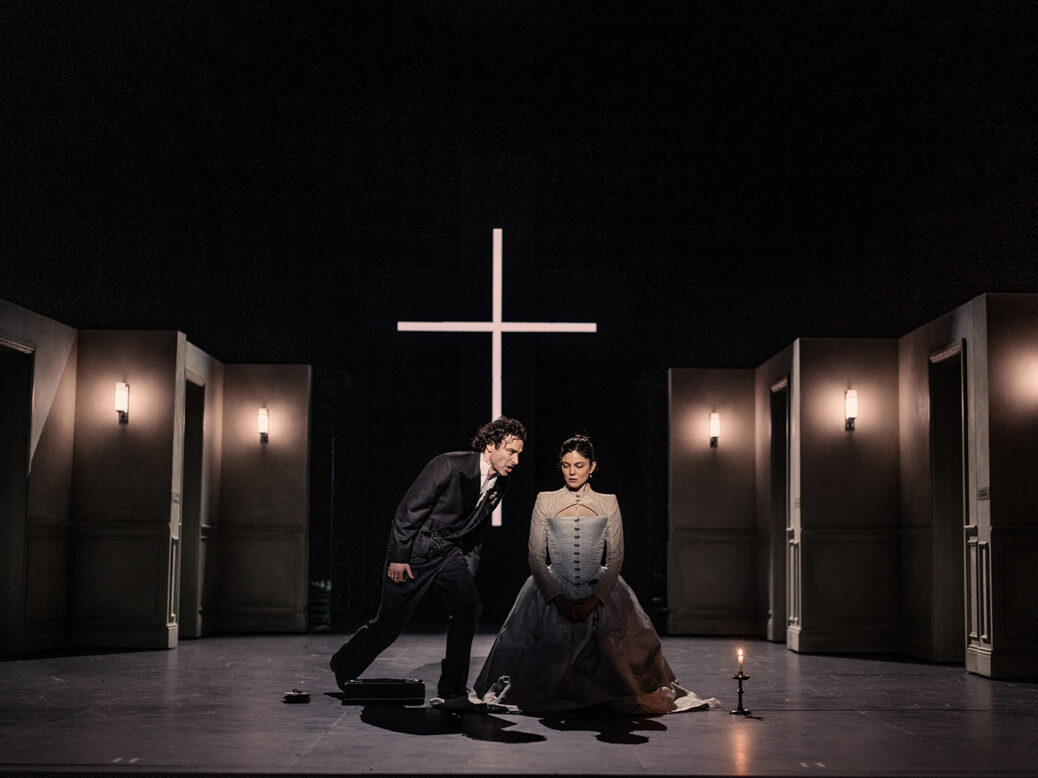
Christopher Hampton has here returned to his own 1985 play (he also wrote the screenplay for the Stephen Frears film adaptation of 1998 starring John Malkovich and Michelle Pfeiffer) and sets it on a timeline of its own, drawing inspiration from pre-revolution France’s aesthetics but with a sharp and metallic modernity. The walls-turned-hidden-doors are lined with mirrors that reflect not only the actors but the audience itself. As was sometimes the case in Laclos’ 18th-century Paris, the mirrors are crowned with Rococo paintings of women in various stages of undress, although the delicate pastels are bleached into shades of grey and white. Rosanna Vize’s set design combined with Natalie Roar’s costumes manage to be at once exuberantly ornate yet have a contemporary stark minimalism.
When the novel was published in 1782, many questioned whether the letters at the heart of the story were, in fact, real. In Hampton’s play they serve as evidence and later a tool of Merteuil and Valmont’s downfall. But where Laclos’ novel concentrated on the stratagems of the main protagonists the play sets out to examine the psychological impact on the victims of their torturous mind games.

Manville and Turner are phenomenal. By masterfully manipulating the atmosphere and tension they manage to get the audience to sympathise with their characters’ amorality against their better judgement. As the play unfurls, the impact of their “games” subtly changes their personalities. As the story turns from disturbed fun to sinister cruelty, the warm yellow glow of the lighting shifts to a stark white; Turner goes from the dandyish Vicomte to a dishevelled man psychologically burdened by his conflicting emotions; the composed Marquise finally snaps. The manipulators have become the manipulated. As Valmont says: “It’s always the best swimmers who drown.”
There is a universality to Les Liaisons Dangereuses: “mind games”, “manipulation” and “gaslighting” seem like 21st-century phenomena but what Laclos showed, and Hampton reinforces, is that there has been little change in how we treat and handle our emotions – especially our capacity for viciousness – over the centuries. Try as we might to dominate them, they will always get the better of us in the end.
After the final bow, when the actors leave the stage with a swish of satin skirts and a flare of crisp white shirt, the audience is forced to do what Merteuil and Vicomte were loath to confront at the end of the performance – sit in silence and study their many reflections in the wall of mirrors.
[Further reading: Romeo and Juliet have been let down]
Content from our partners



Related



Join the debate
Subscribe here to comment