
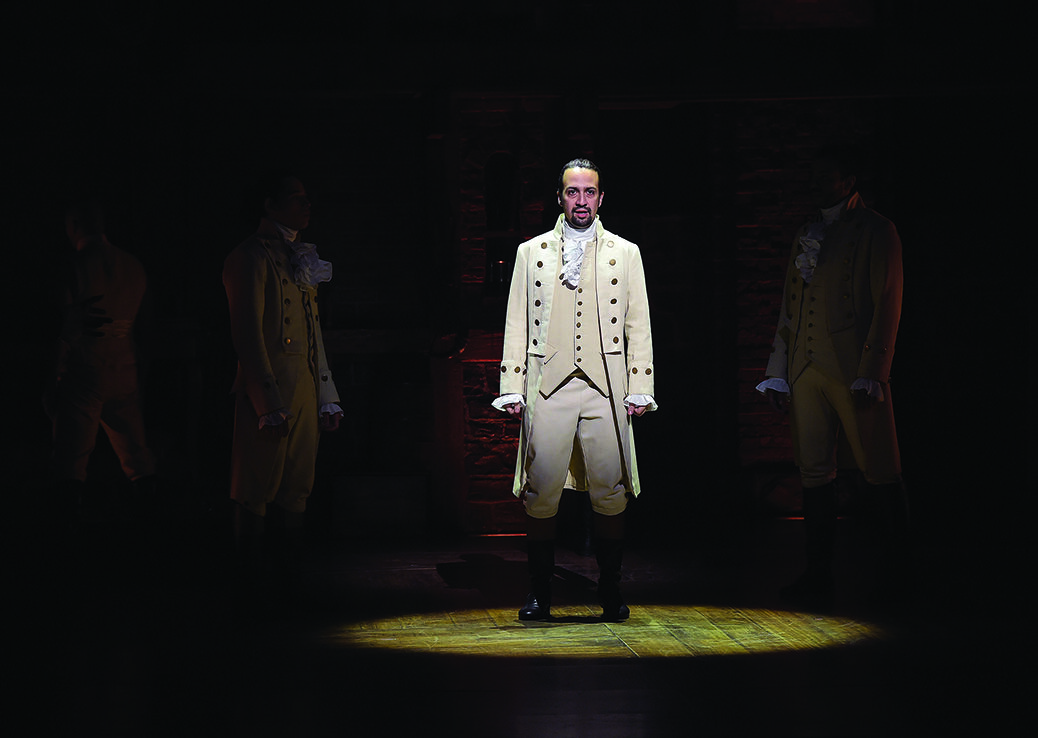
The last person I expected to see at the Queen’s Jubilee in 2022 was Lin-Manuel Miranda. An inveterate New Yorker, embraced by US presidents, the creator and star of a show that proudly advertised itself as Hamilton: An American Musical, he seemed the least likely celebrity to take a bow on the steps of Buckingham Palace. And yet there he was, hailed by Andrew Lloyd Webber as “American royalty”, before taking his place on a piano bench next to the revered composer. Adapting the lyrics to “King Herod’s Song” from Jesus Christ Superstar, Lloyd Webber greeted Miranda as someone who was “making ripples on the Broadway scene”. Miranda similarly updated the lyrics to Hamilton’s “You’ll Be Back” in his salute to the Queen. Then they introduced a performance by the London cast of Hamilton. What was happening?
As Hamilton celebrates its tenth anniversary this year, much of the critical conversation has circled around its shifting allegory for American politics. Was it an Obama-era dream of multiracial immigrant ingenuity reinvigorating the national narrative? A rather more traditional retelling of slave-owning founders remixed to hip-hop beats? A prophecy of self-destructive Trumpian fracture and political violence? But as the Queen’s Jubilee cheekily suggested, Miranda’s musical isn’t only an interrogation of American identity. Like the nation itself, the self-styled “American musical” has British roots.
If you just focused on “You’ll Be Back” – a song about King George III – it might seem that Hamilton only summoned the spectre of British culture to break free from it. One of the show’s comic high points, the song is sung by a ridiculously and gloriously bewigged, bejewelled royal. It plays on the triple resonance of the British invasion: the king’s threat to “send a fully armed battalion to remind you of my love”; the Beatles-style guitar rhythms that underscore his catchy singalong chorus; and the memories of Lloyd Webber musicals taking over Broadway in the 1980s. Miranda even described King George’s role as “Rufus Wainwright meets King Herod in [Jesus Christ Superstar]” – a louche, preening figure who sneers at the revolutionaries from across the sea. If the king figures the mother country, the musical’s energy is mostly bent on providing an American hip-hop antidote.
Yet the revolutionaries rap in the cadences of British popular drama. Shakespeare, supremely popular in the colonies during the American Revolution, turns up when Alexander Hamilton, “son of a whore and a Scotsman”, writes to his sister-in-law about his despair at trying to pass his economic agenda: “My dearest Angelica, ‘Tomorrow and tomorrow and tomorrow creeps in this petty pace from day to day’/I trust you’ll understand the reference to another Scottish tragedy without my having to name the play.” As a professionally trained Shakespeare geek, I felt a self-satisfied thrill of recognition at this couplet when I first heard it on Broadway, but it was only when I saw the show’s London opening at the Victoria Palace Theatre that I heard the whole audience laugh at the Macbeth reference, too. Angelica gets it the first time, responding to Hamilton with Lady Macbeth’s advice: “Screw your courage to the sticking place.” The tragedy is in motion.

Hamilton’s mentor, George Washington, enters to a heavy bass beat, hip-hop swagger incarnate. Yet his self-description borrows the patter of a famous Gilbert and Sullivan general from The Pirates of Penzance: “Now I’m the model of a modern major general/The venerated Virginian veteran whose men are all/Lining up to put me on a pedestal.” Perhaps Miranda’s rhyme for “general” one-ups the operetta, swapping Gilbert and Sullivan’s slant rhyme of “mineral” for the surprising and authoritative “men are all”, but even the updated allusion diminishes the distance between Penzance and Virginia.
And when Hamilton and Washington disagree, their musical flow adopts a rhythm that aligns them with Jesus Christ Superstar, too. For a show first recorded as a concept album, Lloyd Webber shifted his time signature into unusual cadences to create sonic variety, breaking out of standard 4/4 time into a tricky 7/8 meter for the unruly mob scenes. As the revolutionaries’ order unravels against the redcoats, Hamilton and Washington rap in 7/8 time, too – a move Miranda has called his hat-tip to Lloyd Webber. It’s not only the king who sings to a Superstar beat. The very structure of Hamilton as a musical borrows self-consciously from Superstar. “OK, Hamilton is my Jesus,” Miranda told me when I researched his biography. “So, [Hamilton’s antagonist Aaron] Burr is my Judas.”
It may seem facile to sort allusions into national traditions. Lloyd Webber himself took inspiration from American rock ’n’ roll as much as the British music hall tradition for Superstar. And King George’s imperial style didn’t only inspire his descendant Prince Harry to sing along after a London performance: Busta Rhymes performed a concert in the crown, and Beyoncé asked to learn the royal moves when she saw the show in New York. Hamilton has proved a long-running hit at Victoria Palace in the West End, produced by Cameron Mackintosh, who previously ushered the British storming of Broadway. And when Miranda moved to the UK to film Mary Poppins Returns, he announced his accent would represent a corner of London “not yet invented”.
What these intertwined legacies demonstrate are the British residues in the American education canon: Miranda played the title role in Superstar as a freshman at Wesleyan University; he starred as the Pirate King in Penzance as a ninth-grader; he studied Macbeth in sixth grade.
When Lloyd Webber was asked to curate a programme of musicals for the Jubilee, he told me “the original idea was only to include British musicals during the reign of the Queen, but I thought, and the Palace agreed, that it would be quite fun to include Hamilton because of the reference to King George”. He and Miranda played with different ways to introduce Hamilton. “We talked about doing a song based on Gilbert and Sullivan – a Modern Major Musical based on the Modern Major-General – but we thought that was a bit esoteric.” Miranda told me that they also considered a one-upmanship number pitting British musicals against American ones, but it felt “too inside baseball for thousands of people there to celebrate the Queen”. Eventually, he pitched the pair of kings: Herod and George. After the performance, Lloyd Webber bowed out of the official party, but Miranda brought his family to the celebration. “The thing that made me smile,” Lloyd Webber said, “was that Hamilton is all about making fun of King George, but Lin just wanted to meet British royals!”
Royalist pageantry has long held an allure in the US, even as King George seems these days more like a figure of pompous, buffoonish, malignant petulance closer to home. Plenty of Shakespearean monarchs have been performed as allegories for American political figures, and it might not be surprising if Hamilton reflects back political dynamics beyond Washington and New York. Concerns over who forms a nation, what role the government should play, how to interact with foreign countries, how individual ambition meshes with national goals, and what languages and rhythms tell a foundational story running far back before the founding of America. Lloyd Webber noted, with perhaps a touch of royalist pride, that King George III hosted a Cherokee delegation in 1762, requesting British support to prevent colonial settlers from taking their land. “So I’ve told Lin,” he said, “that he needs to write a sequel about George the Third!”
[See also: The quiet power of noble craft]
Content from our partners



Related



This article appears in the 17 Sep 2025 issue of the New Statesman, Can Zohran Mamdani save the left?
Join the debate
Subscribe here to comment