
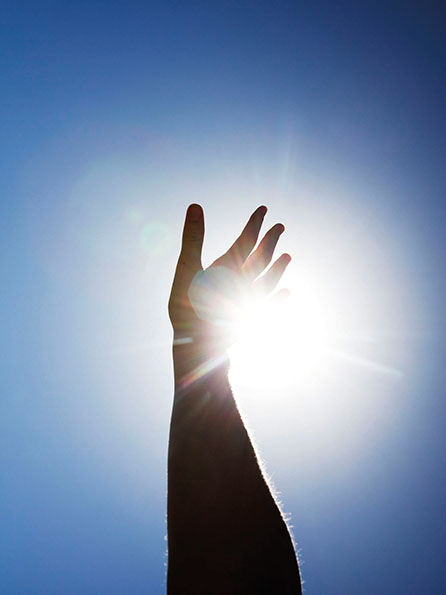
My favourite band is Felt. During the Eighties, when they were active, I followed them obsessively. At one gig – Manchester University Students’ Union, I think – they came on stage and launched into an ethereal four-minute number with half-sung, half-spoken lyrics and a jangly melody. After the applause had died down people started calling out requests. Someone behind me shouted “I Worship the Sun”. Retuning his guitar and without looking up, the mononymous lead singer, Lawrence, replied: “We just played that.”
In his short poem “Water”, Philip Larkin describes how he would make H2O an essential element of sacredness, were he “called in/To construct a religion”. It’s a good shout. Water is naturally occurring, has an alluring transparency, is mystifyingly tasteless and odourless but supremely quenching, and is essential to life – as well as having the capacity to take life away without too much trouble. Science has also recognised its properties – as an arbiter of all kinds of neutrality, as a baseline for many calibrations, and as a substance that demonstrates absolute flatness.
And I like Larkin’s notion that the authorities might entrust such a project to a poet, rather than a minister from the Department for Culture, or, God forbid, someone from the Church. On balance, however, I think I’m with Lawrence on this matter; the sun has far better credentials as an object of veneration and a potential deity. Its attributes are obvious, and the long list of civilisations that have offered prayers in its direction confirms as much.
My own sun-worship would be a kind of fearful obedience. I once got sunstroke as a kid, and the queasiness seems to live on in my bones, ready to rise into nausea if I go out in hot weather without a hat. In my teens I got badly sunburned during a long walk in the hills, and was painted with calamine lotion until I looked like a tribesman in one of those dodgy old encyclopaedias of exploration and colonialism. My wife, with her Italian complexion, does like the sun, and it likes her right back. It leads to some divisions of opinion and practice: I always want to walk on the shady side of the street, and she always wants to head south.

Last month, steering towards warmth and brightness, we drove from the Latitude Festival in Suffolk to St Ives in Cornwall, one of the longest journeys possible in terms of the UK’s cardinal compass points, and pretty much following the course of the sun during its daily transit. It’s 12 years now since I walked the north coast of the South West Coast Path, busking my way from cove to cove by giving readings every night, staying with complete strangers, then describing the experience in the prose book Walking Away. It was nature writing, I guess, and a surprise bestseller, despite the moaning and complaining that led one reviewer to describe me as the Eeyore of hiking.
Not long afterwards, I got a message to say Raynor Winn had written a memoir called The Salt Path, recounting her journey along the same route at a similar time, during which her husband, Moth, occasionally enjoyed the benefits of being mistaken for me. I gave it my blessing – if that’s what was being sought – because the couple sounded down on their luck. Millions of sales, a clutch of literary prizes and several years later, I got an email from a production company, seeking a similar blessing and sending pages of a script for The Salt Path movie. Once again I was the running gag, but this time Moth is confused with the poet laureate, because it’s funnier if the person he is mistaken for holds that office. When I pointed out to the producer that I wasn’t the poet laureate when I made the trek, she said, “It’s not real.” To which I replied, “But I am.”
I’m mulling this over as I walk across Porthkidney Sands, following in the footsteps of a couple who apparently followed mine, standing in the shadow of a tale which began in the shadow of my own tale, and thinking about The Salt Path controversy, which is now a bigger story than the story itself. The sun is unrelenting and I’m feeling woozy and disorientated, plodding along with nowhere to shelter, wondering if I’m poetry or prose, a person or a character, fact or fiction.
[See also: How Britain lost the status game]
Content from our partners



Related

This article appears in the 07 Aug 2025 issue of the New Statesman, Summer Special 2025
Join the debate
Subscribe here to comment